Showing posts with label Good Governance. Show all posts

Saturday, October 10, 2009

Who I am, and why I blog

Recently, a young Malaysian, who is researching citizen journalism and citizen blogging in Malaysia, emailed me with some questions to answer. After sending him/her my reply, I realised that what I wrote was a statement of why I blog, and of who I am as a blogger. I reproduce here his/her questions and my responses to them, as a statement of principles.

1. What prompted you to start blogging?
Social and political developments in Malaysia. March 8 2008 gave me a lot of hope that Malaysia was on the right track as far as our social and political growth was concerned. However, by end of 2008, cracks began to appear in the Pakatan Rakyat coalition, and Umno/BN began to make succesful attacks on the idea of a two party system, and on multiracial and multireligious cooperation in Malaysia. These attacks were also made through their Main Strean Media (MSM) and bloggers, often with dodgy evidence and very flimsy reasoning. I felt that I could do something to counter them, and to share with others my own opinions on how Malaysia should go forward.
Why is there a need to self-publish?
Before the advent of blogging, there were few economical avenues for ordinary citizens to get their views heard: letters to the editor in the MSM, or join (or form) an association and issue press statements (again to the MSM). At the end of the day, the MSM and their owners decide if your views are worthy of publication, and if your views are consistent with their agenda. Blogging allows me to avoid that "censorship", and to share my views quickly.
2. How would you categorize or describe your blog? (Is it a watchblog, political blog, community blog?)
I blog about the importance of human rights, freedom and justice in a democracy, and I blog about whenever these are threatened. The people and institutions whose actions I write about are politicians, government, MSM and other bloggers. So I guess that my blog is a socio-political watchblog.
3. Who/What are you sources of information?
1) What I personally observe and record at the events I attend, 2) tip-offs from friends and sources, which I verify first, 3) news from other bloggers and MSM, 4) the internet
Do you read news and blog about it afterwards?
Yes, but only if it is pertaining to what I write about: human rights, freedom and justice in a democracy
4. What do you understand about ‘citizen journalism’?
As I understand it, Citizen Journalism is ordinary citizens gathering news and presenting it along with their own views, using technology to reach a wide audience. IMHO, It's a democratisation of news (and views) gathering and dissemination.
5. Do you think you are practicing citizen journalism? Would you consider yourself a citizen journalist?
Yes, and yes
6. What do you hope to achieve through blogging? (Eg: To create awareness among the public?
1) persuade Malaysians as to the importance of human rights, freedom and justice in a democracy, and of the principles and values that underly them, 2) Create awareness about the ways in which MSM and other bloggers spin, lie and abuse logic to create inter-racial tension and fear for political purposes, 3) Motivate Malaysians to work together for a better future for our country
7. How would you define Malaysia’s current mainstream media?
Our MSM is 100% owned by either political parties or corporate interests. Therefore, the news they report reflects their owners' need for political and pro-corporate propaganda, not Malaysian's need for news and views on human rights, freedom, justice, good governance, transparency and democracy.
Do you still believe in their news reporting?
No. I always look for how they may be spinning the news in their interest. So should everyone else.
8. Bloggers are sometimes misunderstood for spreading non-objective (bias) commentaries. What is your take on that?
There is no misunderstanding there. There are bloggers who are very non-objective. Indeed, it may be questioned if true objectivity is even achievable. The key is for 1) Malaysians to be able to read everything critically, and 2) for all media (MSM and bloggers) to be transparent about what their position or slant is, and what they are advocating. I myself subscribe to the principles of Advocacy Journalism.
9. Are there topics/news that you choose not to blog about?
No. I believe that all topics that are in the citizens' interest can (and should) be written about responsibly.
Do you practice self-censorship?
If you define self censorship as "the act of censoring or classifying one's own work (blog, book(s), film(s), or other means of expression), out of fear or deference to the sensibilities of others", then my answer is no. However, I do subscribe to the Society of Professional Journalists' Code of Ethics, and take pains to "Minimize Harm - Ethical journalists treat sources, subjects and colleagues as human beings deserving of respect". I also choose to present my arguments in a way that (I believe) will be understood and accepted by my intended audience (Malaysians).
10. Some professional journalists do not approve citizen journalism because they believe that only trained journalists can write objectively and ethically. What do you think?
Looking at the way some professional journalists in Malaysia write, it's obvious that professional training is no assurance that a person will write objectively and ethically. IMHO, a citizen journalist can do just as well (if not better, because he/she has no editor to report to) as long as he/she is committed to ethical and objective writing and takes the trouble to learn and practice it.
p.s: Out of curiosity, is there a reason to remain anonymous? It would help me understand bloggers better.
I choose only to identify myself as Malaysian, because our current situation is one where people judge what one writes by one's religion, age, gender, ethnicity, socio-economic status etc. I would like my arguments to stand or fall on their own merits, not my identity. As an anonymous blogger, I feel more motivated to research and provide evidence for whatever I write, because being anonymous does not provide the automatic credibility (or incredibility) that some readers are content with.

I really hope that Malaysians will achieve a stage of maturity where they can read and evaluate arguments for what they are, and not be swayed by the name (and the religion, age, gender, ethnicity, socio-economic status) of who is saying it.
Sincerely,
Malaysian Heart

Monday, October 5, 2009

Did Hishamuddin Hussein and Syed Hamid Albar lie about Waythamoorthy's passport?


SAD FAREWELL: A picture of Waythamoorthy and his daughter, taken after their breakfast in Singapore,
before he departed for UK yesterday (photo and caption from this Malay Mail report datelined 28/9/09)


One of the standard responses of Umno/BN to any people's power movement that they find threatening, is to to impugn the movements motives and cast aspersions on the honour and credibility of its leaders via lies and propaganda. The Hindraf phenomenon have been (and still are) treated the same: they have been called terrorists, traitors, embezzlers and so on by our government and its mouthpieces. One such smear was the attempt to paint Hindraf leader P. Waythamoorthy, who is in exile in the UK, as a dishonest man who exiled himself just to enjoy a comfortable life in London living on Hindraf's money. Part of that smear is the lie that Waythamoorthy had willingly surrendered his passport to the Malaysian High Commission in London, and lied about it having been revoked by the Malaysian authorities.

These are the news articles that reported what Syed Hamid Albar (the former home minister) and Hishamuddin Hussein (the present one), said:
These are some of the specific things they said:

Hishamuddin showing a copy of Waythamoorthy's passport to the media (photo from here).
Hishamuddin has said the following:
Reported here: "Dia sendiri yang datang serahkan dan bukan kita yang pergi rampas. Bahkan paspot itu masih lagi sah digunakan dan di dalam simpan pejabat Pesuruhjaya Tinggi kita di London," and added, "Beliau sewajarnya berhenti dari menuduh kita macam-macam...beliau boleh ke pejabat kita (Pesuruhjaya Tinggi Malaysia) untuk ambil paspot yang dipulangkan oleh beliau sendiri itu pada bila-bila masa. Mungkin beliau merasa malu sendiri" .
Reported here: “Yes, he was the one who surrendered the passport,” he [Hishamuddin] confirmed. He added that Waythamoorthy should stop claiming that the government is stopping him from getting his passport. “Why should we apologise to him? Would you? Of course, not,” he said. Hishammuddin also added that Waythamoorthy could be too ashamed to go and get his passport because he had surrendered the document himself. “Maybe he received a better offer at that moment, he felt that the grass is always greener on the other side but when he went to the other side, he felt that it was not worth it. "Maybe he was ashamed because he himself surrendered the passport. That is why he claimed that we did not allow him to have his passport,” he said.."


Syed Hamid Albar (photo from here)
Syed Hamid has said the following (reported here):
"In other words, the Malaysian government has never made any cancellation to the mentioned travel document," said Home Minister Syed Hamid Albar Syed Hamid in a statement today.
On 3 October 2009, Waytha's wife Mrs. Shanti, his brother P. Uthayakumar and lawyer N. Surendran held a press conference at Hindraf's office where they (again) presented evidence to prove that Malaysian authorities had informed the British authorities that Waythamoorthy's passport had been cancelled, and had requested them to impound and return it to the Malaysian authorities.

Here is the letter they gave reporters, which you can download in pdf format from the link below:

I reproduce here the 4 questions asked by Waytha's lawyers, and the answers received from the UK Border Agency:
1. The precise date when the British Embassy in Kuala Lumpur was notified of the cancellation?
A: The letter from the Malaysian authorities to the High Commission was dated 14 March 2008.

2. Which Malaysian authority notified the British Embassy (was it, for example, the Immigration authorities, Foreign Office or Home Ministry, or any other department)?
A: l can confirm that the Home Office does hold information that is relevant to this part of your request. However, we have decided not to communicate this information to you in accordance with the exemption under Section 27 (2) of the Freedom of Information (FOl) A[ct] 2000, which covers confidential information obtained from a State other than the United Kingdom or from an international organisation or international court. I have explained more about this exemption below.

3. Whether any particular reason was given for the said cancellation
A: The passport was cancelled as the Malaysian authorities were seeking your client’s arre[st] to face criminal charges.

4. When was the request made by the issuing authority for the return of the passport and was there any reason given for this request?
A: A request was made by the Malaysian authorities for the return of your client’s passport on 2 July 2008 no reason was given for why they wanted the passport returned to them, Malaysian passports are of the property of the issuing authority and not of the individual holder and therefore this is why we intend to return the passport to them.
Based on this and other evidence, we can draw a timeline of events surrounding the issue of Waytha's passport. I have emphasised our minister's statements in bold:
  • 25 November 2007 - Hindraf rally in KL
  • 28 November 2007 - Waythamoorthy leaves Malaysia to avoid possible detention under the Internal Security Act and to obtain international support for HINDRAF's cause. He goes to India, then to London.
  • 13 December 2007 - Uthayakumar and 4 others detained under ISA
  • 14 March 2008 - British High Commision in KL receives letter from Malaysian authorities, informing them that Waytha's passport had been cancelled because the Malaysian authorities were seeking Waytha's arrest to face criminal charges
  • 17 April 2008 - Waytha goes to Geneva to brief the United Nations High Commissioner’s office on Human Rights
  • 19 April 2008 - Waytha moorthy returned to London from Geneva, but was informed that the Malaysian government had revoked his passport, and therefore refused entry at Gatwick airport. Waytha asked the British authorities to seek a confirmation with the Malaysian government that his passport was, indeed, being revoked. Waytha spent 2 days at Gatwick.
  • 21 April 2008 - UK Border Agency British immigration confirmed that Waytha's passport was revoked by the Malaysian government, and they (UK Border Agency) impounded his passport upon the Malaysian authorities' request. It was only then that Waytha decided to seek political asylum, which was duly given by the British authorities.
  • 26 May 2008 - Malaysian Insider article: Syed Hamid: Hindraf chief's passport never revoked
  • 2 July 2008 - Malaysian authorities requested the British authorities (in writing) for the return of Waytha's passport to them.
  • 22 October 2008 - Bernama article: Hindraf Leader P. Waytha Moorthy's Passport Was Never Revoked: Syed Hamid
What are we to make of this? It seems to me that either the UK Border Agency is lying, or our ministers are. It's sad that some Malaysians have swallowed whole the disinformation and lies of Umno/BN, and parrot them in the online discussions and comments sections without question.

Sincerely,
Malaysian Heart

P.S. The only news organisations (which I could find) had reported the press conference were:
Malaysiakini: Proof of lies, claims Waytha's lawyer
Malaysian Insider: Uthayakumar claims proof Hishammuddin lied

(UPDATED) The Nut Graph had this story on 9/10/09: No pass for Waythamoorthy

What happened to the others? What's the point of paying them RM 1.50 or RM 1.20 every day if they choose not to report the news that matters?

Thursday, September 24, 2009

If our politicians are working only for their own interests, it is because we do not make them work for ours!

Dear Readers,

Hope you all had happy and meaningful Hari Raya holidays, because now it's time to get back to the work we must all do: bringing change to our country, beginning with ourselves.

Raja Petra wrote an excellent article, "Me serve the rakyat? Nah!", published on Malaysia Today yesterday. While I can't vouch for the factuality of the specifics RPK reported as going on behind the scene of Pakatan Rakyat Selangor, on the whole it seems plausible to me. However, what struck me the most were these words (bold emphasis mine):
It is therefore not difficult to understand why there is so much chaos in Pakatan Rakyat Selangor. Not only are PKR, DAP and PAS trying to outmanoeuvre each other. Internally, within PKR, DAP and PAS, there are many factions and each is trying to kill off the other.

We have inter-party and we have intra-party wars going on. And it is all because no one is interested in bringing changes or to serve the rakyat. They are only interested in seeking power because politicians naturally lust for power.

So we, the people, need to keep them in check. If power goes to their heads they will very quickly forget that it was the people who put them there. They will forget that they are supposed to work for the rakyat. They will become just like Barisan Nasional in thinking that the rakyat are the slaves while they are the masters.

Never trust politicians. They will use us when it best suits them. Then they will turn on us and betray the trust we gave them. And that is why the need for some of us to remain as political activists and not become politicians. This is so that we can whack the politicians when they forget themselves, which will be as soon as they win the election and form the new government.

Please read the entire article here. I feel that RPK has put it in the best way possible: if we elect a particular set of politicians, and expect that they will automatically do what is right and good for our country because (we hope) that they are good people, then we are in for a big disappointment. While I believe that there are individual politicians who are principled, the prevailing political culture and system, compounded by we Malaysians' apparent apathy to values and good governance, make it difficult for them to make their voices heard over the shrill cacophony of self-interest. As Franklin D. Roosevelt told A. Philip Randolph, who had just given FDR an earful on what direction America should be taking (my bold emphasis):
"I agree with everything that you've said, including my capacity to be able to right many of these wrongs and to use my power and the bully pulpit. ... But I would ask one thing of you, Mr. Randolph, and that is go out and make me do it."
If we want our government and politicians to listen to us, and act to promote our interests and aspirations, we have to make them do it. We have to have press freedom so that what they do behind closed doors is exposed in the open. We need to tell them what we want, keep track of their promises, and hold them accountable when they don't deliver. We need to fight for what is right whenever it is right, not just when it suits us or ours. We need to unite our voices so that when we speak, they sit up and listen. We cannot do this as long as we identify ourselves by our race and religion, as Umno/BN wants us to.

Our end goal must be to establish a new political culture in Malaysia: one where the rakyat's interests come first, and one where only principled leaders have a chance of being elected to office.

I believe that the Saya Anak Bangsa Malaysia initiative is an excellent platform from which to make our politicians work for us instead of the other way around. Please read their charter here, read the SABM powerpoint presentation here and see Haris Ibrahim's speech here.

Whatever we want Malaysia to be, it's not going to happen if we just watch from the sidelines. It's time to get involved, people! ARE YOU, YOUR FAMILY MEMBERS AND FRIENDS REGISTERED VOTERS?

Sincerely,
Malaysian Heart

Thursday, September 17, 2009

The Charter of the Saya Anak Bangsa Malaysia Initiative

ANAK BANGSA MALAYSIA

PREAMBLE:
Recognising that our beloved Malaysia is:
  • A sovereign and independent member of the global community of nations;
  • A polity founded on the principles of a constitutional monarchy and a parliamentary democracy;
  • A multi-ethnic, multi-faith and multi-cultural society formed on the basis of a shared choice of membership;
  • A country built and nurtured by the immeasurable efforts and invaluable contributions of all her people, past and present;
  • A nation where her people are inextricably bound by a shared history, heritage, a common interest and destiny;
  • A land blessed with rich natural and human resources.
And fully subscribing to the immutable and universal principle that we are all of a single human race and born equal;

DECLARATION
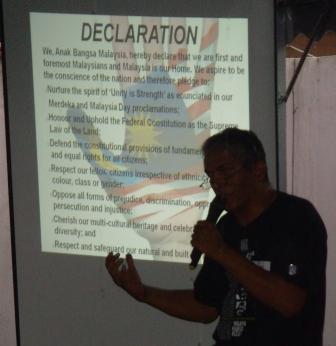
We, Anak Bangsa Malaysia, hereby declare that we are first and foremost Malaysians and Malaysia is our Home. We aspire to be the conscience of the nation and therefore pledge to:
  1. Nurture the spirit of 'Unity is Strength' as enunciated in our Merdeka and Malaysia Day proclamations;
  2. Honour and Uphold the Federal Constitution as the Supreme Law of the Land;
  3. Defend the constitutional provisions of fundamental liberties and equal rights for all citizens;
  4. Respect our fellow citizens irrespective of ethnicity, faith, colour, class or gender;
  5. Oppose all forms of prejudice, discrimination, oppression, persecution and injustice;
  6. Cherish our multi-cultural heritage and celebrate our rich diversity; and
  7. Respect and safeguard our natural and built environment;
COMMITMENT
We, Anak Bangsa Malaysia, herewith undertake to:
  1. Engender a National Mindset to think and act first and foremost as Malaysians;
  2. Engage the Hearts and Minds of our people to rise above the social constructs and divisive forces of ethnicity, faith, colour, class or gender;
  3. Promote the humanitarian Values of inclusiveness, equality and justice for all;
  4. Advance the principles of Good Governance, namely, stewardship, integrity, accountability and transparency;
  5. Educate our people to be responsible and caring Global Citizens contributing to peace, prosperity and sustainable development.
We are committed to actualising the spirit and substance of Anak Bangsa Malaysia —
"One People, One Nation".

Towards this end, we are determined to take this message to the PEOPLE.

25th April 2009


Note: I photographed and OCRed this; please excuse any errors. You can read more about the SABM initiative here, here, here, here, here, here, here, here, here and here. BM Version here.

The Saya Anak Bangsa Malaysia initiative: launched on Hari Malaysia!

On the 46th anniversary of the formation of Malaysia, another endeavour of hope has been launched: the Saya Anak Bangsa Malaysia initiative, the goal of which is to actualise the spirit and substance of "One People, One Nation".

It is an initiative by a group of Malaysians who believe that we can, and need to, do better as a nation. The difference between this particular effort and the others that have gone before and that continue to suck our precious resources, is that these folk believe in, and know, what they are doing. They:
  • Have identified the things (attitudes, mindsets, policies) that are holding us back as a nation
  • Suggested a set of values and guiding principles that (I strongly believe) our nation needs
  • Proposed a programme of specific actions to address those needs
  • Suggested many ways how we as individuals can help realise the goals, starting with things we can practically do
Why is there a need for such an initiative? Because, as events post GE-12 have clearly shown, our political parties (on both sides) have not been able to effectively address our nation's need for a national identity and consciousness; for justice, human rights, freedom and democracy. Even though DS Najib is promoting his One Malaysia, it is vague and undefined beyond platitudes, and seems to be designed to present different faces to Malaysians from different communities. Furthermore, even as our PM goes around the nation promoting it, his cabinet and their mainstream media are working hard to divide Malaysians by race and religion, just so they stand a chance of winning GE-13.

PR on the other hand, have fared no better. As Kg. Buah Pala has shown, they have made election promises which they have seen fit to break, resulting in injustice being done to poor Malaysians.

It's clear (to me) that we need civil society groups to be the voice of the rakyat. We need to educate and empower ourselves to hold our elected representatives and our public servants to account. We need to decide how our nation is going to move forward and progress as a diverse democracy. We have to do this ourselves, for the political parties have let us down.

Who are leading this initiative? A small group of Malaysians led by civil rights lawyer Haris Ibrahim, of the People's Parliament. They are the folks who came up with the groundbreaking People's Voice and the People's Declaration way back in February 2008. Here they are during the launch of the SABM on 16/9/09:


And here is Haris presenting the SABM initiative:


This is a video where he talks about discrimination, social justice, inclusiveness and diversity (apologies for the poor video quality):


Please do visit the SABM website here and please do read the SABM Charter if you can (note: I've also posted it here) . I believe that if we want a Malaysia that is free from all forms of racism, discrimination and inequality, we need to seriously practise its principles in our daily lives.

Sincerely,
Malaysian Heart

Friday, September 11, 2009

Is this what Rocky's Bru has turned into? How to read partisan blogs 4


(Updated Below)

The testimony of Sivanesan Tanggavelu that he was hit with a metal rod, punched, kicked, slapped all over and even caned on his genitals and the soles of his feet until he passed out from the pain, while in the custody of the ACA, should be cause for serious concern for all Malaysians. After all, we have been plagued with a series of suspicious deaths in custody, and we have seen many complaints against the high-handed tactics that Malaysian law enforcement agencies allegedly use. In the context of Teoh Beng Hock's mysterious death while in custody of the MACC (the ACA's new name), it raises an extremely serious question about the circumstances surrounding Teoh's death: did he also experience such abuse before he died?

Given the seriousness of the issue, what does Ahirudin Attan, editor-in-chief of The Malay Mail have to say about it? Here is his blog post of 9/9/09, charmingly titled "S'pender at Inquest":
NST 09/09: Beng Hock's inquest: Witness T. Sivanesan alleges he was slapped, kicked and caned on penis by MACC officer, showed underwear as proof

After all these years, many of us still can't get images of the mattress during the Sodomy Part I trial. And now we have this - a torn s'pender* at the Teoh Beng Hock inquest!

I don't know why the Coroner allowed Sivanesan's spender to the hearing. The MACC official who had caned his prick could be a rogue officer. If it's true, Sivanesan's bad experience should be brought to the Royal Commission that the
Government has set up in connection with TBH to look into the procedures at the MACC.

The Coroner must now allow for witnesses who were NOT tortured by the MACC interrogation to share their experience with the Inquest. Just a week ago, a GLC head told me of his experience. I'm sure he still has his untorn s'pender/boxer/underwear to prove his point.

* S'pender is an old slang, believed to be short for suspender, to describe underwear. It's like gostan, which is derived from go a stern, which we still use to mean reverse.

(Please read the Rocky's entire, updated post here)
Instead of being outraged and disgusted at the revelations, Rocky seems to be modeling behavour as if beating up suspects is something we shouldn't be too worried about. He seems to be more concerned about being offended by Sivanesan's torn underwear, than he is about (what is prima facie) evidence of abuse suffered by a fellow Malaysian, and serious misconduct by MACC officers, including one who was involved in Teoh Beng Hock's interrogation, done in our name.

Without offering any supporting evidence, Rocky is quick to rationalise and justify Sivanesan's ordeal as possibly the actions of a rogue officer. He makes light of Sivanesan's humiliation at the ACA hands, and to add insult to injury, he mocks Sivanesan's testimony by expecting us to believe that a GLC head would be treated the same as how someone like Sivanesan would be. Finally, Rocky chooses to enlighten us on the Malaysian slang for underwear; what an impeccable sense of priority and proportion he has!

What Rocky did is to divert our attention from the horrific implications about TBH's death which arise from Sivanesan's testimony. He did this by making fun of Sivanesan's alleged torture and humiliation by ACA officers, and focusing our attention on his torn "spender" instead. This is a common propaganda technique, namely dehumanising the victim to make their testimony carry less weight. Rocky's message is: Sivanesan's story is a laughing matter and a joke, we should all laugh at it and not take him seriously.

I'd like to know just who, or what, is Rocky spinning for this time?

From "The Elements of Journalism: What Newspeople Should Know and the Public Should Expect", (bold emphasis mine):
  1. Journalism's first obligation is to the truth.
  2. Its first loyalty is to citizens.
  3. Its essence is a discipline of verification.
  4. Its practitioners must maintain an independence from those they cover.
  5. It must serve as an independent monitor of power.
  6. It must provide a forum for public criticism and compromise.
  7. It must strive to make the significant interesting and relevant.
  8. It must keep the news comprehensive and proportional.
  9. Its practitioners must be allowed to exercise their personal conscience.
There was a time when Rocky used to speak out against torture, police states and abuses of the weak by the powerful. When two Malaysians were detained at Guantanamo Bay, Rocky called upon the Abdullah administration to "demand that they are sent back here to be fairly dealt with", because (in Rocky's words), "Human rights does not exist in Guantanamo Bay". Rocky also remarked, in a post titled "torture for two", that Bush could "keep the two Malaysians - and everyone else - detained at Guantanamo Bay for as long as he wishes and also resorts to the harshest means - including torture - to get them to confess to their crimes and terror links." He also reported how Al-Jazeera accuses "the US of resorting to methods usually applied in 'police states'."

It was certainly commendable of Rocky to speak for human rights then. It is sad to see him change his tune now that his circumstances have changed. Does his criteria for what constitutes torture and abuse depend on who is signing his paycheck? Can The Malay Mail still claim to be "the paper that cares" when it's editor-in-chief does not even pretend to anymore?

Sincerely,
Malaysian Heart

UPDATED: Ong Hock Chuan from Indonesia, who blogs at Unspun, had this to say about Rocky today:
"... Rocky's Bru, a blog that used to speaks its mind, but now seems to be channeling the UMNO establishment. "
Looks like others have noticed Rocky's metamorphosis too.

Monday, September 7, 2009

Y.B. Sivarasa on DSAI's prosecution - videos from Media Rakyat

Dear Readers,

This is a must see from the folks at Media Rakyat!

Sivarasa Rasiah: You The Rakyat Be The Jury (Pt 1)

Sivarasa Rasiah: You The Rakyat Be The Jury (Pt 2)

Sivarasa Rasiah: You The Rakyat Be The Jury (Pt 3)

These videos (and lots more like them) are available at Media Rakyat. In their own words:
The Universal Declaration of Human Rights indicates: “Everyone has the right to freedom of opinion and expression; this right includes freedom to hold opinions without interference, and impart information and ideas through any media regardless of frontiers”

Mediarakyat is dedicated to improve the freedom of information in Malaysia.

At Mediarakyat, you will find plenty of informative & interesting video clips concerning current events & speeches that the mainstream newspapers & TV stations may not be able to cover or reluctant to cover.

Please consider supporting them so that they may bring us the news and views that BN does not want us to know about.

Sincerely,
Malaysian Heart

Saturday, September 5, 2009

Y.B. Khalid Samad - a principled Malaysian leader (UPDATED)


(Photo of Y.B. Ir. Khalid Samad from here)

Never let it be said that there are no principled politicians in Malaysia. There is at least ONE, and his name is Y.B. Khalid Samad, M.P. for Shah Alam, and a member of PAS Central Political Bureau.

In the wake of the BN inspired cow's head incident, when our government ministers have chosen to defend bigots who threatened violence on their fellow Malaysians, our law enforcement has chosen to practice double standards, and BN's propaganda machine is working overtime to spin the story in their favour, Y.B. Khalid has chosen to stay true to his principles and values, even if it means losing in the next election.

Instead of doing what politicians do to stay "popular", i.e. pander to their "base", dog-whistling and engage in populist demagoguery, he has become (along with some very principled non-politicians and politicians) the voice of reason in a sea of intolerance and hate.

Here is his letter to the residents of Section 23, in full (from here):

Friday, September 4, 2009

Surat Terbuka Untuk Penduduk Seksyen 23

2hb September 2009 M
13 Ramadan 1430 H

السلام عليكم ورحمة الله وبركاته

Kehadapan penduduk Seksyen 23 yang dihormati,

Semoga surat ini menemui tuan-tuan dalam keadaan sihat wal afiat serta keimanan yang teguh dan jitu berkat bulan Ramadhan ini.

Saya mengambil kesempatan ini untuk mengingatkan diri saya serta tuan-tuan akan Firman Allah, Surah Al Maaidah ayat 8 yang bermaksud;
“Bertindak adil! Ianya lebih rapat dengan keTaqwaan.”
Semoga dalam usaha kita membina keTaqwaan dalam bulan Ramadhan ini, kita mengingati hakikat bahawa ‘keTaqwaan’ yang diusahakan itu mempunyai hubungan rapat dengan keadilan. Keadilan ini pula perlu dilaksanakan terhadap semua, walaupun terhadap yang tidak disenangi. Ini ditegaskan di dalam ayat yang sama yang bermaksud,

“dan jangan oleh kerana kebencian kamu terhadap sesuatu kaum menyebabkan kamu tidak berlaku adil…”
Kalau terhadap kaum yang dibenci sekalipun dituntut keadilan, apatah lagi terhadap jiran sekampung dan warga sekota? Walaupun mereka tidak sebangsa dan seagama, hakikatnya mereka tidak memusuhi kita atau memusuhi Islam. Maka, mereka layak mendapat layanan yang adil. Adakah adil sekiranya kita menafikan mereka hak tempat beribadat yang berhampiran dan sebaliknya memaksa mereka ke seksyen 22, di tengah-tengah kawasan Industri berat, jauh dari kawasan kediaman? Tiada apa di sana kecuali kilang-kilang.


Saya hanyalah seorang wakil rakyat yang dipilih oleh tuan-tuan melalui pilihan raya yang diadakan pada masa-masa tertentu. Saya tidak berhak memaksa apa-apa pandangan atau keputusan ke atas tuan-tuan semua. Saya hanya mengharapkan keputusan yang tuan-tuan rumuskan sendiri berhubung cadangan pemindahan kuil ke Seksyen 23 mengambil kira persoalan keTaqwaan dan keAdilan seperti di atas.

Islam adalah agama yang adil. Keadilannya mampu menawan hati semua manusia. Yang paling saya takuti adalah tindakan yang memberikan gambaran bahawa Islam adalah sebaliknya. Allah murka terhadap mereka yang bertindak dengan cara yang merosakkan imej Islam sehingga menyebabkan manusia terhalang untuk mengenali keadilannya. Allah berfirman ayat 94 Surah An-Nahl yang bermaksud:-
“Dan kamu ditimpa kehinaan kerana menjadi penghalang kepada jalan Allah (disebabkan tindakan buruk kamu) dan untuk kamu azab yang amat dahsyat (pada hari akhirat kelak)”
Ada yang bertanya kepada saya, tidakkah saya khuatir saya kalah dalam Pilihan Raya yang bakal tiba oleh kerana isu ini. Bagi saya sekiranya itulah kehendak pengundi, apakan daya? Yang penting sejarah akan menjadi saksi bahawa ada Ahli Parlimen dari parti Islam yang memperjuangkan keadilan untuk semua walaupun orang Hindu. Seperti kisah seorang raja Islam di Mysore, Bangalore, India pada abad ke 18 yang bernama Sultan Fateh Ali Khan Tippu (Tippu Sultan). Rakyatnya terdiri daripada orang Islam, Hindu dan Sikh. Hingga ke hari ini rakyat India masih menceritakan mengenai pemerintahan beliau yang berasaskan Islam sebagai sebuah pemerintahan yang adil.


Semoga Allah memberkati kita semua dan memimpin kita ke jalan yang diRedhaiNya.

وسلام عليكم و السلام على من التبع الهدى
YB KHALID BIN ABDUL SAMAD
Ahli Parlimen Shah Alam


Reading his letter, what are the principles and values that we can see him hold dear? I can see him uphold justice, fairness, equality, inclusiveness and acceptance of diversity, civility, good neighbourliness, empathy and humility. These are the very values that we need if we are going to rid Malaysia of racism, bigotry, corruption, oppression, bad governance and tainted judiciary.

Y.B. Khalid has shown himself to be one person who is truly worthy of the title "Yang Berhormat". Such people are more than mere politicians; they are leaders, and statesmen. Long may he lead us, and may Malaysia be blessed with more citizens such as he. If you appreciate his principled stand, and would like to encourage and support him, please consider sending him a message at his blog here.

Sincerely,
Malaysian Heart

UPDATED: Please read this excellent article on Y.B. Khalid at "Saya Anak Bangsa Malaysia". He/she writes: "Inilah bakal pemimpin Malaysia yang akan membawa Malaysia ke arah perpaduan." I concur.

Friday, September 4, 2009

Is Malaysia becoming a police state? What on earth is happening to us?

Yesterday, 3 September 2009, blogger Ronnie Klassen, posted this entry, "Malaysia, a police state in the making?" In it, he writes:
One month ago, on 3 August,army personnel's from the 7 RAMD (Gerak Khas) swooped on Pulau Pandanan Kecil, off Semporna and ordered the villagers there to take down all the Parti Keadilan Rakyat (PKR) flags hoisted at their houses. When the villagers declined to comply, the army personnel's brought the flags down for them.
If this is true, it is a most serious violation of our democratic right to suport the political party of our choice. As Ronnie explains, "The inhabitants of a police state experience restrictions on their mobility, and on their freedom to express or communicate political or other views, which are subject to police monitoring or enforcement."

This action must be explained satisfactorily to the rakyat, and the government must be held accountable for it. Wakil rakyat, what are you waiting for?

Sincerely,
Malaysian Heart

P.S. Please read Ronnie's entire post here. It includes links to 2 videos of the incident.

Monday, August 31, 2009

After 52 years of independence, we need a declaration of INTERdependence

After 52 years of independence, it is no exaggeration to say that inter-ethnic and inter-religious relations in Malaysia are in a bad state. Recent events such as the cow head incident in Shah Alam only serve to underscore what Malaysians know to be true.

However, Malaysian inter-ethnic and inter-religious relations have never been very good, and have been dragging us down for some time. I believe that this is due to our system of government; although we claim to be a democracy, the reality is that all this while we have been run as a consociationalism. Under this form of government, it is accepted belief that the people from various groups cannot work together in a normal democratic process, and the elites of each group are ones who need to bargain with each other behind closed doors to decide on how to run the country, and who gets what.

The consequences of this system in Malaysia has been that, freed from having to be accountable to the rakyat, the elites (i.e. Umno, MCA, MIC etc.) have been able to indulge in corruption, cronyism and nepotism with impunity, thereby concentrating power and wealth in their hands.

Another consequence is that there has been no real public discourse on matters of national interest. Indeed, discussion of key topics is deemed "sensitive" and clamped down upon. The threat of violence, either official or unofficial, has been used to prevent this discourse. The rakyat have kept divided by the elites in order to protect their grip on power; playing the politics of communalism has succeded to an extent in getting each group to identify with the elites who "represent" them.

We can see why while neighbours and colleagues from different groups may form friendships and close relations, there is no real understanding between groups. Acceptance of each other has not become part of the collective consciousness; the "muhibbah" planned and organised by elites remains superficial, and barely limited to tolerance.

In this way, inter-ethnic and inter-religious relations have been held hostage to the political interests of the various elite parties in Malaysia. It is no coincidence that inter-ethnic conflict has flared whenever the elites find their monopoly on power threatened: in 1969, 1987 and 2001. In the sensational Utusan Malaysia and Berita Harian articles, chauvinistic posturing by BN leaders, and most recently, the cow's head procession, I believe that we are seeing BN trying to repeat its so far very successful use of communal politics, this time to gain an advantage in the post GE-12 scenario.

Is there something that we Malaysians can do to once and for all remove this knife that BN is holding to our throat? 64 years ago, the philosophers Will and Ariel Durant (the husband and wife authors of the magnum opus, The Story of Civilization), along with some like-minded people, pondered the same problem. The world had just survived a world war in which racial intolerance and hatred played a large part, with millions dead. How could civilisation be protected from once again suffering the brutality and violence of dictatorship and demagoguery?

They decided that the best way was to form a movement to promote human tolerance and fellowship through mutual consideration and respect. In the words of Will Durant, "no democracy can long endure without recognizing and encouraging the interdependence of the racial and religious groups composing it." They came up with a Declaration of INTERdependence, which represented their core beliefs. This is the entire text of the declaration at present:
Declaration of INTERdependence

Human progress having reached a high level through respect for the liberty and dignity of men, it has become desirable to re-affirm these evident truths:
  • That differences of race, color, and creed are natural, and that diverse groups, institutions, and ideas are stimulating factors in the development of man;
  • That to promote harmony in diversity is a responsible task of religion and statesmanship;
  • That since no individual can express the whole truth, it is essential to treat with understanding and good will those whose views differ from our own;
  • That by the testimony of history intolerance is the door to violence, brutality and dictatorship; and
  • That the realization of human interdependence and solidarity is the best guard of civilization.
Therefore, we solemnly resolve, and invite everyone to join in united action.
  • To uphold and promote human fellowship through mutual consideration and respect;
  • To champion human dignity and decency, and to safeguard these without distinction of race, or color, or creed;
  • To strive in concert with others to discourage all animosities arising from these differences, and to unite all groups in the fair play of civilized life.
ROOTED in freedom, bonded in the fellowship of danger, sharing everywhere a common human blood, we declare again that all men are brothers, and that mutual tolerance is the price of liberty.

----------------oooOOOooo----------------

I believe that if Malaysians realize that all of us are interdependent, and if we practice the principles of this declaration, we will achieve the following:
  • Build real understanding and trust between ethnic and religious groups in Malaysia
  • Build the foundations for real dialogue and discourse on matters of national interest, including "sensitive" ones
  • Prevent attempts by political parties to use communal politics to divide and rule over Malaysians
  • Be able to tackle corruption, cronyism and nepotism and promote good governance without being accused of ethnic and religious bias
  • MOST IMPORTANTLY, free ourselves from the constant implied threat of politically sanctioned violence and chaos when we attempt to build a Malaysia that is truly free, just and democratic.
If you feel that this declaration is something that can help us Malaysians, would you consider helping to spread its message? We could blog about it or share it with our family, friends and colleagues. Perhaps the best thing we could do is to practice it in our daily lives. In the words of Will Durant:
"Our main task is to reduce the causes of racial animosity. First by recognizing that we are all guilty. Which of us has never uttered a word of racial hositility? Let us resolve never to do it again. Let us watch our own conduct, and by our moderation, our modesty, our good will, give no handle or excuse to racial division. Let us burn the second half of this Declaration into our hearts, and make a sacred vow, here and now."
Are we up to it?

Sincerely,
Malaysian Heart

P.S. Thanks to Fisha of Dream a Little More Dream, for first making me aware of the life and work of Will and Ariel Durant. To participate in the international signature campaign, please visit this webpage.

Selamat Hari Merdeka ke-52!!!

Selamat Hari Merdeka!!!


Walaupun kerajaan Malaysia kini dikuasai parti yang zalim durjana, tetapi Ibu Pertiwi tetap Ibu Pertiwi, tanah tumpah darah kita tetap disanjungi. Dimana bumi dipijak, disitulah langit dijunjung.

Semoga rakyat Malaysia akan celik dan bangkit memilih kerajaan yang amanah dan jujur, yang bakal mengisi kemerdekaan dalam ertikata yang sebenarnya; dengan menegakkan keadilan, kebebasan, hak asasi dan demokrasi, supaya keamanan dan kemakmuran sejati boleh kita capai bersama.


MERDEKA! MERDEKA! MERDEKA! MERDEKA! MERDEKA! MERDEKA! MERDEKA!


Tanah Pusaka


Kemegahan Negara Ku

Friday, August 21, 2009

"One Malaysia?" - op-ed article from the New York Times


I've just read a very interesting op-ed article by Philip Bowring, on the New York Times website. In the article titled "One Malaysia?", he (in my opinion) quite accurately describes the socio-political situation we Malaysians find ourselves in, in the aftermath of GE-12 and the first 100 days of DS Najib's government. How can one not concur when he writes, "Malaysia badly needs a break from 52 years of sometimes authoritarian and corrupt rule by a coalition of race-based parties headed by the United Malays National Organization (UMNO), which controls most levers of power and money"?

Bowring isn't accurate in everything; for example, he describes Altantuya's murderers as DS Najib's "security guards" rather than as police officers serving in PDRM's Unit Tindakan Khas. However, his last three paragraphs more than make up for it (bold emphasis mine):
Ultimately, the race issue prevents wholehearted cooperation among the opposition parties in Anwar’s coalition. Some of the Islamists hanker to make common cause with UMNO to strengthen Malay unity and defend pro-Malay, pro-Islamic discrimination. This in turn fits well with allegations by senior UMNO figures that Anwar is a traitor to his race by aligning with the Chinese and Indian minorities.

The notion that Malays and Muslims are under threat from minorities is absurd. But it helps keep Malays loyal to UMNO even while the ruling coalition can claim that it is both multiracial and moderate. The coalition, however corrupted, is still seen by many as representing moderation and stability. UMNO may have pandered to Islamist demands, but few would accuse its leaders of piety or puritanism.

Najib’s slogan is “One Malaysia,” an attempt to portray his government as a unifying force. Its actual policies may remain racially skewed in favor of Malays and oppressive of dissent. But given the opposition’s divisions, and the Malay sense of entitlement that makes multiracial politics so difficult, the slogan may work to keep UMNO in power for another decade.

Spot on, wouldn't you say? What are we doing about it?

Please do read the entire article here. You may need to register with nytimes.com first, which is free and takes only a few minutes. You can find more articles by Philip Bowring here.

Thursday, August 20, 2009

How to read partisan blogs 1: Shamsul Yunos and his "anger" towards lawyers


Definition of partisan adj.-
  • From The American Heritage Dictionary of the English Language, Fourth Edition: devoted to or biased in support of a party, group, or cause
  • From the Collins Essential English Dictionary, 2nd Edition 2006: prejudiced or one-sided
Dear Reader,

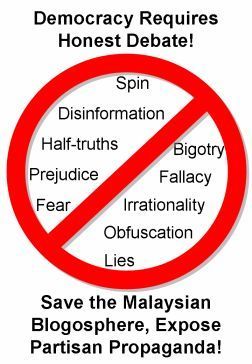
Of late, I have been writing quite a bit (most recently here) about why I believe that our Malaysian blogosphere has become extremely partisan, and increasingly bereft of honest argument and reasoned debate. When I surf Malaysian blogs and online news, I often get an uneasy feeling that there is something very wrong with the ideas being "sold". Unfortunately, it's not always easy for me to put my finger on what's wrong (and no, it's not the tapai pulut I had this morning). I realise that I need to be better at thinking critically; therefore, I am starting a series of postings in which I shall attempt to analyse and describe the biased, prejudiced and one-sided arguments that I find in our Malaysian blogosphere. Will you to join me in this endeavour?

Let's be very clear on one thing - there is absolutely nothing wrong with a blogger or writer having strong political beliefs and affiliations, or with expressing them vigorously and with passion. However, as I have stated before, we have a responsibility to argue our cases justly and honestly; if not to our readers, then at least for the sake of our own conscience. Democracy needs a forum for honest discussion and open debate on issues of National interest; telling one's side of the story is fine, but pretending to tell both sides while misrepresenting the other is dishonest.

For this first installment, I'd like to analyse a post by Shamsul Yunos, who blogs at "My Anger, it May Be Yours Too". In his recent entry, "Did you know lawyers are special?", he criticises the Malaysian Bar Council for saying that lawyers should not be arrested while on duty. This statement was made by Bar Council president Ragunath Kesavan on 16 August 2009, during the public inquiry by Suhakam into the arrest and detention of five lawyers of the Kuala Lumpur Legal Aid Centre at the Brickfields Police Station on 7 May 2009. The lawyers were arrested when they tried to see their clients, who were among 14 arrested that day for taking part in a candlelight vigil (for arrested political scientist and activist Wong Chin Huat), outside said police station. The Bar Council's description of what transpired that day is available here, and you can read the five arrested lawyers' own accounts here, here, here, here and here. The only statement from the police (regarding anything related to the arrests) that I could find was in this video.

Let's get a few facts straight first:
  • Even if the 14 arrested individuals had commited a crime by holding the vigil, they had the right of access to a legal practitioner of their choice, as per Section 28A (4) of the Criminal Procedure Code (CPC) and Article 5 of the Federal Constitution. Granted, that Section 28A (8) of the CPC allows the police to refuse lawyers access to their clients, but it should be invoked only in extraordinary circumstances; such as when the delay in questioning the suspect may cause the occurrence of another crime or cause danger to others, e.g. when the client may pass harmful information to an outsider via the lawyer, or hide evidence, such as in kidnap cases. When the police were asked for the grounds on which they were invoking that clause, they were unable to provide an answer. To date, there has been no explanation from the police whatsoever as to why they invoked Section 28A (8) of the CPC.
  • The lawyers arrested were trying to provide their clients with legal counsel in their professional capacity as members of the Bar Council's Legal Aid Centre; they were not part of the candlelight vigil. Although lawyers do take part in protests, they know how to separate their professional duties from their activism. They were in no shape or form a threat to public order or safety, or obstructing justice, which could have justified their arrest that night. In applying to see their clients in the police station that night, they were merely fulfilling their obligations as advocates and solicitors.
  • The Bar Council did not call for blanket immunity for lawyers while on duty. They are neither seeking nor expecting preferential treatment nor exemptions from the law. They seek instead to uphold the fundamental right of lawyers to have access to their clients, a right which was arbitrarily denied by the police when they refused to let the lawyers see their clients, and arrested them instead.
  • The role of the police in a democratic country, is to enforce the law and ensure public safety and order. To enable our police to fulfil their responsibilities, they are delegated wide discretionary powers, e.g. to deny permission to assemble and to issue orders to disperse. However, they must never forget that the raison d'etre of law enforcement is to uphold our human rights (including the right to assemble peacefully), not to deny them arbitrarily or for political reasons. They must also never forget that they are public servants, and that they are accountable for their actions and decisions.
So, given the above, how did Shamsul Yunos choose to comment on the Bar Council's statement? If you have read his entire post, you would have seen how he has used negative connotations and outright slurs against lawyers throughout it. In a post 313 words long, he managed to:
  • Liken lawyers to "particularly odorous boogers" to be flicked out of a moving car onto gravel
  • Imply that they drink lots of alcohol
  • Accuse them of lying for a living
  • Imply that they are too cowardly to stand up for what they believe in
  • Characterise them being wealthy and stingy
  • Accuse them of speaking with "forked tongues", without thinking first
What Shamsul Yunos has done is to use the techniques of propaganda, namely:
  • Ad hominem arguments
  • Appeal to prejudice
  • Demonizing the enemy
  • Name-calling
  • Stereotyping
Techniques like these work to stir up negative feelings and attitudes (e.g. disgust) towards the targets (in this case lawyers), by appealing to the emotional and irrational side of our nature. They make the other parts of his case easier to accept.

Let's look at Shamsul's more "substantive" arguments. The first thing to note, is that he has (intentionally or not) neglected to quote from, refer to or even provide links to Ragunath's statements as reported in the news. Neither has he mentioned the context in which the statement was made, namely the arbitrary denial of a fundamental human right, the arrests of the five lawyers, and Suhakam's public inquiry into it. Why is this important? When he first refers to the statement by BC president, he follows it with "What the F does that mean?" Is he trying to imply that the Bar Council's position is unclear, unreasonable or difficult to understand? Would the Bar Council's position have been in any way unclear to anyone who had read their statements and was aware of the issues involved?

Next, he uses a "straw man" argument, i.e. by substituting a superficially similar (and weaker) proposition (the "straw man") for his oponents' real one, then refuting it, without ever having actually refuted their original position. Shamsul does this by first conceding that lawyers should not be arrested if they are not breaking any laws. Then he writes, "but I hardly think that anyone in this country should get time out just because they are on duty." The straw man that he is putting up here is that the Bar Council called for blanket immunity for all lawyers on duty, even if they break the law. A glance at this headline shows how grossly Shamsul has misrepresented the Bar Council's position, and again, he neglects to consider the human rights issues involved. Knowing the whole truth reveals Shamsul Yunos' argument for what it is.

Instead of honestly discussing the possibility that it's in the public interest that lawyers and their clients have certain rights and privileges, he goes on to use a rhetorical question to make light of the issue; he sarcastically suggests that the Bar Council asked for special treatment ("different laws" as he put it) because lawyers believe that they are superior to others.

So, what are we to make of the post in question? Should we dismiss it as the prejudiced pronouncements of a partisan propagandist? Well, Shamsul Yunos does not want us to think so; as he maintains (in response to a reader's comment to a different post) here, "I put forth both sides of the story". Yeah, right!

One thing that disturbs me very much, is that in between the put downs, slurs and hyperbole, Shamsul makes a sinister, chilling statement with dangerous implications for human rights, freedom and justice in Malaysia. He writes: "If lawyers think arrest is a risk they do not want to face, then do not accompany people who the police may want to arrest. hey a champion must make scarifices, a warrior must be brave..."

Take a moment to consider exactly what he is saying. Is he implying that if lawyers work for or defend people whom the police (or the government) do not like or approve of, then they should be prepared to face arrest and persecution from the authorities?

As a result of our 12th general elections (GE-12), Malaysia is now at a crossroads, from where, for the first time in a long while, we have a choice of taking a path to a future that we want for ourselves & our children. Malaysians from all walks of life have been increasingly vocal in expressing our dissent against racism, bigotry, corruption, oppression, bad governance, tainted law enforcement and judiciary; both individually as well as via mass protests and demonstrations.

However, not everyone is happy that we have this choice, and there are those who would prefer that we return to the days before GE-12, and even further back, to Mahathirism. I believe that there are efforts being taken that, if we are not vigilant, will roll back the progress that we have made of late. These efforts include inhibiting democratic expression and eroding the foundations of our basic human rights, by various means. Our laws and legal system (such as it is), and our lawyers, are vital elements in the defense of our human rights and freedoms. Equal protection and access to justice would be just an empty slogan without the right to legal counsel. Are people like Shamsul Yunos part of an effort to reduce our legal community's effectiveness (and motivation) in standing up for human rights? I believe so.

So, who is Shamsul Yunos? The first entry on his blog dates back to 27 April 2008 (incidentally, 50 days after the GE-12). According to Rocky, who introduced Shamsul's blog here, and regularly refers to it in his own posts, Shamsul Yunos is a journalist. Googling for "Shamsul Yunos", I found (assuming that they are all one and the same person) that he writes for the Malay Mail. I also found that a Shamsul Yunos attended the Asia Media Summit 2008, held on 27 - 28 May 2008 in Kuala Lumpur. In this list of delegates, he is referred to as a Special Writer from the Ministry of Information, Malaysia. I do not know what exactly a "Special Writer" in the Ministry of Information is, but if it's possible to define one from what one writes, then perhaps we should compare how he has written about the Bar Council's position with this description:
A propagandist, in the strict sense, is not interested in the truth for its own sake, or in spreading it. His purpose is differ­ent. He wants a certain kind of action from us. He doesn't want people to think for themselves. He seeks to mold their minds so that they will think as he wants them to think, and act as he wants them to act. He prefers that they should not think for them­selves. If the knowledge of certain facts will cast doubts in the minds of his hearers, he will conceal these facts.

From The Art of Making Sense: A Guide to Logical Thinking by Lionel Ruby
What are the key lessons to draw from reading Shamsul Yunos' post? IMHO, they are:
  • Always look for the other side of the story and its context, from another source. Do not expect that Shamsul has provided it for us
  • Look for propaganda techniques designed to evoke an emotional and irrational response to the subject of the story
  • Look for dishonest arguments, e.g. the "straw man", and rhetorical questions used to divert attention away from real issues.
  • Always look for affiliations and links to organisations. Such affiliations are not evidence of propaganda per se, but are a useful guide for us to look for potential bias and vested interest
The next time you read Shamsul Yunos, or any other partisan blogger, do look out for these tricks. Better yet, blog about it and let others know too! According to Rocky, Shamsul will be contributing articles daily from Permatang Pasir for The Malay Mail. Will he be putting forth "both sides of the story" from there too? Do feel free to share you analyses of Shamsul Yunos' reports in the comments section.

Sincerely,
Malaysian Heart

Friday, August 7, 2009

Police Misconduct and the Mainstream Media's Response to it: Malaysia and India


An Indian police officer beats a demonstrator near an August 2008 procession in Jammu (© 2008 Reuters, taken from page 2 of photo feature accompanying HRW report).

Kuala Krai MP Dr Hatta Ramli's shirt gets ripped in a scuffle outside the National Mosque during the anti-ISA rally on 1/8/09 (taken from the Malaysian Insider).

Malaysian policeman during anti-PPSMI demonstration on 7/3/09 (taken from here).


Human Rights Watch, an international non-governmental organization that conducts research and advocacy on human rights, has released a report on the state of the Indian Police Service. The report, titled "Broken System: Dysfunction, Abuse and Impunity in the Indian Police, is based on interviews with more than 80 police officers of varying ranks, 60 victims of police abuses, and numerous discussions with experts and civil society activists. You can read the press release and download the report itself from this webpage.

While it makes compelling reading for anyone interested in human rights and justice, reading the report as a Malaysian is heartbreaking; in so many ways it describes the trouble with our own PDRM in Malaysia. Some 'highlights' from the report:

Practices
The Indian Police Service practices arbitrary arrest and detention, torture and extrajudicial killings. They break the laws they are supposed to protect, and believe that unlawful methods, including illegal detention and torture, are necessary tactics of crime investigation and law enforcement. Therefore, they use "short-cuts" and their old methods - abuse and threats, hold suspects illegally and coerce them to confess, frequently using torture and ill-treatment. Sound familiar?

Here is an example from the report, how a fruit vendor in Varanasi described how police tortured him to extract confessions to multiple, unrelated false charges: :
"[M]y hands and legs were tied; a wooden stick was passed through my legs. They started beating me badly on the legs with lathis (batons) and kicking me. They were saying, ‘You must name all the members of the 13-person gang.' They beat me until I was crying and shouting for help. When I was almost fainting, they stopped the beating. A constable said, ‘With this kind of a beating, a ghost would run away. Why won't you tell me what I want to know?' Then they turned me upside down... They poured water from a plastic jug into my mouth and nose, and I fainted."
Underlying Causes
The Indian Police Service, hence it's ethos, laws and regulations originated from the Imperial Police, the colonial-era police force whose primary objective was to help the British control and oppress the population with impunity, not protect their human rights. As the report states "[t]he institutional culture of police practically discourages officers from acting otherwise, failing to give them the resources, training, ethical environment and encouragement to develop professional police tactics".

Colonial-era police laws enable state and local politicians to interfere routinely in police operations, sometimes directing police officers to drop investigations against people with political connections, including known criminals, and to harass or file false charges against political opponents.

Other contributing factors are overwhelming workloads, insufficient resources, abysmal conditions for police officers, lack of sufficient ethical and professional standards and appreciation of modern criminology. Overall, the report seems to identify the system rather than individual officers or commanders as the main underlying cause.

Other Similarities
In 2006, a landmark Indian Supreme Court judgment mandated the reform of police laws. But the central government and most state governments have either significantly or completely failed to implement the court's order, suggesting that officials have yet to accept the urgency of comprehensive police reform, including the need to hold police accountable for human rights violations. Shades of our IPCMC?

It's not surprising that the Indian police are overstretched and outmatched by criminal elements, and unable to cope with increasing demands and public expectations. When faced with real terrorists during the Mumbai attacks, their immediate response did not prevent substantial loss of life.

HRW's Conclusions and Recommendations
The report concludes that the system of policing in India facilitates and even encourages human rights violations, and that successive governments have failed to deliver on promises to hold the police accountable for abuses and to build professional, rights-respecting police force.

The report then recommends two main thrusts: First, renewed commitment by national and state officials to discipline or prosecute as appropriate police officers who commit human rights violations is essential, with benchmarks to measure progress in implementing the commitment, and second, an overhaul of police laws and regulations, and institutional structures and practices that facilitate the abuses.

According to Brad Adams, Asia director at Human Rights Watch, "conditions and incentives for police officers need to change," and, "Officers should not be put into a position where they think they have to turn to abuse to meet superiors' demands, or obey orders to abuse. Instead they should be given the resources, training, equipment, and encouragement to act professionally and ethically." He added that "it's time for the government to stop talking about reform and fix the system."

For the detailed recommendations, see this section of the report.

If you are not convinced that our PDRM and India's notorious police have similar problems, just read this account below, fellow Malaysian, then we can cry tears of shame together:

[P]olice arrested Gita Pasi in August 2006 in relation to an alleged kidnapping of a Yadav caste woman by a member of the local Dalit community. She died at the station and police claimed it was a suicide. According to Pasi’s brother-in-law, the police claim was implausible:

"She was kept in the police station all night. In the morning, when we went to meet her, they said she had killed herself. They showed us her body, where she was hanging from a tree inside the police station. The branch was so low, it is impossible that she hanged herself from it. Her feet were clean, although there was wet mud all around and she would have walked through it to reach the tree. It is obvious that the police killed her and then pretended she had committed suicide."

Mainstream Media Response
It is unfortunate that the similarities between Malaysian and Indian police forces are not complemented by similarities between our news media. I found the way in which the Indian mainstream media covered the story very different to how our own would have treated it. While the story naturally got international coverage from the likes of CNN and the BBC, the Times of India, Hindustan Times, Deccan Chronicle and news portals such as Rediff.com not only carried the story in detail and without spin, but also provided a forum for active debate on the issue. There were no Indian MSM denunciations (that i could find) of Human Rights Watch as anti-Indian, anti-religious, imperialist, neo-colonialist, western or zionist.

However serious the challenges that democracy, human rights and justice face in India, their news media seems prepared to play their part, by upholding a journalists duty. As long as our MSM are owned by interested parties, and (more importantly) willing to sacrifice their journalistic integrity to spin stories and spread propaganda for their poilitical masters, we cannot reasonably expect the same from any of them. They will keep on plying their trade quite profitably, so long as we Malaysians keep availing ourselves of their services - Hartal MSM!