Showing posts with label Makkal Sakthi. Show all posts

Monday, October 5, 2009

Did Hishamuddin Hussein and Syed Hamid Albar lie about Waythamoorthy's passport?


SAD FAREWELL: A picture of Waythamoorthy and his daughter, taken after their breakfast in Singapore,
before he departed for UK yesterday (photo and caption from this Malay Mail report datelined 28/9/09)


One of the standard responses of Umno/BN to any people's power movement that they find threatening, is to to impugn the movements motives and cast aspersions on the honour and credibility of its leaders via lies and propaganda. The Hindraf phenomenon have been (and still are) treated the same: they have been called terrorists, traitors, embezzlers and so on by our government and its mouthpieces. One such smear was the attempt to paint Hindraf leader P. Waythamoorthy, who is in exile in the UK, as a dishonest man who exiled himself just to enjoy a comfortable life in London living on Hindraf's money. Part of that smear is the lie that Waythamoorthy had willingly surrendered his passport to the Malaysian High Commission in London, and lied about it having been revoked by the Malaysian authorities.

These are the news articles that reported what Syed Hamid Albar (the former home minister) and Hishamuddin Hussein (the present one), said:
These are some of the specific things they said:

Hishamuddin showing a copy of Waythamoorthy's passport to the media (photo from here).
Hishamuddin has said the following:
Reported here: "Dia sendiri yang datang serahkan dan bukan kita yang pergi rampas. Bahkan paspot itu masih lagi sah digunakan dan di dalam simpan pejabat Pesuruhjaya Tinggi kita di London," and added, "Beliau sewajarnya berhenti dari menuduh kita macam-macam...beliau boleh ke pejabat kita (Pesuruhjaya Tinggi Malaysia) untuk ambil paspot yang dipulangkan oleh beliau sendiri itu pada bila-bila masa. Mungkin beliau merasa malu sendiri" .
Reported here: “Yes, he was the one who surrendered the passport,” he [Hishamuddin] confirmed. He added that Waythamoorthy should stop claiming that the government is stopping him from getting his passport. “Why should we apologise to him? Would you? Of course, not,” he said. Hishammuddin also added that Waythamoorthy could be too ashamed to go and get his passport because he had surrendered the document himself. “Maybe he received a better offer at that moment, he felt that the grass is always greener on the other side but when he went to the other side, he felt that it was not worth it. "Maybe he was ashamed because he himself surrendered the passport. That is why he claimed that we did not allow him to have his passport,” he said.."


Syed Hamid Albar (photo from here)
Syed Hamid has said the following (reported here):
"In other words, the Malaysian government has never made any cancellation to the mentioned travel document," said Home Minister Syed Hamid Albar Syed Hamid in a statement today.
On 3 October 2009, Waytha's wife Mrs. Shanti, his brother P. Uthayakumar and lawyer N. Surendran held a press conference at Hindraf's office where they (again) presented evidence to prove that Malaysian authorities had informed the British authorities that Waythamoorthy's passport had been cancelled, and had requested them to impound and return it to the Malaysian authorities.

Here is the letter they gave reporters, which you can download in pdf format from the link below:

I reproduce here the 4 questions asked by Waytha's lawyers, and the answers received from the UK Border Agency:
1. The precise date when the British Embassy in Kuala Lumpur was notified of the cancellation?
A: The letter from the Malaysian authorities to the High Commission was dated 14 March 2008.

2. Which Malaysian authority notified the British Embassy (was it, for example, the Immigration authorities, Foreign Office or Home Ministry, or any other department)?
A: l can confirm that the Home Office does hold information that is relevant to this part of your request. However, we have decided not to communicate this information to you in accordance with the exemption under Section 27 (2) of the Freedom of Information (FOl) A[ct] 2000, which covers confidential information obtained from a State other than the United Kingdom or from an international organisation or international court. I have explained more about this exemption below.

3. Whether any particular reason was given for the said cancellation
A: The passport was cancelled as the Malaysian authorities were seeking your client’s arre[st] to face criminal charges.

4. When was the request made by the issuing authority for the return of the passport and was there any reason given for this request?
A: A request was made by the Malaysian authorities for the return of your client’s passport on 2 July 2008 no reason was given for why they wanted the passport returned to them, Malaysian passports are of the property of the issuing authority and not of the individual holder and therefore this is why we intend to return the passport to them.
Based on this and other evidence, we can draw a timeline of events surrounding the issue of Waytha's passport. I have emphasised our minister's statements in bold:
  • 25 November 2007 - Hindraf rally in KL
  • 28 November 2007 - Waythamoorthy leaves Malaysia to avoid possible detention under the Internal Security Act and to obtain international support for HINDRAF's cause. He goes to India, then to London.
  • 13 December 2007 - Uthayakumar and 4 others detained under ISA
  • 14 March 2008 - British High Commision in KL receives letter from Malaysian authorities, informing them that Waytha's passport had been cancelled because the Malaysian authorities were seeking Waytha's arrest to face criminal charges
  • 17 April 2008 - Waytha goes to Geneva to brief the United Nations High Commissioner’s office on Human Rights
  • 19 April 2008 - Waytha moorthy returned to London from Geneva, but was informed that the Malaysian government had revoked his passport, and therefore refused entry at Gatwick airport. Waytha asked the British authorities to seek a confirmation with the Malaysian government that his passport was, indeed, being revoked. Waytha spent 2 days at Gatwick.
  • 21 April 2008 - UK Border Agency British immigration confirmed that Waytha's passport was revoked by the Malaysian government, and they (UK Border Agency) impounded his passport upon the Malaysian authorities' request. It was only then that Waytha decided to seek political asylum, which was duly given by the British authorities.
  • 26 May 2008 - Malaysian Insider article: Syed Hamid: Hindraf chief's passport never revoked
  • 2 July 2008 - Malaysian authorities requested the British authorities (in writing) for the return of Waytha's passport to them.
  • 22 October 2008 - Bernama article: Hindraf Leader P. Waytha Moorthy's Passport Was Never Revoked: Syed Hamid
What are we to make of this? It seems to me that either the UK Border Agency is lying, or our ministers are. It's sad that some Malaysians have swallowed whole the disinformation and lies of Umno/BN, and parrot them in the online discussions and comments sections without question.

Sincerely,
Malaysian Heart

P.S. The only news organisations (which I could find) had reported the press conference were:
Malaysiakini: Proof of lies, claims Waytha's lawyer
Malaysian Insider: Uthayakumar claims proof Hishammuddin lied

(UPDATED) The Nut Graph had this story on 9/10/09: No pass for Waythamoorthy

What happened to the others? What's the point of paying them RM 1.50 or RM 1.20 every day if they choose not to report the news that matters?

Friday, October 2, 2009

What lessons can Malaysians learn from Mahatma Gandhi and Satyagraha?


Mohandas Karamchand Gandhi
2 October 1869 – 30 January 1948
photo from here

Today, 2 October 2009 is the 140th anniversary of the birth of Mahatma Gandhi. In India it is celebrated as Gandhi Jayanti, and internationally it is celebrated as the International Day of Non-Violence. Besides commemorating the birth of such a human being, what lessons can we learn from his life and struggle, and why would they be of use to us?

In my humble opinion, the Mahatma's greatest achievement was in leading oppressed people to freedom. This is a very difficult undertaking, requiring great courage and ability, physical, intellectual, emotional and moral. The oppressors whom he faced were very powerful and ruled with an iron fist, yet the Mahatma was able to bring about change in a peaceful and ethical way. In a world where "one man's terrorist is another man's freedom fighter", and where the ends are held to have justified the means, the Mahatma stands out as a shining example of how one man can make a difference for the better. As Albert Einstein said of him, "Generations will scarce believe that such a one as this ever in flesh and blood walked upon this earth."

What were the personal characteristics that set the Mahatma apart? I believe that he had a very strong sense of values and principles by which he lived and by which he guided the struggle. Among these principles were (adapted from Wikipedia):
  • Truth: Gandhi dedicated his life to the wider purpose of discovering truth, or Satya. Gandhi summarized his beliefs first when he said "God is Truth". He would later change this statement to "Truth is God". Thus, Satya (Truth) in Gandhi's philosophy is "God".
  • Non-violence: Although Mahatama Gandhi was not the originator of the principle of non-violence, he was the first to apply it in the political field on a huge scale. In his own words, "There are many causes that I am prepared to die for but no causes that I am prepared to kill for."
  • Simplicity: Gandhi earnestly believed that a person involved in social service should lead a simple life. His simplicity began by renouncing the western lifestyle he was leading in South Africa. He called it "reducing himself to zero," which entailed giving up unnecessary expenditure, embracing a simple lifestyle and washing his own clothes.
  • Faith: Gandhi was born a Hindu and practised Hinduism all his life, deriving most of his principles from Hinduism. As a common Hindu, he believed all religions to be equal, and rejected all efforts to convert him to a different faith. Gandhi believed that at the core of every religion was truth and love (compassion, nonviolence and the Golden Rule). He also questioned what he saw as hypocrisy, malpractices, and dogma in all religions, including his own, and he was a tireless advocate for social reform in religion. Later in his life when he was asked whether he was a Hindu, he replied: "Yes I am. I am also a Christian, a Muslim, a Buddhist and a Jew."
These principles became the core of Satyagraha, the philosophy and practice of nonviolent resistance that led to freedom. Gandhi described it as follows:

I have also called it love-force or soul-force. In the application of satyagraha, I discovered in the earliest stages that pursuit of truth did not admit of violence being inflicted on one’s opponent but that he must be weaned from error by patience and compassion. For what appears to be truth to the one may appear to be error to the other. And patience means self-suffering. So the doctrine came to mean vindication of truth, not by infliction of suffering on the opponent, but on oneself.[2]

"The Satyagrahi’s object is to convert, not to coerce, the wrong-doer." Success is defined as cooperating with the opponent to meet a just end that the opponent is unwittingly obstructing. The opponent must be converted, at least as far as to stop obstructing the just end, for this cooperation to take place.

When using satyagraha in a large-scale political struggle involving civil disobedience, Gandhi believed that the satyagrahis must undergo training to ensure discipline. He wrote that it is “only when a people have proved their active loyalty by obeying the many laws of the State that they acquire the right of Civil Disobedience.”[11]

He therefore made part of the discipline that satyagrahis:

  1. appreciate the other laws of the State and obey them voluntarily
  2. tolerate these laws, even when they are inconvenient
  3. be willing to undergo suffering, loss of property, and to endure the suffering that might be inflicted on family and friends[11]
Gandhi also proposed this series of rules for satyagrahis to follow in a resistance campaign:[8]
  1. harbour no anger
  2. suffer the anger of the opponent
  3. never retaliate to assaults or punishment; but do not submit, out of fear of punishment or assault, to an order given in anger
  4. voluntarily submit to arrest or confiscation of your own property
  5. if you are a trustee of property, defend that property (non-violently) from confiscation with your life
  6. do not curse or swear
  7. do not insult the opponent
  8. neither salute nor insult the flag of your opponent or your opponent’s leaders
  9. if anyone attempts to insult or assault your opponent, defend your opponent (non-violently) with your life
  10. as a prisoner, behave courteously and obey prison regulations (except any that are contrary to self-respect)
  11. as a prisoner, do not ask for special favourable treatment
  12. as a prisoner, do not fast in an attempt to gain conveniences whose deprivation does not involve any injury to your self-respect
  13. joyfully obey the orders of the leaders of the civil disobedience action
  14. do not pick and choose amongst the orders you obey; if you find the action as a whole improper or immoral, sever your connection with the action entirely
  15. do not make your participation conditional on your comrades taking care of your dependents while you are engaging in the campaign or are in prison; do not expect them to provide such support
  16. do not become a cause of communal quarrels
  17. do not take sides in such quarrels, but assist only that party which is demonstrably in the right; in the case of inter-religious conflict, give your life to protect (non-violently) those in danger on either side
  18. avoid occasions that may give rise to communal quarrels
  19. do not take part in processions that would wound the religious sensibilities of any community
Why are these lessons relevant to us Malaysians? Isn't our situation in Malaysia in some ways similar to that faced by Gandhi in India? We too live in a multiracial and multireligious country, we too are ruled by what is essesntially a colonial government - one where the hard work and resources of the rakyat are expropriated for the use of those in power and their cronies. We too are denied our basic human rights, and we too are kept in control by law enforcement system that serves it's political masters, not justice (ironically, the descendant of the same law enforcement that Gandhi suffered). Perhaps our most striking similarity is that we too are oppressed because we have not been able to transcend our racial and religious divisions; our oppressors have effectively divided and ruled over us because of it.

I believe that if we Malaysians want to bring much needed change to our country in a sustainable, peaceful and ethical way, we need to practice the Mahatma's principles. Where do we start? In the words of the Mahatma himself: "You must be the change you want to see in the world."


Gandhi at Dandi, South Gujarat, picking salt on the beach at the end of the Salt March, 5 April 1930. Photograph from here

Raghupati Raghava Raja Ram, the Mahatma's favourite bhajan

Mahatma Gandhi speaking: God is Life, Truth, Light, Love and The supreme Good

Sincerely,
Malaysian Heart

Sunday, September 27, 2009

Justice for Kugan petition to DYMM YDP Agong 26/09/09 - what I observed

This is what I observed at the peaceful assembly in front of the Istana Negara on 26 September 2009, which was called by Hindraf and the Human Rights Party Malaysia to deliver a petition to the the DYMM Yang Di-Pertuan Agong. The petition, which you can download and read here, pleads to the YDP Agong for justice for Kugan and his family. Eight months after his death in police custody, the killer/s of A. Kugan, have yet to be arrested and brought to justice.

I tried to get to the Istana Negara at about 10.30 a.m., but there was a police roadblock where Jalan Dewan Bahasa joins Jalan Istana, and the police were not allowing any cars to get past. I made some calls and found out that the petitioners were meeting at Naga's Restaurant in Brickfields, which is where I headed to.

Members of Kugan's family were already there, including Madam Indra (his mother), sister, brothers and uncle. With them were a small group of Hindraf and MHRP folks; MP for Kapar YB S Manikavasagam, MP for Puchong YB Gobind Singh Deo, and ADUN for Kota Shah Alam YB M. Manoharan were also there. Soon, Human Rights Party Malaysia pro-tem secretary-general P. Uthayakumar and Hindraf coordinator Mr. Jayathas arrived, and the group organised themselves for the trip to the istana.

Some of Kugan's family members waiting for transport to the Istana

I hitched a ride in one of the cars carrying some of Kugan's relatives. We set of towards the Istana, but somehow got separated from the lead cars. We parked before the roadblock at Jln Dewan Bahasa, and began walking towards the Istana proper.

Members of the police manning the roadblock blocked our way and told us that we could not pass.

The police stop us from proceeding

We told them that we were going to deliver a petition to the Istana, and that Kugan's relatives were with us. The policeman asked us to wait while he radioed his superiors for permission. He took an inordinate amount of time doing this.

Asking for instructions, or delaying tactics?

After about ten minutes of waiting with no indication of any permission forthcoming, our group decided not to wait there any longer, but to get back into our cars and try another route. By 11.30 we were walking towards the group of petitioners in front of the Istana.

The petitioners outside the Istana, outnumbered by the police, reporters and cameramen. By what stretch of the imagination could they have been considered a threat to public security?

As I approached this group at 11.33 a.m., a policeman was already ordering the crowd to disperse. This is what I managed to record:


Thus the people's attempt to express their plea for justice to their King was foiled by the police. The people there made their way back, and as you can see in the video above, their frustration and disappointment was evident.

The petitioners leaving the Istana area


The leaders of the petitioners had a quick discussion, and decided to hold a press conference back at Naga's Restaurant.


These are the people who prevented the rakyat from presenting their petition to DYMM YDP Agong. They are supposed to protect and serve the rakyat, but whose interests are they protecting now? Whose orders were they following?


Kugan's mother and other family members waiting by the roadside of Jalan Istana, having been chased away from the Istana area itself. Don't they have a right to plead for justice from their King, when the Malaysian AG and police have denied them justice for eight months? Why must they be treated so?

We got back into our cars and headed back to Naga's, where the impromptu press conference was held. Here are some video clips from it (apologies for the poor audio quality):


YB Gobind Singh Deo


YB M. Manoharan


Mr. Uthayakumar, YB Manickavasagam, YB Manoharan and lawyer Mr. N. Surendran


Madam Indra, with YB Manoharan translating for her. Kugan's mother still grieves.


YB Gobind Singh Deo again pt. 1


Pt. 2


Pt. 3

During the press conference, there were three gentlemen who were hanging about the restaurant, with a video camera. here they are, numbered accordingly:


I cannot verify this, but I was told that they were special branch officers. Here is another shot of them:


Here is number 3 recording the press conference from up close:


According to this Bernama report of the event:
Brickfields police chief ACP Wan Abdul Bari Wan Abdul Khalid said police managed to disperse the gathering without any untoward incidents.

"No arrests were made. Police were on duty in front of Istana Negara to prevent incidents as the group comprised Hindraf members and politicians.

"The public should respect the residence of the Yang di-Pertuan Agong and the laws of the country," he said when contacted today.
Reading his statement, and having seen the events unfold for myself, these are the questions and thoughts that come to my mind:

1) What "untoward incident" was he expecting? Was he afraid that Kugan's mother was going to assault him with a deadly petition?

2) Why are Hindraf members and politicians singled out for "special treatment", when the cow head protestors get a free pass? Blatant double standards at work!

3) What did any of the petitioners do there, which can be construed as disrespecting the YDP Agong or his residence? Palace officials had already been informed and were prepared to accept the memorandum. Isn't DYMM YDP Agong the King for all Malaysians, including for Kugan and his family? Wasn't His Majesty's palace built and maintained with their blood, sweat and tears as well? What laws did they break? Why is the Brickfields police chief slandering them?

4) Why aren't Malaysians allowed to exercise their right to assemble peacefully? Were these folks in any way or form a threat to public safety and security? If peaceful assemblies like these are broken up by the police, how else are Malaysians going to express their views and feelings? IMHO, all the while our 1Malaysia government is embarking on a "feel-good" PR campaign, they are severely eroding our rights to assemble peacefully, amongst many others. We need work urgently to re-establish our rights, before we lose them altogether.

5) Why was it that the people who showed up in support of the petition were virtually all Indians? In the past (for example during Kugan's funeral), there was heartwarming and encouraging support from all communities; we must never let such cooperation and understanding die away. Kugan's case, just like Adi Anwar Mansor's and Teoh Beng Hock's, is a serious issue for all Malaysians. If we only fight for justice when our own race is involved, then Umno/BN will win, because we cannot defeat them by ourselves. Civil society and progressive groups must work together to find common ground and strive for change with a united voice. This will require high quality, principled leaders. United we stand; divided, we'll all die with Umno/BN in power for the next 52 years. Please people, we must break down the racial walls that Umno/BN have built between us!

6) We must ensure that the IPCMC is formed. IMHO, the police have become an instrument for the oppression of Malaysian's political expression and aspirations. If we are to have any hope of change in Malaysia, we must reform the police into an organisation that serves the rakyat, and not the political purposes of the party which happens to be in government.


The pain and anguish that our mothers bear for us, transcends time, language, race, and religion. Paradise lies beneath their feet, but all we give them in return is suffering. When our time comes, will God have mercy on us?

Sincerely,
Malaysian Heart

Please read more reports of the event here, here, here and here.

Thursday, September 10, 2009

What was Hindraf singing during their vigil?

Those of us who have seen the video of Hindraf's candle light vigil on 5/9/09, and the subsequent arrests by our police, would have heard the vigillers singing a song in Tamil, as they tried unsuccessfully to get to Dataran Merdeka. For the benefit of those of us who would like to understand what they were singing, and why, here is some info.

The title of the song is Tholvi nilayena ninaithaal, and it is from the 1986 movie Oomai Vizhigal. In the movie, politically connected thugs (who had earlier killed a journalist), destroy the printing press of a newspaper, in order to silence their investigative reporting. This song is what the editor sings to motivate his team after the attack. Here is a translation in English:

If we only dwell on on our defeated condition, how can we even hope of living?
If we consider this life a burden, isn't that trampling upon our mothers' dreams?

Having lost our rights, having lost our belongings, shall we give up our humanity too?
Being human, and still alive, how can we forget our dreams?

When dawn is about to break, why should our hearts be heavy?
When our hearts are full of courage, why should our eyes have tears?

Even if they oppose us, even if they spill our blood, can we ever change our path?
Our blood will only drive our fear away, then can our principles ever die?


Here is the song in full, as sung in the movie by P.B. Srinivas and Abavaanan:


Some people find that anything which is unfamiliar to them makes them uncomfortable; hence they become intolerant towards it. This is especially true if there are negative stereotypes and prejudices already associated with that particular community. People like blogger Dnightcaller even go so far as to call Hindraf "biadap" simply for choosing to sing a Tamil song.

I believe that if we take the trouble to understand our fellow humans better, we will find that they feel exactly what we feel, and that what they want for their children is exactly what we want for ours. However, we first need to get over our own prejudices and speak (and act) against the subtle (and often not so subtle) racism that our fellow Malaysians still suffer in our midst.


If you would like to join them in singing this song, here are the lyrics in Romanised Tamil.

Sincerely,
Malaysian Heart

My gratitude to M.A. for providing the translation, and explaining its meaning to me.

Tuesday, September 8, 2009

How old is the Sri Mahamariamman temple in Section 19?

There seem to be at least two different figures quoted as the age of the Sri Mahamariamman temple in Section 19. The news media seem to believe that the temple is 150 years old, as can be seen in these reports:
However, Hindraf, which was formed to protect (inter alia) Hindu temples from being demolished, has a different figure. In their open letter to the Attorney General way back in June 2007, it is stated that among the thirty one Hindu temples within the Klang Valley that have been threatened with demolishment, is the "Sri Mariaman Temple (109 years old) in Section 19 which has a sacred 100 year old tree given notice to relocate on 18/10/2006." If this is true, then the temple is 111 years old now, and not 150.

So, which age is correct? Is it important? I believe that it is. While a 111 year old temple is just as worthy of protection and preservation as a 150 year old one, inaccurate reporting can be used to impugn the credibility of the people working to preserve the temple, as well as that of its devotees. This has already been done in these two pro-Umno/BN blogs: here and here.

Working to promote the human rights, including the right to freedom of religion, is not made any easier by sloppy reporting.

Sincerely,
Malaysian Heart

Sunday, September 6, 2009

Hindraf's candle light vigil 5/9/09 - what I observed


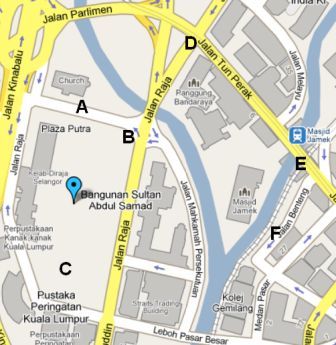
Map of Dataran Merdeka and its environs

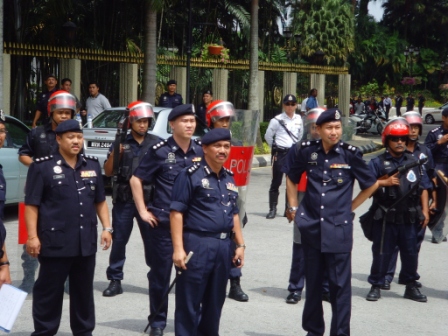
As I crossed Jalan Kinabalu to get to Dataran Merdeka, it was 6 pm. In front of St. Mary's church (A on the map), I could see police officers walking towards Jalan Raja, adjusting their uniforms and berets. Ahead, there was a police "balai bergerak", and a van. An assortment of uniformed officers stood by, while about 25 - 30 people dressed in plain clothes milled about.

There were a few tourists and photographers along Jalan Raja, but nowhere near it's usual Saturday evening crowd. A group of press photographers were there too; I heard them joke that they would outnumber the protesters.

Media photographers. Anyone else?

The police began to place metal barricades at the entrances to Jalan Raja in front of Dataran Merdeka. Traffic policemen on their big bikes rode to and fro. At one corner of Dataran Merdeka (B), the people in plainclothes formed into rows, and a uniformed officer spoke to them.

Briefing?

At about 6.20 pm, officers approached the people along Jalan Raja, and asked them to leave the area. The reason given was that the police had declared the area a "restricted area", and that they were about to begin "operations" there. I did not see any notices or signs to that effect anywhere.

As I made my way out across the barricade, I noticed that the officers manning it diverted all motor and pedestrian traffic away.

The barricade


Interestingly, there were a number of scruffy looking people scattered about the area. One could easily have taken them for Dataran Merdeka groundskeepers or similar, until one noticed the walkie-talkies they were carrying.

The entry onto the flag platform (C) from the Selangor Club was not barricaded. As I walked onto the area, at 7 pm, I saw that some who had come to attend the vigil were already there. They were waiting for the vigil to start.

At about 7.15 pm, two uniformed policewomen approached some of the people there and (it seemed to me) politely asked them to leave the area. The people there did not leave. Later, someone said that the main group of Hindraf vigillers were on their way from Jalan Tun Perak. We waited for them to appear.

Two policewomen asking people to leave

At 7.45 pm, I noticed that there were lots of blue flashing lights at the junction of Jalan Tun Perak and Jalan Raja (D). At 8 pm a siren sounded, and someone said that the vigillers had been arrested. I followed a small group that made its way across the field and towards the flashing lights at the Jln. Tun Perak junction. There, I saw a police lorry and a van with lots of police milling around, including ones in riot gear.

The van

Press photographers were snapping away at the vehicles, but I was unable to make out who was in it. Both vehicles left soon after.

The lorry leaving

At about 8.15 pm, someone said that the remaining members of the Hindraf vigillers were near the Masjid Jamek LRT station (E), and we walked there. On the way, I saw the trampled remains of roses, and candles, on the sidewalk.

"Weapons" of mass liberation

The Hindraf folk were standing together on the sidewalk, talking in hushed tones. They were calm, but their concern for their arrested colleagues was clear. They related how some of them were arrested even as they were walking away from the police, trying to comply with the order to disperse. I heard some of them try to account for those who had been arrested. Standing in the station and observing the group, were two gentlemen in plainclothes, each with a small bag slung across his shoulder.

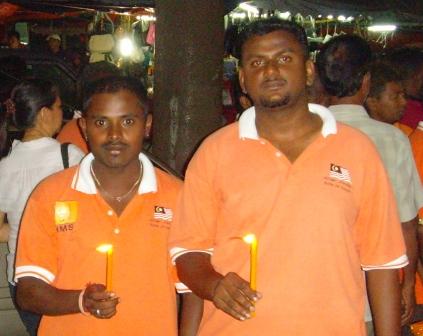
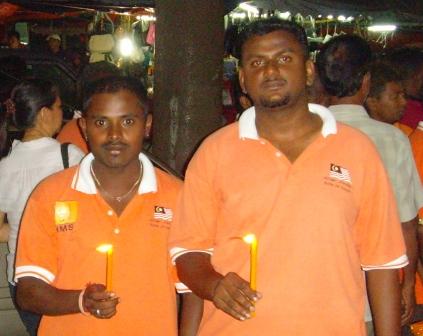
A few of them still had some candles left, which they lit as they stood together silently on the sidewalk. As I took a photograph, one of them said something barely audible. Translated it meant "what a cruel country".

Are we a cruel country?

Suddenly, someone said that there were police officers on the way to arrest more people. The small group dispersed, leaving only a few behind. I saw a group of approximately 5 uniformed officers walking towards us from Jalan Raja. Some of them stationed themselves at the sidewalk, while the others seemed to be looking for the vigillers along the riverbank opposite the Masjid Jamek (F).

Back at the LRT station, I noticed 2 women vigillers standing at the corner, busy with their cellphone, with the uniformed officers standing not far away, and the plainclothes people still keeping watch from above.

That was the situation at the Masjid Jamek station when I left at 8.35 pm.

Please read these news reports here and here, see the video here, and read Hindraf's statement here. (UPDATED: Please also see photos taken by Hindraf here.)


Have we done right by our brothers?

Sincerely,
Malaysian Heart

Sunday, May 10, 2009

P. Uthayakumar: "Never Give In To Them"

In human history, there have been many times when people facing injustice & oppression have used nonviolent resistance to achieve social & political change.

Because of the highest moral standards needed to achieve true change, the leaders of these movements have to shoulder an enormous responsibility. Whilst all the time keeping a clear eye on their goal & inspiring & motivating people, they need to ensure that their movement never deviates from the principles of their struggle. If they sacrifice their principles
& accept that the ends justifies the means, their movement's moral standing is lost, and will soon disintegrate.

In shouldering these respon
sibilities, time and time again these leaders have had to make great personal sacrifices. Let's look at three notable examples.
  1. Mahatma Gandhi was imprisoned in 1908 by the racist government in South Africa for resisting the unjust Asiatic Act law. In the words of Nelson Mandela, "Gandhi's most painful experience must have been when he was told that his wife, Kasturbai, was critically ill. He was given the option to pay his fine and rush to her bedside. His commitment to satyagraha would not allow him to do so." Read more here and on page 88 here.
  2. Martin Luther King, Jr. took part in protests against segregation in the town of Albany, Georgia in 1961, and was sentenced to imprisonment. The authorities offered to release him (and his colleague) if they paid a fine of US$178. Sticking to principle, they refused. Finally the police chief himself paid their fine & released them to avoid embarrasment. Read more here and here.
  3. Nelson Mandela was undergoing life imprisonment in Robben Island, a maximum security prison, when the apartheid government offered to release him in exchange for accepting the bantustan policy by recognising the independence of the Transkei and agreeing to settle there. He chose to never compromise his principles. He remained in prison until he was released unconditionally on 11 February 1990, after being imprisoned for a total of 27 years. Read more here.
To this fellowship (which includes many others, some of whom we may not know about), we can now add a Malaysian, P. Uthayakumar, who refused to accept any conditions for his release from detention under the ISA. In his own words, “If they force me (to sign the conditional release papers, which among other things would have barred him from speaking at public functions), I will not do it as I prefer going back to Kamunting prison,” (the words in brackets being mine).

Leaders like them inspire us.

They & their loved ones have suffered pain, physical & emotional, for us. Let us stand, not behind them but shoulder to shoulder with them, and work together for justice for ALL Malaysians.

Let us never forget what these brave people have shown, that truth & justice will always triumph over lies & oppression. Let us not forget either, that all that is needed for the triumph of evil
is that good people do nothing.

Finally, let us never forget these words of Uthayakumar: "Never give in to them."


May all victims of the ISA get the justice that they deserve.

Makkal Sakthi!