Showing posts with label Oppression. Show all posts

Friday, October 2, 2009

What lessons can Malaysians learn from Mahatma Gandhi and Satyagraha?


Mohandas Karamchand Gandhi
2 October 1869 – 30 January 1948
photo from here

Today, 2 October 2009 is the 140th anniversary of the birth of Mahatma Gandhi. In India it is celebrated as Gandhi Jayanti, and internationally it is celebrated as the International Day of Non-Violence. Besides commemorating the birth of such a human being, what lessons can we learn from his life and struggle, and why would they be of use to us?

In my humble opinion, the Mahatma's greatest achievement was in leading oppressed people to freedom. This is a very difficult undertaking, requiring great courage and ability, physical, intellectual, emotional and moral. The oppressors whom he faced were very powerful and ruled with an iron fist, yet the Mahatma was able to bring about change in a peaceful and ethical way. In a world where "one man's terrorist is another man's freedom fighter", and where the ends are held to have justified the means, the Mahatma stands out as a shining example of how one man can make a difference for the better. As Albert Einstein said of him, "Generations will scarce believe that such a one as this ever in flesh and blood walked upon this earth."

What were the personal characteristics that set the Mahatma apart? I believe that he had a very strong sense of values and principles by which he lived and by which he guided the struggle. Among these principles were (adapted from Wikipedia):
  • Truth: Gandhi dedicated his life to the wider purpose of discovering truth, or Satya. Gandhi summarized his beliefs first when he said "God is Truth". He would later change this statement to "Truth is God". Thus, Satya (Truth) in Gandhi's philosophy is "God".
  • Non-violence: Although Mahatama Gandhi was not the originator of the principle of non-violence, he was the first to apply it in the political field on a huge scale. In his own words, "There are many causes that I am prepared to die for but no causes that I am prepared to kill for."
  • Simplicity: Gandhi earnestly believed that a person involved in social service should lead a simple life. His simplicity began by renouncing the western lifestyle he was leading in South Africa. He called it "reducing himself to zero," which entailed giving up unnecessary expenditure, embracing a simple lifestyle and washing his own clothes.
  • Faith: Gandhi was born a Hindu and practised Hinduism all his life, deriving most of his principles from Hinduism. As a common Hindu, he believed all religions to be equal, and rejected all efforts to convert him to a different faith. Gandhi believed that at the core of every religion was truth and love (compassion, nonviolence and the Golden Rule). He also questioned what he saw as hypocrisy, malpractices, and dogma in all religions, including his own, and he was a tireless advocate for social reform in religion. Later in his life when he was asked whether he was a Hindu, he replied: "Yes I am. I am also a Christian, a Muslim, a Buddhist and a Jew."
These principles became the core of Satyagraha, the philosophy and practice of nonviolent resistance that led to freedom. Gandhi described it as follows:

I have also called it love-force or soul-force. In the application of satyagraha, I discovered in the earliest stages that pursuit of truth did not admit of violence being inflicted on one’s opponent but that he must be weaned from error by patience and compassion. For what appears to be truth to the one may appear to be error to the other. And patience means self-suffering. So the doctrine came to mean vindication of truth, not by infliction of suffering on the opponent, but on oneself.[2]

"The Satyagrahi’s object is to convert, not to coerce, the wrong-doer." Success is defined as cooperating with the opponent to meet a just end that the opponent is unwittingly obstructing. The opponent must be converted, at least as far as to stop obstructing the just end, for this cooperation to take place.

When using satyagraha in a large-scale political struggle involving civil disobedience, Gandhi believed that the satyagrahis must undergo training to ensure discipline. He wrote that it is “only when a people have proved their active loyalty by obeying the many laws of the State that they acquire the right of Civil Disobedience.”[11]

He therefore made part of the discipline that satyagrahis:

  1. appreciate the other laws of the State and obey them voluntarily
  2. tolerate these laws, even when they are inconvenient
  3. be willing to undergo suffering, loss of property, and to endure the suffering that might be inflicted on family and friends[11]
Gandhi also proposed this series of rules for satyagrahis to follow in a resistance campaign:[8]
  1. harbour no anger
  2. suffer the anger of the opponent
  3. never retaliate to assaults or punishment; but do not submit, out of fear of punishment or assault, to an order given in anger
  4. voluntarily submit to arrest or confiscation of your own property
  5. if you are a trustee of property, defend that property (non-violently) from confiscation with your life
  6. do not curse or swear
  7. do not insult the opponent
  8. neither salute nor insult the flag of your opponent or your opponent’s leaders
  9. if anyone attempts to insult or assault your opponent, defend your opponent (non-violently) with your life
  10. as a prisoner, behave courteously and obey prison regulations (except any that are contrary to self-respect)
  11. as a prisoner, do not ask for special favourable treatment
  12. as a prisoner, do not fast in an attempt to gain conveniences whose deprivation does not involve any injury to your self-respect
  13. joyfully obey the orders of the leaders of the civil disobedience action
  14. do not pick and choose amongst the orders you obey; if you find the action as a whole improper or immoral, sever your connection with the action entirely
  15. do not make your participation conditional on your comrades taking care of your dependents while you are engaging in the campaign or are in prison; do not expect them to provide such support
  16. do not become a cause of communal quarrels
  17. do not take sides in such quarrels, but assist only that party which is demonstrably in the right; in the case of inter-religious conflict, give your life to protect (non-violently) those in danger on either side
  18. avoid occasions that may give rise to communal quarrels
  19. do not take part in processions that would wound the religious sensibilities of any community
Why are these lessons relevant to us Malaysians? Isn't our situation in Malaysia in some ways similar to that faced by Gandhi in India? We too live in a multiracial and multireligious country, we too are ruled by what is essesntially a colonial government - one where the hard work and resources of the rakyat are expropriated for the use of those in power and their cronies. We too are denied our basic human rights, and we too are kept in control by law enforcement system that serves it's political masters, not justice (ironically, the descendant of the same law enforcement that Gandhi suffered). Perhaps our most striking similarity is that we too are oppressed because we have not been able to transcend our racial and religious divisions; our oppressors have effectively divided and ruled over us because of it.

I believe that if we Malaysians want to bring much needed change to our country in a sustainable, peaceful and ethical way, we need to practice the Mahatma's principles. Where do we start? In the words of the Mahatma himself: "You must be the change you want to see in the world."


Gandhi at Dandi, South Gujarat, picking salt on the beach at the end of the Salt March, 5 April 1930. Photograph from here

Raghupati Raghava Raja Ram, the Mahatma's favourite bhajan

Mahatma Gandhi speaking: God is Life, Truth, Light, Love and The supreme Good

Sincerely,
Malaysian Heart

Murugiah's attempt to stifle legitimate political discourse (and give BN an edge in Bagan Pasir) must be opposed!

From the New Straits Times 4 days ago (bold emphasis mine):

Instant detention threat for talk on cow's head

2009/09/28

PORT DICKSON: Anyone bringing up the Shah Alam cow's head incident during the Bagan Pinang election campaign will be detained immediately and could face charges of inciting racial tensions.

The warning was made by Deputy Minister in the Prime Minister's Department Datuk T. Murugiah, who said that it applied to Barisan Nasional and the opposition.

"We will assign officers to keep tabs on all ceramah and other activities during the campaign and they will alert the police immediately if the issue is raised."

Murugiah is the deputy minister in charge of the National Unity and Integration Department.

"We want a clean and fair campaign and to ensure no racial or religious issues are raised to incite the people."

The real purpose of this threat is to protect Umno/BN from the political fallout resulting from the deep outrage Malaysians from all walks of life felt at the Umno/BN inspired cow's head incident. Futhermore, it is a pernicious attack on free speech in Malaysia and the right of Malaysians to freely discuss and exchange ideas on matters of national interest. If this threat is left unopposed, it will set a dangerous precedent for the future of political discourse in Malaysia: that the party in government can decide what we Malaysians can and cannot speak about.

To see that this threat has nothing whatsoever to do with preserving racial harmony in Malaysia, let's take a closer look at it, by examining some definitions first:
  • Incite - to stir up or provoke to action
  • Tension - a situation or condition of hostility, suspense, or uneasiness
  • Racial - Arising from or based on differences among human racial groups
Put them together in this context, and "inciting racial tensions" means stirring up or provoking hostility, suspense or uneasiness between groups of Malaysians based on their race. The result of "inciting racial tensions" is that Malaysians would feel (and perhaps behave with) hostility, enmity and agression towards other Malaysians, just because they are from a particular other race.

Next, let's look at the cow's head incident. Was it a racial (or religious) incident, or was it a political one? Is it credible that the Malay/Muslim residents of Section 23 spontaneously decided to insult their Hindu neighbours? While there had been dissatisfaction over the temple for some time, the aggressive, thuggish behaviour only began after GE-12, when Pewaris, one of Umno/BN's "astroturf" organisations, got involved. After the incident itself, Hishamuddin and Mukhriz Mahathir provided justification and sympathy for the protesters, and Perkasa, another Umno/BN proxy, took up their case as a "jihad".

No, the cow head incident was not about race or religion per se, but Umno/BN would like it to have become one. It was just one of a series of activities inspired and encouraged by Umno/BN to destabilise Pakatan Rakyat led state governments, and in the longer term to polarise Malaysians racially and by religion. Although we Malaysians have not yet reached the stage of accepting and truly cherishing our diversity, we have been living and praying side by side and in relative peace and with mutual tolerance for centuries. Whenever there has been serious inter-racial conflict (e.g. 13 May 1969), it's easy to identify the political hands behind it.

However, this time it backfired badly on the perpetrators. Malaysians of all walks of life were horrified, and in a heartwarming demonstration of good values, principles and unity, civil society groups and opinion leaders of all races and religions rose as one to condemn the antics of the cow head protesters (and their backers). Unfortunately, Malaysia had already become a laughing stock in the world media.

Umno/BN were caught on the back foot, and realising how damaging the truth would be to them, they tried to expunge the evidence by getting the MCMC to go after Malaysiakini to remove the videos of the incident itself, and Hishamuddin's support for it, with the ridiculous excuse that the video was offensive to Hindus. In reality it was the spitting and stamping on the cow's head, as well as the threats of violence that was offensive to all Malaysians. All that the videos could do was to embarass Hishamuddin, and further damage Umno/BN's credibility as a party with values and principles for all Malaysians.

Now, is it important that Malaysians know what Umno/BN has been up to? Of course it is. We have the right to know how our government and politicians try to manipulate and divide us by race and religion so that they may hang on to power uninterrupted. We voters need to know the truth about the perfidy that pervades Umno/BN, so that we can boot them out in elections.

Would telling the truth about the cow head incident be "inciting racial tensions"? Only if the facts were twisted to imply that Malays and Muslims as a group are behind it, and meant to insult Hindus, and that Hindus should feel enmity towards all Malays and Muslims in turn. Given the fact that it was Umno/BN inspired, and that many Malay and Muslim Malaysians have strongly spoken out against it, this would be factually wrong. Anyone who argued so would be in the same category as the cow head protesters, their supporters, and people like Ridhuan Tee and Awang Selamat; they would certainly be inciting racial tension (whether all these people should be charged with sedition is another matter altogether).

Would it be in PR's interest to incite racial tensions in this way? They would have to be stupid to do so. The PR candidate in Bagan Pinang is a Malay from the Muslim party PAS. How would PR best explain the incident to the voters? By exposing Umno/BN's hand in the incident, and making it clear that it was about politics, not about race. Report the truth and let the facts speak for themselves; res ipsa loquitor, and the only ones who would deserve the rakyat's enmity would be Umno/BN dalang behind the incident.

Would doing this incite racial tension? Not in the least, but it would effectively kill off support for Umno/BN amongst reasonable peace loving Malaysians, including the Indian community who form 20% of the voters in Bagan Pinang. That is what Umno/BN is afraid of, and that is why they sent Murugiah to issue the threat. The last thing they want is a "clean and fair campaign", where Umno/BN's shenanigans can be laid bare for voters to see, and they have no qualms about abusing their position in government to threaten the rakyat.

So, how should we respond to this politically inspired "order" that is masquerading as concern for racial harmony? IMHO, we have to expose it. We need to organise ourselves so that the facts about the cow head incident are as widely known to every voter in Bagan Pinang, by all means possible. We must take great pains to show why it has nothing to do with race and religion per se, and everything to do with Umno/BN using racial and religious issues for political gain; i.e. politics as usual, Umno/BN style.

One more thing we must do. We must never let the idea, that the party in government can dictate political discourse, become accepted practice here. IMHO, we must call their bluff and challenge it by peacefully disobeying such an unjust order. We need a large multiracial and multireligious group of Malaysians who are willing to speak the truth and give the voters of Bagan Pinang the facts about the cow's head incident. These people must be prepared to be detained; and there must be sufficient others ready to take their place and be arrested in turn. Let's see how many of us Najib's 1Malaysia can arrest, and if it is willing to face the acute embarassment that will result once the free newsmedia start exposing it for the two-faced scam that it is.

Sincerely ,
Malaysian Heart

Sunday, September 27, 2009

Justice for Kugan petition to DYMM YDP Agong 26/09/09 - what I observed

This is what I observed at the peaceful assembly in front of the Istana Negara on 26 September 2009, which was called by Hindraf and the Human Rights Party Malaysia to deliver a petition to the the DYMM Yang Di-Pertuan Agong. The petition, which you can download and read here, pleads to the YDP Agong for justice for Kugan and his family. Eight months after his death in police custody, the killer/s of A. Kugan, have yet to be arrested and brought to justice.

I tried to get to the Istana Negara at about 10.30 a.m., but there was a police roadblock where Jalan Dewan Bahasa joins Jalan Istana, and the police were not allowing any cars to get past. I made some calls and found out that the petitioners were meeting at Naga's Restaurant in Brickfields, which is where I headed to.

Members of Kugan's family were already there, including Madam Indra (his mother), sister, brothers and uncle. With them were a small group of Hindraf and MHRP folks; MP for Kapar YB S Manikavasagam, MP for Puchong YB Gobind Singh Deo, and ADUN for Kota Shah Alam YB M. Manoharan were also there. Soon, Human Rights Party Malaysia pro-tem secretary-general P. Uthayakumar and Hindraf coordinator Mr. Jayathas arrived, and the group organised themselves for the trip to the istana.

Some of Kugan's family members waiting for transport to the Istana

I hitched a ride in one of the cars carrying some of Kugan's relatives. We set of towards the Istana, but somehow got separated from the lead cars. We parked before the roadblock at Jln Dewan Bahasa, and began walking towards the Istana proper.

Members of the police manning the roadblock blocked our way and told us that we could not pass.

The police stop us from proceeding

We told them that we were going to deliver a petition to the Istana, and that Kugan's relatives were with us. The policeman asked us to wait while he radioed his superiors for permission. He took an inordinate amount of time doing this.

Asking for instructions, or delaying tactics?

After about ten minutes of waiting with no indication of any permission forthcoming, our group decided not to wait there any longer, but to get back into our cars and try another route. By 11.30 we were walking towards the group of petitioners in front of the Istana.

The petitioners outside the Istana, outnumbered by the police, reporters and cameramen. By what stretch of the imagination could they have been considered a threat to public security?

As I approached this group at 11.33 a.m., a policeman was already ordering the crowd to disperse. This is what I managed to record:


Thus the people's attempt to express their plea for justice to their King was foiled by the police. The people there made their way back, and as you can see in the video above, their frustration and disappointment was evident.

The petitioners leaving the Istana area


The leaders of the petitioners had a quick discussion, and decided to hold a press conference back at Naga's Restaurant.


These are the people who prevented the rakyat from presenting their petition to DYMM YDP Agong. They are supposed to protect and serve the rakyat, but whose interests are they protecting now? Whose orders were they following?


Kugan's mother and other family members waiting by the roadside of Jalan Istana, having been chased away from the Istana area itself. Don't they have a right to plead for justice from their King, when the Malaysian AG and police have denied them justice for eight months? Why must they be treated so?

We got back into our cars and headed back to Naga's, where the impromptu press conference was held. Here are some video clips from it (apologies for the poor audio quality):


YB Gobind Singh Deo


YB M. Manoharan


Mr. Uthayakumar, YB Manickavasagam, YB Manoharan and lawyer Mr. N. Surendran


Madam Indra, with YB Manoharan translating for her. Kugan's mother still grieves.


YB Gobind Singh Deo again pt. 1


Pt. 2


Pt. 3

During the press conference, there were three gentlemen who were hanging about the restaurant, with a video camera. here they are, numbered accordingly:


I cannot verify this, but I was told that they were special branch officers. Here is another shot of them:


Here is number 3 recording the press conference from up close:


According to this Bernama report of the event:
Brickfields police chief ACP Wan Abdul Bari Wan Abdul Khalid said police managed to disperse the gathering without any untoward incidents.

"No arrests were made. Police were on duty in front of Istana Negara to prevent incidents as the group comprised Hindraf members and politicians.

"The public should respect the residence of the Yang di-Pertuan Agong and the laws of the country," he said when contacted today.
Reading his statement, and having seen the events unfold for myself, these are the questions and thoughts that come to my mind:

1) What "untoward incident" was he expecting? Was he afraid that Kugan's mother was going to assault him with a deadly petition?

2) Why are Hindraf members and politicians singled out for "special treatment", when the cow head protestors get a free pass? Blatant double standards at work!

3) What did any of the petitioners do there, which can be construed as disrespecting the YDP Agong or his residence? Palace officials had already been informed and were prepared to accept the memorandum. Isn't DYMM YDP Agong the King for all Malaysians, including for Kugan and his family? Wasn't His Majesty's palace built and maintained with their blood, sweat and tears as well? What laws did they break? Why is the Brickfields police chief slandering them?

4) Why aren't Malaysians allowed to exercise their right to assemble peacefully? Were these folks in any way or form a threat to public safety and security? If peaceful assemblies like these are broken up by the police, how else are Malaysians going to express their views and feelings? IMHO, all the while our 1Malaysia government is embarking on a "feel-good" PR campaign, they are severely eroding our rights to assemble peacefully, amongst many others. We need work urgently to re-establish our rights, before we lose them altogether.

5) Why was it that the people who showed up in support of the petition were virtually all Indians? In the past (for example during Kugan's funeral), there was heartwarming and encouraging support from all communities; we must never let such cooperation and understanding die away. Kugan's case, just like Adi Anwar Mansor's and Teoh Beng Hock's, is a serious issue for all Malaysians. If we only fight for justice when our own race is involved, then Umno/BN will win, because we cannot defeat them by ourselves. Civil society and progressive groups must work together to find common ground and strive for change with a united voice. This will require high quality, principled leaders. United we stand; divided, we'll all die with Umno/BN in power for the next 52 years. Please people, we must break down the racial walls that Umno/BN have built between us!

6) We must ensure that the IPCMC is formed. IMHO, the police have become an instrument for the oppression of Malaysian's political expression and aspirations. If we are to have any hope of change in Malaysia, we must reform the police into an organisation that serves the rakyat, and not the political purposes of the party which happens to be in government.


The pain and anguish that our mothers bear for us, transcends time, language, race, and religion. Paradise lies beneath their feet, but all we give them in return is suffering. When our time comes, will God have mercy on us?

Sincerely,
Malaysian Heart

Please read more reports of the event here, here, here and here.

Tuesday, September 15, 2009

Five ISA detainees released - THANK GOODNESS!!! Nine more to go!


(Mat Sah Satray with his son Shuaib. Photograph taken from here)

Mat Sah Mohamad Satray, Dr Abdullah Daud, Mohd Nasir Ismail @ Hassan, Ahmad Kamil Md Hanapiah and Muhammad Amir Md Hanapiah will be released from detention without trial under the Internal Security Act today. En. Mat Sah, who had been detained without trial since April 2002, is the husband of anti-ISA activist Pn. Norlaila Othman, or Kak Laila. She has worked tirelessly with the Gerakan Mansuhkan ISA for the freedom of ALL ISA detainees. I'm really happy that Kak Laila and her family, and the families of all those released, will be able to celebrate Aidil Fitri with their loved one after so long.

But her work (and our work too) is far from over. There are nine people still detained under ISA: four Malaysians and one each from Bangladesh, Pakistan, Thailand, Singapore and Indonesia. Detention without trial is inherently unjust, and there exist enough laws to allow our law enforcement agencies to investigate, arrest, charge, try in an open court and (if guilty) punish anyone who threatens our national security. If our law enforcement claim to be unable to protect Malaysia's security with the just powers they have been given, I say it is time for their leaders to step down and allow those more capable and committed to do the job.

Furthermore, our ISA has been abused to improperly clamp down on legitimate political activity and expression, even to torture and brainwash detainees into providing false testimony for politically motivated trials. This travesty must be eliminated.


(Kak Laila and son Shuaib, after being arrested during the anti-ISA protest, 1/8/09. Photo from here)

Please support Gerakan Mansuhkan ISA. Here are their principles:
GMI berpegang kepada prinsip bahawa tiada sesiapa pun yang berhak ditahan tanpa bicara. Seseorang itu perlulah di bawa ke mahkamah untuk pengadilan atau dibebaskan. Seseorang itu perlulah dianggap tidak bersalah sebelum dibuktikan bersalah (innocent until proven guilty).

GMI memperjuangkan prinsip-prinsip hak asasi manusia seperti yang termaktub dalam Arktikel 5 dan 10, Perlembagaan Persekutuan

GMI berpegang kepada prinsip bahawa penglibatan dan penggemblengan masyarakat adalah penting untuk melaksanakan perubahan
Repeal the ISA! Justice for all detainees! Close down the Kamunting Detention Camp!

Sincerely,
Malaysian Heart

UPDATE: Please read Kak Laila's blog post on their family's Aidil Fitri together here.


Thursday, September 10, 2009

What was Hindraf singing during their vigil?

Those of us who have seen the video of Hindraf's candle light vigil on 5/9/09, and the subsequent arrests by our police, would have heard the vigillers singing a song in Tamil, as they tried unsuccessfully to get to Dataran Merdeka. For the benefit of those of us who would like to understand what they were singing, and why, here is some info.

The title of the song is Tholvi nilayena ninaithaal, and it is from the 1986 movie Oomai Vizhigal. In the movie, politically connected thugs (who had earlier killed a journalist), destroy the printing press of a newspaper, in order to silence their investigative reporting. This song is what the editor sings to motivate his team after the attack. Here is a translation in English:

If we only dwell on on our defeated condition, how can we even hope of living?
If we consider this life a burden, isn't that trampling upon our mothers' dreams?

Having lost our rights, having lost our belongings, shall we give up our humanity too?
Being human, and still alive, how can we forget our dreams?

When dawn is about to break, why should our hearts be heavy?
When our hearts are full of courage, why should our eyes have tears?

Even if they oppose us, even if they spill our blood, can we ever change our path?
Our blood will only drive our fear away, then can our principles ever die?


Here is the song in full, as sung in the movie by P.B. Srinivas and Abavaanan:


Some people find that anything which is unfamiliar to them makes them uncomfortable; hence they become intolerant towards it. This is especially true if there are negative stereotypes and prejudices already associated with that particular community. People like blogger Dnightcaller even go so far as to call Hindraf "biadap" simply for choosing to sing a Tamil song.

I believe that if we take the trouble to understand our fellow humans better, we will find that they feel exactly what we feel, and that what they want for their children is exactly what we want for ours. However, we first need to get over our own prejudices and speak (and act) against the subtle (and often not so subtle) racism that our fellow Malaysians still suffer in our midst.


If you would like to join them in singing this song, here are the lyrics in Romanised Tamil.

Sincerely,
Malaysian Heart

My gratitude to M.A. for providing the translation, and explaining its meaning to me.

Wednesday, September 9, 2009

"I am an individual" - excellent post by Hussein Abdul Hamid

Blogger Hussein Abdul Hamid, who blogs at Steadyaku47, writes this excellent entry, part of which I reproduce here:

Tuesday, September 8, 2009

I am an individual.

The state of affairs now seen on our country leaves us with no other conclusion then that UMNO has failed. It has failed in its effort to justify their demand that we Malaysian should allow them to continue for another fifty years with their tinkering of our democratic values and principals as a trade off to the ongoing development of our country and the yet to be achieved uplifting of the Malay race to be a developed ethnic community. Two remarkable and truly laudable goals -- economic development and the rise and rise of the Malays - but arguments that are fundamentally flawed.

The Government insists that the particularity of Malaysian Politics, its multi ethnic divides and its religious enclaves make a need for the ISA to be enforced arbitrarily over its people. It continues to dominate over its people who live defenseless under its shadows. And in all this there is no political accountability in what they do.

I say that the Politics of Barisan Nasional is no longer appropriate for our people, for our country. I say that a multi ethnic, multi party democracy is what we need. We no longer want a trade-off between democracy and development. Between freedoms to demonstrate responsibly as against what the Government perceives as our inability to do so without causing riot and chaos in the streets.

Please read his entire post here: http://steadyaku-steadyaku-husseinhamid.blogspot.com/2009/09/i-am-individual.html

Sincerely,
Malaysian Heart

Sunday, September 6, 2009

Hindraf's candle light vigil 5/9/09 - what I observed


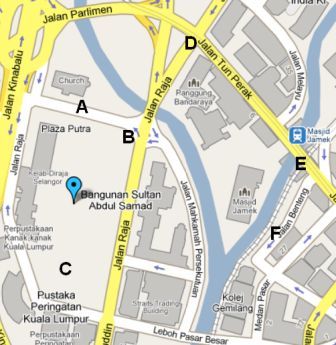
Map of Dataran Merdeka and its environs

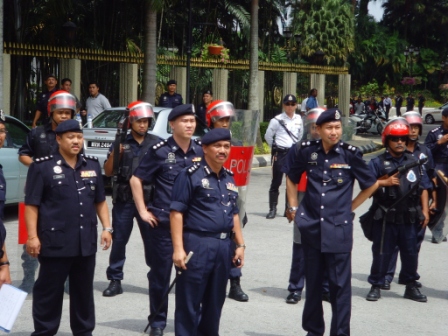
As I crossed Jalan Kinabalu to get to Dataran Merdeka, it was 6 pm. In front of St. Mary's church (A on the map), I could see police officers walking towards Jalan Raja, adjusting their uniforms and berets. Ahead, there was a police "balai bergerak", and a van. An assortment of uniformed officers stood by, while about 25 - 30 people dressed in plain clothes milled about.

There were a few tourists and photographers along Jalan Raja, but nowhere near it's usual Saturday evening crowd. A group of press photographers were there too; I heard them joke that they would outnumber the protesters.

Media photographers. Anyone else?

The police began to place metal barricades at the entrances to Jalan Raja in front of Dataran Merdeka. Traffic policemen on their big bikes rode to and fro. At one corner of Dataran Merdeka (B), the people in plainclothes formed into rows, and a uniformed officer spoke to them.

Briefing?

At about 6.20 pm, officers approached the people along Jalan Raja, and asked them to leave the area. The reason given was that the police had declared the area a "restricted area", and that they were about to begin "operations" there. I did not see any notices or signs to that effect anywhere.

As I made my way out across the barricade, I noticed that the officers manning it diverted all motor and pedestrian traffic away.

The barricade


Interestingly, there were a number of scruffy looking people scattered about the area. One could easily have taken them for Dataran Merdeka groundskeepers or similar, until one noticed the walkie-talkies they were carrying.

The entry onto the flag platform (C) from the Selangor Club was not barricaded. As I walked onto the area, at 7 pm, I saw that some who had come to attend the vigil were already there. They were waiting for the vigil to start.

At about 7.15 pm, two uniformed policewomen approached some of the people there and (it seemed to me) politely asked them to leave the area. The people there did not leave. Later, someone said that the main group of Hindraf vigillers were on their way from Jalan Tun Perak. We waited for them to appear.

Two policewomen asking people to leave

At 7.45 pm, I noticed that there were lots of blue flashing lights at the junction of Jalan Tun Perak and Jalan Raja (D). At 8 pm a siren sounded, and someone said that the vigillers had been arrested. I followed a small group that made its way across the field and towards the flashing lights at the Jln. Tun Perak junction. There, I saw a police lorry and a van with lots of police milling around, including ones in riot gear.

The van

Press photographers were snapping away at the vehicles, but I was unable to make out who was in it. Both vehicles left soon after.

The lorry leaving

At about 8.15 pm, someone said that the remaining members of the Hindraf vigillers were near the Masjid Jamek LRT station (E), and we walked there. On the way, I saw the trampled remains of roses, and candles, on the sidewalk.

"Weapons" of mass liberation

The Hindraf folk were standing together on the sidewalk, talking in hushed tones. They were calm, but their concern for their arrested colleagues was clear. They related how some of them were arrested even as they were walking away from the police, trying to comply with the order to disperse. I heard some of them try to account for those who had been arrested. Standing in the station and observing the group, were two gentlemen in plainclothes, each with a small bag slung across his shoulder.

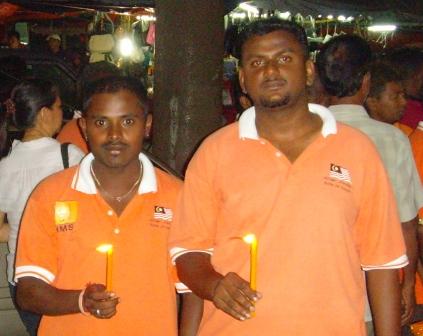
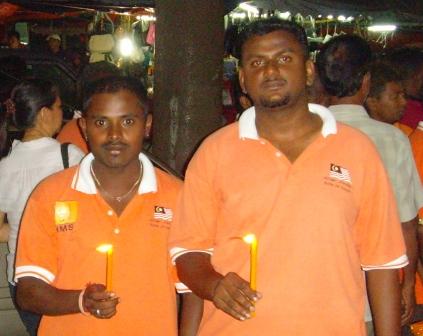
A few of them still had some candles left, which they lit as they stood together silently on the sidewalk. As I took a photograph, one of them said something barely audible. Translated it meant "what a cruel country".

Are we a cruel country?

Suddenly, someone said that there were police officers on the way to arrest more people. The small group dispersed, leaving only a few behind. I saw a group of approximately 5 uniformed officers walking towards us from Jalan Raja. Some of them stationed themselves at the sidewalk, while the others seemed to be looking for the vigillers along the riverbank opposite the Masjid Jamek (F).

Back at the LRT station, I noticed 2 women vigillers standing at the corner, busy with their cellphone, with the uniformed officers standing not far away, and the plainclothes people still keeping watch from above.

That was the situation at the Masjid Jamek station when I left at 8.35 pm.

Please read these news reports here and here, see the video here, and read Hindraf's statement here. (UPDATED: Please also see photos taken by Hindraf here.)


Have we done right by our brothers?

Sincerely,
Malaysian Heart

Friday, September 4, 2009

Is Malaysia becoming a police state? What on earth is happening to us?

Yesterday, 3 September 2009, blogger Ronnie Klassen, posted this entry, "Malaysia, a police state in the making?" In it, he writes:
One month ago, on 3 August,army personnel's from the 7 RAMD (Gerak Khas) swooped on Pulau Pandanan Kecil, off Semporna and ordered the villagers there to take down all the Parti Keadilan Rakyat (PKR) flags hoisted at their houses. When the villagers declined to comply, the army personnel's brought the flags down for them.
If this is true, it is a most serious violation of our democratic right to suport the political party of our choice. As Ronnie explains, "The inhabitants of a police state experience restrictions on their mobility, and on their freedom to express or communicate political or other views, which are subject to police monitoring or enforcement."

This action must be explained satisfactorily to the rakyat, and the government must be held accountable for it. Wakil rakyat, what are you waiting for?

Sincerely,
Malaysian Heart

P.S. Please read Ronnie's entire post here. It includes links to 2 videos of the incident.

Thursday, September 3, 2009

Let’s stamp out racism - article by Azmi Sharom in the Star

Dear Readers,

This is an excellent article by Dr. Azmi Sharom, an associate professor in the Faculty of Law at Universiti Malaya, which was published in the Star today:

Thursday September 3, 2009

Let’s stamp out racism

BRAVE NEW WORLD
By AZMI SHAROM

Not only must we condemn the cow-head protest in Shah Alam last week but we must look into ourselves and make sure we don’t think and speak like racists.

THE cow-head protest in Shah Alam last week left me feeling utterly disgusted. The men who organised and participated in that foul act are nothing but rank racists, and by cloaking their activities in a veil of piousness they show themselves to be even more despicable.

Yes, I was furious, but sadly I was not surprised. How can I be and how can anyone else be? We have allowed racists to have their way for so many years now.

Their appalling words and actions get progressively bolder and it just builds and builds until we have these men feeling they have the right to insult another religion in the most vile and brutal manner.

In the light of how Malay and Islamic supremacist thinking and expression have caught hold in the last few years, this sickening behaviour is simply a natural progression.

It happened because we allowed it to happen. Those bigoted thugs did what they did because we did not stamp down on the racists among us hard.

We allowed racist politicians to spout their garbage about “immigrant races”; we allowed them to tell our brothers and sisters to “go back to where you belong”; we allowed them to wave weapons of war; and we allowed them to ask for the weapons to be bathed in blood.

It’s too late for any politician to condemn something now when all the other acts of bigotry that have been brewing in the past few years were not even protested against because they suited their political needs.

It is too late to be making pleas of unity on National Day when not enough has been done before.

Let’s look at something recent. Two books that attacked the Mentri Besar of Selangor and Opposition Leader Anwar Ibrahim are blatantly racist.

They claim that Selangor is for Malays only. They claim that the Pakatan Rakyat state government threatens Malays because they hire non-Malay staff.

In other words, the government must only hire Malays so that only Malays get benefits from the government. This is racism pure and simple. But because it suits the ruling party, as these books attack Pakatan, nothing is said.

Racism is racism, be it some vile words published in some cheap self-published drivel, or a bleeding cow head stomped and spat upon. Racism is racism and it must be fought.

When it is not fought, when it is not faced down every single time, then those without the courage to fight it are merely accomplices who, through their cowardice or selfishness, support it.

And how should we fight it? The law that should be used is the Penal Code. The Sedition Act is a blunderbuss of a law and could be used against genuine dissent as well. Let us not look to that archaic leaving of the British.

Use the provisions in the Penal Code that make incitement an offence. Charge these people under the Penal Code and lock them away.

But that is for the authorities to do, if they so choose to. We, the people, must look into ourselves and make sure we don’t think and speak like racists. We must be even more careful that we do not infect our children.

We should speak out against racism and we should tell our political leaders that if they do not fight racism then they are supporting racism and we will not support them.

We must make sure that what happened in Shah Alam faces utter and complete public contempt. Only in that way can we ensure it is not repeated.

Dr Azmi Sharom is a law teacher. I fully subscribe to and support his views expressed here.

You can read more about Dr. Azmi here, here and here.

Dead cow heads vs. dead political aides?

In response to a post on Malaysia Today titled "Cow’s Head, Pig’s Head, Chicken’s Head and next?" (taken from the Kadayan Journal), a regular MToday contributor and commentator, who uses the handle "batsman", posted the following:
written by batsman, September 03, 2009 09:10:09
Are we now more concerned over assaulted dead cow he*** than assaulted dead political aides?
This is my response to him, which I have posted there:

Batsman wrote: "Are we now more concerned over assaulted dead cow he*** than assaulted dead political aides?"

The cow head incident is cause for deep concern, because:

1) The protesters (in no uncertain terms) threatened violence and bloodshed to solve their "grievances". This could well become a new trend in Malaysia.
2) Their actions were quite obviously done with the intention of insulting the culture and religion of some Malaysians.
3) Such an intention to insult could have been followed by an (equally planned?) reaction which would have played into Umno/BN's hands, by allowing them to justify continuing their high-handedness and unjust laws.

It is made even more serious by the apparent fact that they have been aided and encouraged by our Umno/BN government. It must be seen in the context of Umno/BN's larger strategy of:
1) destabilising PR state governments, to precipitate a BN takeover,
2) causing racial and religious hatred, distrust and fear, so that Malaysians will stop working with each other on issues of national importance, and instead get in line behind the BN party representing their respective race.

To think that it is only about the life or death of a cow is extremely shortsighted and lacking in intelligence.

If Malaysia is to have any hope of being liberated from BN's rule, people and groups who profess to work to that end need to be able to work together on multiple issues, without having petty arguments over which is more worthy of concern. United we stand, divided we live [and die] with BN in power for another 52 years.

(For the record, I believe that it's people who feel insulted, not religions per se. However, people's reactions need to be considered and taken into account)

Wednesday, August 26, 2009

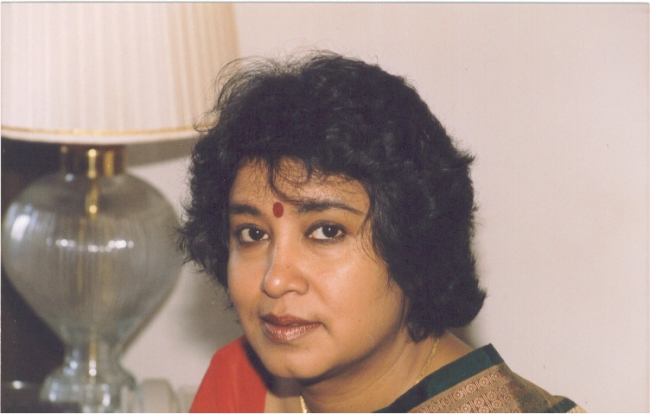
Happy Birthday, Dr. Taslima Nasrin


(Picture of Dr. Nasrin taken from here)

Yesterday (25 August 2009) was the birthday of Dr. Taslima Nasrin, the controversial Bangladeshi physician turned author, and feminist and human rights activist, who works to build support for secular humanism, freedom of thought, equality for women, and human rights by publishing, lecturing, and campaigning.

From Wikipedia:
Nasrin started writing poetry when she was thirteen. While still at college in Mymensingh, she published and edited a literary magazine, SeNjuti ("Light in the dark"), from 1978 to 1983. She published her first collection of poems in 1986. Her second collection, Nirbashito Bahire Ontore ("Banished within and without", 1989) was a big success.[citation needed]. She succeeded in attracting a wider readership when she started writing columns in late 1980s, and then novels, for which she has won significant acclaim.[20] In the early 1990s, she began writing novels. In all, she has written more than thirty books of poetry, essays, novels, short stories, and memoirs, and her books have been translated into 20 different languages.
Even if one does not agree with everything that she has written, one can still respect her for her courage and principles. Whatever our own beliefs are, we must all defend, to the death, her right to free speech. In her own words:
Freedom of expression for some is not enough.
We must work for freedom of expression for all.

Human rights for some is not enough.
We must work for the human rights for all.

Peace for some is not enough.
We must work for peace for all.

I, come what may, will not be silenced.
Come what may, I will continue my fight for equality and justice without any compromise until my death.

Come what may, I will never be silenced.

And so must we.

Happy Birthday, Dr Nasrin! May you be happy and have peace wherever you are!

Sincerely,
Malaysian Heart

P.S. You can read the first part of her autobiography, My Girlhood, here, and the second part, My Stormy Youth, here. You can send her a birthday message on her Facebook page, here, and read more about her work here.

P.P.S. Here is a blog by Tamoso Deep, a fan of Taslima Nasrin.

Friday, August 7, 2009

Police Misconduct and the Mainstream Media's Response to it: Malaysia and India


An Indian police officer beats a demonstrator near an August 2008 procession in Jammu (© 2008 Reuters, taken from page 2 of photo feature accompanying HRW report).

Kuala Krai MP Dr Hatta Ramli's shirt gets ripped in a scuffle outside the National Mosque during the anti-ISA rally on 1/8/09 (taken from the Malaysian Insider).

Malaysian policeman during anti-PPSMI demonstration on 7/3/09 (taken from here).


Human Rights Watch, an international non-governmental organization that conducts research and advocacy on human rights, has released a report on the state of the Indian Police Service. The report, titled "Broken System: Dysfunction, Abuse and Impunity in the Indian Police, is based on interviews with more than 80 police officers of varying ranks, 60 victims of police abuses, and numerous discussions with experts and civil society activists. You can read the press release and download the report itself from this webpage.

While it makes compelling reading for anyone interested in human rights and justice, reading the report as a Malaysian is heartbreaking; in so many ways it describes the trouble with our own PDRM in Malaysia. Some 'highlights' from the report:

Practices
The Indian Police Service practices arbitrary arrest and detention, torture and extrajudicial killings. They break the laws they are supposed to protect, and believe that unlawful methods, including illegal detention and torture, are necessary tactics of crime investigation and law enforcement. Therefore, they use "short-cuts" and their old methods - abuse and threats, hold suspects illegally and coerce them to confess, frequently using torture and ill-treatment. Sound familiar?

Here is an example from the report, how a fruit vendor in Varanasi described how police tortured him to extract confessions to multiple, unrelated false charges: :
"[M]y hands and legs were tied; a wooden stick was passed through my legs. They started beating me badly on the legs with lathis (batons) and kicking me. They were saying, ‘You must name all the members of the 13-person gang.' They beat me until I was crying and shouting for help. When I was almost fainting, they stopped the beating. A constable said, ‘With this kind of a beating, a ghost would run away. Why won't you tell me what I want to know?' Then they turned me upside down... They poured water from a plastic jug into my mouth and nose, and I fainted."
Underlying Causes
The Indian Police Service, hence it's ethos, laws and regulations originated from the Imperial Police, the colonial-era police force whose primary objective was to help the British control and oppress the population with impunity, not protect their human rights. As the report states "[t]he institutional culture of police practically discourages officers from acting otherwise, failing to give them the resources, training, ethical environment and encouragement to develop professional police tactics".

Colonial-era police laws enable state and local politicians to interfere routinely in police operations, sometimes directing police officers to drop investigations against people with political connections, including known criminals, and to harass or file false charges against political opponents.

Other contributing factors are overwhelming workloads, insufficient resources, abysmal conditions for police officers, lack of sufficient ethical and professional standards and appreciation of modern criminology. Overall, the report seems to identify the system rather than individual officers or commanders as the main underlying cause.

Other Similarities
In 2006, a landmark Indian Supreme Court judgment mandated the reform of police laws. But the central government and most state governments have either significantly or completely failed to implement the court's order, suggesting that officials have yet to accept the urgency of comprehensive police reform, including the need to hold police accountable for human rights violations. Shades of our IPCMC?

It's not surprising that the Indian police are overstretched and outmatched by criminal elements, and unable to cope with increasing demands and public expectations. When faced with real terrorists during the Mumbai attacks, their immediate response did not prevent substantial loss of life.

HRW's Conclusions and Recommendations
The report concludes that the system of policing in India facilitates and even encourages human rights violations, and that successive governments have failed to deliver on promises to hold the police accountable for abuses and to build professional, rights-respecting police force.

The report then recommends two main thrusts: First, renewed commitment by national and state officials to discipline or prosecute as appropriate police officers who commit human rights violations is essential, with benchmarks to measure progress in implementing the commitment, and second, an overhaul of police laws and regulations, and institutional structures and practices that facilitate the abuses.

According to Brad Adams, Asia director at Human Rights Watch, "conditions and incentives for police officers need to change," and, "Officers should not be put into a position where they think they have to turn to abuse to meet superiors' demands, or obey orders to abuse. Instead they should be given the resources, training, equipment, and encouragement to act professionally and ethically." He added that "it's time for the government to stop talking about reform and fix the system."

For the detailed recommendations, see this section of the report.

If you are not convinced that our PDRM and India's notorious police have similar problems, just read this account below, fellow Malaysian, then we can cry tears of shame together:

[P]olice arrested Gita Pasi in August 2006 in relation to an alleged kidnapping of a Yadav caste woman by a member of the local Dalit community. She died at the station and police claimed it was a suicide. According to Pasi’s brother-in-law, the police claim was implausible:

"She was kept in the police station all night. In the morning, when we went to meet her, they said she had killed herself. They showed us her body, where she was hanging from a tree inside the police station. The branch was so low, it is impossible that she hanged herself from it. Her feet were clean, although there was wet mud all around and she would have walked through it to reach the tree. It is obvious that the police killed her and then pretended she had committed suicide."

Mainstream Media Response
It is unfortunate that the similarities between Malaysian and Indian police forces are not complemented by similarities between our news media. I found the way in which the Indian mainstream media covered the story very different to how our own would have treated it. While the story naturally got international coverage from the likes of CNN and the BBC, the Times of India, Hindustan Times, Deccan Chronicle and news portals such as Rediff.com not only carried the story in detail and without spin, but also provided a forum for active debate on the issue. There were no Indian MSM denunciations (that i could find) of Human Rights Watch as anti-Indian, anti-religious, imperialist, neo-colonialist, western or zionist.

However serious the challenges that democracy, human rights and justice face in India, their news media seems prepared to play their part, by upholding a journalists duty. As long as our MSM are owned by interested parties, and (more importantly) willing to sacrifice their journalistic integrity to spin stories and spread propaganda for their poilitical masters, we cannot reasonably expect the same from any of them. They will keep on plying their trade quite profitably, so long as we Malaysians keep availing ourselves of their services - Hartal MSM!

Saturday, August 1, 2009

For the Anti-ISA Protestors: Abou Ben Adhem by Leigh Hunt


(photograph from GMI's blog)

The current situation in KL, with some Malaysians willing to threaten and intimidate other Malaysians with violence just to prevent them from exercising their right to free speech and peaceful assembly, fills me with deep concern. If we care about our rights and freedoms, and for a Malaysia that is free from unjust laws, violence and thuggery, we must effectively oppose groups like Pewaris.

I will write more about how groups like Pewaris are a threat to our freedom and democracy. Until then, I'd like to share with you this poem by Leigh Hunt. It is one of my all-time favourites, and I humbly dedicate it to the Gerakan Mansuhkan ISA (GMI), and all who join in their protest today. May all who are unjustly detained without trial get the justice they deserve.

Abou Ben Adhem
by Leigh Hunt

Abou Ben Adhem (may his tribe increase!)
Awoke one night from a deep dream of peace,
And saw, within the moonlight of his room,
Making it rich, and like a lily in bloom,
An angel writing in a book of gold:-

Exceeding peace had made Ben Adhem bold,
And to the presence in the room he said,
'What writest thou?' - The vision raised its head,
And with a look made of all sweet accord,
Answered 'The names of those who love the Lord.'

'And is mine one?' said Abou. 'Nay, not so,'
Replied the angel. Abou spoke more low,
But cheerly still; and said 'I pray thee then,
Write me as one that loves his fellow-men.'

The angel wrote, and vanished. The next night
It came again with a great wakening light,
And showed the names who love of God had blessed,
And lo! Ben Adhem's name led all the rest.


Please support the Gerakan Mansuhkan ISA in their struggle for Justice.

Leigh Hunt based the protagonist in this poem on the legend of Ibrahim Bin Adham, the 8th century Sufi mystic. According to the legend, as described by Rumi in his famous Masnavi, he was the ruler of Balkh, who abandoned the throne to become a zahid.

Hunt also seems to have been inspired by the Islamic belief of Lailatul Bara'ah (or Nisfu Syaaban, as it is referred to in Malaysia). On this night it is believed that the records of our deeds during the past year will be collected, and a new "book" opened. This year, it falls on the evening of Wednesday, 5th August 2009, in four days time. This webpage has information about it.

God knows best.

Sincerely,
Malaysian Heart

Thursday, June 25, 2009

What, If Anything, Should Malaysia Learn From America?


Let's start having the real conversations we need to have. How do we create together our Malaysian Dream that will make us proud of ourselves & our Nation? This is too important a question to let the likes of Deminegara decide for us.

Recently, blogger Ninitalk posted a very thoughtful & inspiring entry entitled "E Pluribus Unum - Out Of Many, One!", which was highlighted at Rocky's Bru. In it Nini notes some parallels between Malaysia and the United States, and draws some lessons in race relations, and creating unity in diversity that we could learn from them. She writes:
"America does this wisely and systematically through a common language, a common education system, a common constitution and law. Lately common national pursuits like the fight against terrorism and the pledge to uphold democracy at home and abroad have united the American people and given them a relevant impetus and a modern identity as a nation."
Here are my thoughts, inspired by Nini's post:

While America & Americans have done much to define & promote democracy & freedom, we must never delude ourselves that they fully practice whatever they preach. Obama or no Obama, there is ample evidence throughout their history which shows that America often lacks the leadership, courage, will or integrity to live up to what they profess. Therefore we must never, by default, rely on them as the final arbiter of what is right or wrong; instead we must objectively examine each issue on its merits.

Nini is right in pointing out the similarities between us & America. It has been suggested elsewhere that our Jalur Gemilang was inspired by their Old Glory. Like them, we are of many cultures, religions & ethnicities. Like them, we too have struggled with troubled & sometimes violent ethnic relations. However, our similarities do not extend to all areas; evidence suggests that Americans are among the most proud and patriotic people in the world, while we, on the other hand, lag some way behind. Considering that after 52 years of Merdeka we are still telling each other to "balik" to wherever our ancestors came from, it's not difficult to see why. So, maybe there is something that we can learn from them (in this area) after all.


Is Uniformity & Homogeneity Everything?

Indeed, America does have a common language, education system, constitution and law. So does Thailand, Indonesia, the Philippines and France. Yet, in Thailand, to this very day, Malay minorities in the southern provinces are the victims of what some have called genocide. In Indonesia, Chinese minorities are the victims of racist riots, and violence between Muslims & Christians erupts in Maluku Province. In the Philippines, Chinese-Filipinos face racist riots too (e.g. in 1992 & 1998), and crimes such as kidnap-for-ransom, extortion and other forms of harassment. In France, minorities (especially from Africa & Middle East) are culturally, religiously & economically discriminated against & marginalised, also resulting in riots & violence. In those four countries, everyone spoke the official language, went to the same type of schools, had the same laws etc., but they still ended up hating each other's guts. Something had gone seriously wrong there.

Clearly, having a common language, education system, constitution and law is not sufficient by itself to bring about good race relations. Something else is needed. I believe that what set America apart from the others is how that common language, education system, constitution and law came to be, which in turn reflects each country's values & ethos.

Thailand, Indonesia, the Philippines & France valued assimilation & homogeneity over individual freedoms. They were willing to force minorities to assimilate even if it meant trampling over their rights. Their ethos was that the majority culture was somehow superior or more worthy, and minority cultures somehow subordinate; anyone who wanted to enjoy the rights of a citizen had to adopt the majority culture & language or face sanctions.

In the case of Thailand, Indonesia & the Philippines, this forced assimilation was imposed on the minorities by autocratic governments which did not respect human rights very much anyway: Phibun Songkhram's fascist dictatorships (1938 - 1944 and 1948 - 1957), Suharto's "orde baru" (1965 - 1998) & Marcos' martial law (1972 - 1981) respectively. France was not much better.

How did these policies of forced assimilation manifest themselves? In the form of institutionalised & legalised intolerance, discrimination & suppression of minority language, culture & even religion. A common target was vernacular schools, which were either closed or had their curricula changed to limit the time spent learning minority language & culture. Minority languages were removed from public use. Minorities were obliged or "encouraged" to adopt names that sounded like those of the majority. Vernacular language media & press were closed down or had restrictive conditions placed upon them. Cultural practices, even ethnic clothing were banned outright or ostracised. Religious practices & facilities were restricted. In more extreme cases, even minority economic activity was restricted or curtailed by law. Those who did not comply were coerced, punished, fined, taxed, ostracised or denied opportunities. All this was done in the name of "national unity", "cohesion" & "patriotism".

Even when minorities were not specifically targeted by discriminatory laws, as in the case of France (that might change soon), by officially ignoring & denigrating minority cultural & religious practices (e.g. headscarf bans in schools, etc) and only recognising & promoting the majority language & culture, France too, in effect, forced assimilation on its minority populations.

But for all that, perhaps the policy with the most serious & insidious long term consequences was this: to gain political advantage & support for assimilation as well as to increase pressure on minorities to comply, politicians & governments demonised minorities, their culture, language & religion. Anti-minority sentiments and prejudices were whipped up with populist & nationalist propaganda. Minorities were stereotyped & scapegoated for the country's problems, even portrayed as treasonous fifth columnists. Is it at all surprising that the result, still evident today, is deep rooted discrimination, inter-ethnic & religious distrust & violence?


What About America?

On the other hand, America seems to have had an altogether different set of values & ethos. Some of the first white settlers in America had fled Europe because their rights as minorities were not respected in their home countries. This awareness of the value of human rights & freedom was strengthened by fighting off British oppression in their War of Independence. The starting point of their Declaration of Independence was the recognition that everyone had the right to "life, liberty & the pursuit of happiness", and that governments were set up only to protect those rights & freedoms, never to interfere with them. Over time, this high value accorded to human rights & freedoms became the core of their national ethos, the American Dream.

Did America always respect minority rights itself? Hell, no. Slavery, oppression & discrimination of Native Americans, African Americans, women and other minorities took place on a large scale, and this is just one of many examples of how America forgot it's principles. However, having those values & principles in their "DNA" (and constitution, bill of rights, etc.) was vital because it allowed those minorities, aided by the justice system & visionary leaders, to eventually successfully fight for their rights (including to affirmative action). In comparison, this was never accomplished in those countries where human rights & freedoms were not as highly valued, and sacrificed for "national unity" or "cohesion".

So, what is this "American Dream"? In essence it enshrines (some would say fetishizes) the rights of all Americans (irrespective of race, religion, gender etc.) to make individual choices to gain an education, secure a livelihood, build friendships and family, and live in peace, free of oppression & undue government interference. In it one's success in life is determined by one's talents and hard work, not by one's family wealth or political connections.

How did this ethos affect how America dealt with minorities? Even when minorities were legally & economically discriminated against, there were no attempts to coerce them into adopting the culture, language & religion of the majority Anglo-Saxon American population. To this day, America does not have an official language. America never had an official religion, and never promoted a national culture based on Anglo-Saxon or Native American culture. There are no "national schools"; the American "common education system" means that parents can freely choose to send their children to public or private schools; they even have the option of homeschooling. Who decides policy in public schools? Ultimately, the citizens themselves; from Wikipedia: "Curriculum decisions in public schools are made largely at the local and state levels; the federal government has limited influence. In most districts, a locally elected school board runs schools. The school board appoints an official called the superintendent of schools to manage the schools in the district."

In short, minority culture, religion & language were never suppressed. Indeed the opposite happened; when some states tried to legitimize intolerance & oppression of non-English languages (prompted by racist sentiments arising from World War 1), the American Supreme Court, in Meyer vs. Nebraska (1923) established a precedent for, and legitimized respect for the language rights of minorities.

So, in spite of all this, how did integration occur, and English become America's common language? As German sociologist & linguist Heinz Kloss, (who studied minorities in America) wrote in his book The American Bilingual Tradition (his own italics):

"As our study shows […] the non-English ethnic groups in the United States were Anglicized not because of nationality laws which were unfavorable toward their languages, but in spite of nationality laws relatively favorable to them. Not by legal provisions and measures of the authorities, not by governmental coercion did the nationalities become assimilated, but rather by the absorbing power of the highly developed American society. The nationalities might be given in numerable possibilities for systematic language maintenance; the manifold opportunities for personal advancement and individual achievements which this society offered were so attractive that the descendants of the "aliens" sooner or later voluntarily integrated themselves into this society."

Naturally & organically, when minorities were confident that their culture, religion and language were not threatened, they learnt & spoke English, and integrated, because they wanted to, not because they were forced to. Today, there are African-Americans, Chinese-Americans, Greek-Americans, Arab-Americans, Indian-Americans etc. Does this make them any less American or any less patriotic? Not in the least.


So, Why Are Americans So Patriotic?

Next question: why are Americans so patriotic? Let's look at the results of the "National Pride in Specific Domains" survey by NORC at the University of Chicago that I quoted earlier. Americans topped the world in national pride in the following three areas: pride in their military, economy and science & technology. This is not surprising at all.

What is revealing is another category in which America tops the world: pride in their Democracy. In this it surpasses the rest of the world by a fair margin; the gap between America & the next country in this category (Australia) is the second highest gap among the 10 categories surveyed. Also interesting is another category in which America was in the top 3 in the world: their pride in fair and equal treatment of all groups in society.

Clearly, our faith & confidence in our democracy & how we treat all Malaysians fairly matters in promoting national pride. Less clear is this: how do we encourage all Malaysians to invest their talents, effort, resources, heart and soul into creating pride-worthy successes in the Malaysian economy, science & technology, arts & literature and sports?

The Americans seem to have found their answer to that question. What motivates them to strive for success in all fields is the American Dream itself. Their human rights & freedoms are protected by their democracy. If they succeed, they get to enjoy the fruits of their success; if they fail, they have only themselves to blame. Americans are patriotic because they have something worthy to believe in & fight for, not because they have been coerced or psycho-ed into patriotism.


Is This Difference Important?

Why is it important for Malaysians to understand this distinction between America on one hand, and Thailand, Indonesia, the Philippines and France on the other? Because it will make all the difference between a Malaysia that is united in diversity & a Malaysia that is rife with racial & religious conflict. As a result of the last general elections, Malaysia is now at a crossroads, from where, for the first time in a long while, we have a choice of taking a path to a future that we want for ourselves & our children. Not everyone is happy that we have this choice, because they would prefer that we return to the days before 8/3/08, and even further back to Mahathirism. Indeed, there are sinister moves afoot in Malaysia that, if we are not vigilant, will take us down the slippery slope to the Thai, Indonesian, Philippine and French model of "national unity".

An example of the kind of people trying to take us down this path is this group of Malaysian bloggers, whose manifesto seems to be:

"...Stop saying we are a multiracial, multicultural, multireligious nation. Stop reminding ourselves to be tolerant of other races, and to live harmoniously in our multiracial society. Stop talking race at every turn. Indeed, ban racial and ethnic classification and identification! We are Bangsa Malaysia, we speak Bahasa Malaysia. But remember, the Arca of this Bangsa Malaysia is the Orang Melayu, the founding fathers of the nation states dotting this Tanah Melayu plus the pribumis of the Borneo states. This unequivocal identity shall be the solid foundation of our nationhood.

Fundamentally, a member of the Bangsa Malaysia should speak the national language of the Federation, Bahasa Malaysia, fluently and as a primary language; be fully versed with adat-adat and tatasusila orang Melayu and other Bumiputras of the Federation; demonstrates respect and deference to Islam as the official religion of the Federation and exhibit traits and mannerisms acceptable to the Malays and other Bumiputras. Non-Malay members of this Bangsa Malaysia may speak in their own dialects in private and may practise their own cultures and religions in the private confines of their community. Also, Budaya Malaysia is based on the budaya of the Malays and other Bumiputras of the Federation – in their various representations.

And the Education System is based on a single, unified Sekolah Kebangsaan system with Bahasa Malaysia as the primary language of instruction

Later, upon satisfactory cohesion and amalgamation of the Malaysian populace into a truly united Bangsa Malaysia, then by law, ALL references to race and ethnicity in our daily activities should be forbidden..."

A few paragraphs later, they say this: "Measures must be conceived and implemented to forge this Bangsa Malaysia society. Perhaps more assertive measures must be implemented." Does all this sound like the Thai model to you? You are right; I have shown here how these folks have actually been inspired by the Thai Ratthaniyom, Phibun Songkhram's policy of forced assimilation of minorities.

Recently, they proposed "Satu Sekolah Untuk Semua" in a memorandum to the Education Minister, in which they accused Malaysian minorities of not being patriotic, and compared vernacular schools to a cancer afflicting Malaysia. They also proposed that the languages & cultures of Malaysian minorities be banished from all national & public roles and be confined to private community matters only. They claim that this "ghettoization" of Malaysian minority culture & languages is required by our Federal Constitution. In the memorandum, they also call for the outright abolition of all vernacular schools in Malaysia.

These people (whom Rocky somehow describes as "pro-unity bloggers" trying to create "a 'true' Bangsa Malaysia") misrepresent their Thai style forced assimilation as integration, and hope that we won't notice the difference. In the blogosphere, they have no qualms about manipulating public opinion using "false flag" tactics. They seem unwilling to discuss & debate their proposal thoroughly, but want it implemented hurriedly. Anyone who doesn't agree with them is deemed as unpatriotic or even racist. Their most recent proposal is to hold a referendum on the abolishing of vernacular schools; in their words, "A simple Yes-No answer". What was their response to the legitimate concerns raised by Malaysians concerning their scheme: "Why should the selfish indulgence of some elements within the 24+7 percent of the populace hold our beloved nation hostage to debilitating social fragmentation in perpetuity?". "Pro-unity bloggers" indeed!

While these people certainly have every right to propose their suggestions (as we have every right to oppose them), it would have been better if they had been honest about their intentions, instead of hiding behind a smokescreen of "patriotism" & "national unity"


In Conclusion

So what can we conclude for ourselves? Firstly, if we want to learn any lessons from America, let's make sure that we learn the right ones. How we achieve a common language, education system, constitution & law is just as, if not more important than merely possessing those attributes. Homogeneity by itself is worthless, and forced assimilation, as shown by the examples above, works against true national unity & cohesion. How we protect the rights & freedoms of all Malaysians, and give them something to work for & believe in, will determine how patriotic & proud we are of Malaysia

Let's not get distracted by the fancy campaigns, flashy branding, catchy slogans & glitzy logos. These are high on form but low on function; we have wasted too much time & resources on these already. Instead, let us focus on the substance, the basics. Let's start by developing our democracy & empowering our citizens. Let's start having the real conversations we need to have. How do we create together our Malaysian Dream that will make us proud of ourselves & our Nation? This is too important a question to let the likes of Deminegara (or his friend Rocky) decide for us.

There is one more, very critical way in which we are a lot like America. Like them, we too often lack the leadership, courage, will & integrity to live up to what we profess. I believe it's no use waiting for our politicians from any party to take us there by the hand. As Nini said, we can’t erase history but we can definitely remove the baggage of hate, vindictiveness and prejudice. Are we Malaysians prepared to step up & lead the way ourselves?

Sincerely,
Malaysian Heart

Note: Please do visit all the links I attached to read the posting or article in its entirety. In that way you can judge for yourself if I have quoted them relevantly & in context.