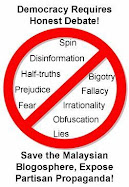
(Disclosure: I am a member of
Hartal MSM*, an advocacy group that calls for a Paper-free Tuesday -- "No buy, No lies")
- Journalism's first obligation is to the truth.
- Its first loyalty is to citizens.
- Its essence is a discipline of verification.
- Its practitioners must maintain an independence from those they cover.
- It must serve as an independent monitor of power.
- It must provide a forum for public criticism and compromise.
- It must strive to make the significant interesting and relevant.
- It must keep the news comprehensive and proportional.
- Its practitioners must be allowed to exercise their personal conscience.
From "The Elements of Journalism": What Newspeople Should Know and the Public Should Expect
When a news organization's editorial policy is dictated by its owners, the quality of its journalism is often the first thing to go out the window (followed closely by its credibility, reputation and circulation figures). The general level of integrity and professionalism in our news media notwithstanding, I have to say that
this "online exclusive" op-ed piece from the New Straits Times (22/7/09), entitled "
They got their Royal Commission of Inquiry but will they stop their lynching?", is as egregious a case of journalistic misconduct as I have ever come across. Lest I be accused of making that claim just because I disagree with the article in question, please allow me share with you my reasons for saying so:
1) The writer made a significant error of fact by claiming that the purpose of the Royal Commission of Inquiry was "
to probe the chary [sic]
death of Teoh Boon Hock [sic]".
This is untrue.
PM Datuk Seri Najib Tun Razak said (
bold emphasis mine): "
The Royal Commission will be set up according to specific terms, which is to scrutinise and study the procedures related to interrogations that are used by the MACC. It will also identify if there were any violations of human rights during Teoh’s interrogation."
The PM also made it clear that
Teoh Beng Hock's death would NOT be investigated by the RCI, but by an inquest. He thus rejected the most critical component of what
Teoh's family,
Pakatan Rakyat leaders and
civil society have been demanding all along.
Why is this error significant? Because the writer uses it to impugn the character and motives of Pakatan Rakyat and its leaders throughout the article, beginning with the headline itself. A major thrust of the article is to show that even when their demands have been met, PR leaders (ostensibly for selfish political reasons), will continue to criticize the RCI. Without this "misinterpretation" of the facts, his thesis cannot stand.
The full import of the PM's statement should have been quite obvious to the writer. He has misrepresented
Pakatan Rakyat's position, and as of 1650 hrs on 24/7/09, this remains uncorrected.
2) The writer used at least two of the 38 dishonest tricks commonly used in argument, specifically:
a) he used
emotionally loaded words, selectively. Against Pakatan Rakyat leaders, followers and their actions, he had this to say, without any supporting evidence (my emphasis in bold):
b) he
attributed prejudices or dishonourable motives to his "opponents", again without offering any evidence in support:
"They were almost certain of getting a favourable Cabinet response but the hyperboles and sly pre-emption that senior Pakatan leaders discharged seemed to have given the appearance that the goading provoked the Cabinet into agreeing to the RCI."
"But let’s not be surprised that Pakatan would claim credit for their RCI ingenuity."
"Pakatan leaders’ pressing for a RCI had a disingenuous purpose:... Pakatan people will be nudged aside from the glare of suspicion..."
"Now anticipate the howls of protest, even if it makes sense to expand the scope of the RCI’s inquiry to include all possibilities."
"Kit will find other specious means to further pile the burden of attestation on Najib to prove that the RCI is “absolutely independent” and will do their job fearlessly."
"Pakatan Rakyat minions will insist no less than a guilty verdict, that some MACC perp pushed Teoh Beng Hock out of the 14th floor to his death for no reason other than wanting to torture the young man.
3) To further his attack on his "opponents", the writer has subverted the meaning of words, obscuring the truth. For example, he describes
Tunku Abdul Aziz Ibrahim, a former vice-chairman of Transparency International’s Board of Directors no less, as a "
sycophant", i.e. "a servile self-seeker who attempts to win favour by flattering influential people". To be sure,
Tunku Aziz is a member of the DAP, but has the writer any evidence to show that Tunku Aziz has ever attempted to win favour by flattering influential people in DAP, Pakatan or anywhere else? If the favour of "influential people" is what Tunku Aziz sought, would the DAP have been the right party for him to join? One would have thought that there might have been much more "favourable" opportunities elsewhere, say, working for certain news media organisations.
One more example: the writer characterised
Pakatan Rakyat's response to Teoh's death as a "lynching, Malaysian-style". To "
lynch" is
to punish violently or to execute, without due process, for real or alleged crimes.
Another definition is "to
punish (a person) without legal process or authority, especially by hanging, for a perceived offense or
as an act of bigotry." It is a crime punishable by law in Malaysia, and it is what the writer accuses Pakatan Rakyat of doing to the MACC. Can he show how, and by what stretch of the imagination, can Pakatan Rakyat's actions thus far be construed as a lynching?
The irony is that the exact opposite may be argued, without any need for verbal obfuscation. Teoh Beng Hock was either a witness or a suspect in an alleged crime, and was,
prima facie, in the custody of the
MACC. If the reports of
Halimi Kamaruzzaman's,
Tan Boon Hwa's and
Dariff Din's experience of the MACC's interrogation methods are reliable, then there is probable cause to suspect that Teoh too, may have been the victim of high handed interrogation tactics. Did Teoh's interrogators limit themselves to asking questions? Was psychological or physical violence used on him? Is it true that during his
10 hour interrogation, "officers dragged him to a window on the 14-story building and threatened to throw him out," as
the Phillipine Daily Enquirer's website, quoting anonymous, "well-placed sources and officials close to the MACC", reports?
Considering the state of law enforcement and criminal investigation in Malaysia, with our history of suspicious deaths in custody, routine denial of access to counsel, allegations of politically motivated selective prosecution, the lack of real transparency and accountability, and our government's apparent inability to institute reforms (such as the
IPCMC), isn't it reasonable for Malaysians to be asking those questions? All this, plus the
inescapable fact that whatever was done to Teoh was done in OUR NAME, makes it a moral imperative that we actively work to uncover the circumstances surrounding his death. Asking our public servants tough questions, exploring the possibility that they have behaved criminally, and being very skeptical about the answers they give us, is not lynching, it is
demanding that they be accountable to us.
By turning the very meaning of this word on its head, this "journalist" from the NST has insulted the memory of all who have suffered
lynching at the hands of the powerful. He has made a mockery of the idea that our government and law enforcement authorities are accountable to the Rakyat; he seems to have chosen to
serve power, rather than be an
independent monitor of it.
With Malaysia at the crossroads in the aftermath of 8/3/08,
advocacy journalism has become a "weapon" in the political "war" to determine which path our country takes. It is a genre of journalism that intentionally (and transparently) adopts a non-objective viewpoint, usually for a social or political purpose. It is certainly not new, and it is not disreputable
per se;
The Economist is an example of a publication that practices it quite well.
However, while advocacy journalists may justifiably eschew their newsroom colleagues' credo of
objectivity (i.e. being neutral and not taking sides in their reporting), this does not absolve them of all standards of ethical journalism. Here is the bare minimum that they have to meet (adapted from
here and
here):
1) They must acknowledge and declare their editorial position and bias up front. Doing so will inform readers as to where the writer is coming from and allows them to employ their critical faculties accordingly. Working to promote a particular point of view without disclosing one's true stance is shilling.
2) They must be truthful, accurate, credible and ensure that every statement they make is factual and based on evidence from neutral sources. In other words don't spread propaganda, don't take quotes or facts out of context, "don't fabricate or falsify", and "don't judge or suppress vital facts or present half-truths". Requiring that media outlets refrain from spreading untruths and falsehood is not too much to ask for, is it?
3) Even if they do not provide equal time for their opponents' views, they must at least understand & address their opponents' relevant points & criticism - they must never ignore, trivialize or distort them. They must be fair and thorough.
4) They must use honest arguments & never resort to the crooked thinking and dishonest tricks commonly used in arguments. Avoid slogans, ranting, and polemics. Instead, "articulate complex issues clearly and carefully."
5) They must not allow their bias to turn into rose coloured glasses, or worse, a blind spot. They must not spare their own cause the tough, critical questions and scrutiny.
Without adhering to these most basic of standards, the resulting media "product" will be nothing more than propaganda, and bad one at that.
Had it come from a political party's media mouthpiece, the article might have been just bearable. After all, political propagandists and shills may rightly claim that they are not bound by any ethics, and are not obliged (or interested) to help citizens seek the truth. They may thus abandon even the pretence of reasoned discourse and honest logic, and to please their masters, may be as chauvinistic and as partisan as they please.
However, coming from the New Straits Times, the news outlet that is
Malaysia's oldest newspaper still in print, one which
claims that "
Our goal is to be the preeminent provider of news, information and entertainment and to achieve total customer satisfaction through our professional and highly regarded workforce that values quality, integrity, innovativeness and personal service", it is nothing short of an abject disgrace.
It stands to reason that the NST's lofty goal will remain out of its reach so long as its journalists (and editors) choose to behave like members of the oldest profession, and not as members of an honourable one. Unfortunately, it also stands to reason that they will keep on plying their trade quite profitably, so long as we Malaysians keep availing ourselves of their services.
Sincerely,
Malaysian Heart
* Hartal MSM is a mediawatch group which had its
beginnings in December 2007 in the
People's Parliament, an initiative convened by civil rights lawyer Haris Ibrahim. The group seeks to promote a free and fair media as an impetus to Malaysia's stalled nation-building process.