Showing posts with label News. Show all posts

Sunday, September 27, 2009

Justice for Kugan petition to DYMM YDP Agong 26/09/09 - what I observed

This is what I observed at the peaceful assembly in front of the Istana Negara on 26 September 2009, which was called by Hindraf and the Human Rights Party Malaysia to deliver a petition to the the DYMM Yang Di-Pertuan Agong. The petition, which you can download and read here, pleads to the YDP Agong for justice for Kugan and his family. Eight months after his death in police custody, the killer/s of A. Kugan, have yet to be arrested and brought to justice.

I tried to get to the Istana Negara at about 10.30 a.m., but there was a police roadblock where Jalan Dewan Bahasa joins Jalan Istana, and the police were not allowing any cars to get past. I made some calls and found out that the petitioners were meeting at Naga's Restaurant in Brickfields, which is where I headed to.

Members of Kugan's family were already there, including Madam Indra (his mother), sister, brothers and uncle. With them were a small group of Hindraf and MHRP folks; MP for Kapar YB S Manikavasagam, MP for Puchong YB Gobind Singh Deo, and ADUN for Kota Shah Alam YB M. Manoharan were also there. Soon, Human Rights Party Malaysia pro-tem secretary-general P. Uthayakumar and Hindraf coordinator Mr. Jayathas arrived, and the group organised themselves for the trip to the istana.

Some of Kugan's family members waiting for transport to the Istana

I hitched a ride in one of the cars carrying some of Kugan's relatives. We set of towards the Istana, but somehow got separated from the lead cars. We parked before the roadblock at Jln Dewan Bahasa, and began walking towards the Istana proper.

Members of the police manning the roadblock blocked our way and told us that we could not pass.

The police stop us from proceeding

We told them that we were going to deliver a petition to the Istana, and that Kugan's relatives were with us. The policeman asked us to wait while he radioed his superiors for permission. He took an inordinate amount of time doing this.

Asking for instructions, or delaying tactics?

After about ten minutes of waiting with no indication of any permission forthcoming, our group decided not to wait there any longer, but to get back into our cars and try another route. By 11.30 we were walking towards the group of petitioners in front of the Istana.

The petitioners outside the Istana, outnumbered by the police, reporters and cameramen. By what stretch of the imagination could they have been considered a threat to public security?

As I approached this group at 11.33 a.m., a policeman was already ordering the crowd to disperse. This is what I managed to record:


Thus the people's attempt to express their plea for justice to their King was foiled by the police. The people there made their way back, and as you can see in the video above, their frustration and disappointment was evident.

The petitioners leaving the Istana area


The leaders of the petitioners had a quick discussion, and decided to hold a press conference back at Naga's Restaurant.
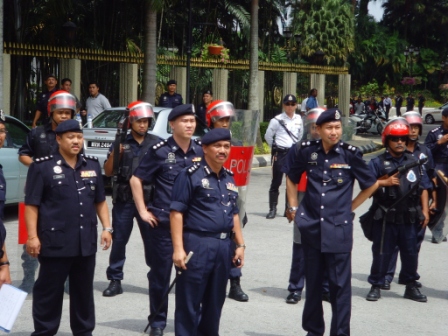

These are the people who prevented the rakyat from presenting their petition to DYMM YDP Agong. They are supposed to protect and serve the rakyat, but whose interests are they protecting now? Whose orders were they following?


Kugan's mother and other family members waiting by the roadside of Jalan Istana, having been chased away from the Istana area itself. Don't they have a right to plead for justice from their King, when the Malaysian AG and police have denied them justice for eight months? Why must they be treated so?

We got back into our cars and headed back to Naga's, where the impromptu press conference was held. Here are some video clips from it (apologies for the poor audio quality):


YB Gobind Singh Deo


YB M. Manoharan


Mr. Uthayakumar, YB Manickavasagam, YB Manoharan and lawyer Mr. N. Surendran


Madam Indra, with YB Manoharan translating for her. Kugan's mother still grieves.


YB Gobind Singh Deo again pt. 1


Pt. 2


Pt. 3

During the press conference, there were three gentlemen who were hanging about the restaurant, with a video camera. here they are, numbered accordingly:


I cannot verify this, but I was told that they were special branch officers. Here is another shot of them:


Here is number 3 recording the press conference from up close:


According to this Bernama report of the event:
Brickfields police chief ACP Wan Abdul Bari Wan Abdul Khalid said police managed to disperse the gathering without any untoward incidents.

"No arrests were made. Police were on duty in front of Istana Negara to prevent incidents as the group comprised Hindraf members and politicians.

"The public should respect the residence of the Yang di-Pertuan Agong and the laws of the country," he said when contacted today.
Reading his statement, and having seen the events unfold for myself, these are the questions and thoughts that come to my mind:

1) What "untoward incident" was he expecting? Was he afraid that Kugan's mother was going to assault him with a deadly petition?

2) Why are Hindraf members and politicians singled out for "special treatment", when the cow head protestors get a free pass? Blatant double standards at work!

3) What did any of the petitioners do there, which can be construed as disrespecting the YDP Agong or his residence? Palace officials had already been informed and were prepared to accept the memorandum. Isn't DYMM YDP Agong the King for all Malaysians, including for Kugan and his family? Wasn't His Majesty's palace built and maintained with their blood, sweat and tears as well? What laws did they break? Why is the Brickfields police chief slandering them?

4) Why aren't Malaysians allowed to exercise their right to assemble peacefully? Were these folks in any way or form a threat to public safety and security? If peaceful assemblies like these are broken up by the police, how else are Malaysians going to express their views and feelings? IMHO, all the while our 1Malaysia government is embarking on a "feel-good" PR campaign, they are severely eroding our rights to assemble peacefully, amongst many others. We need work urgently to re-establish our rights, before we lose them altogether.

5) Why was it that the people who showed up in support of the petition were virtually all Indians? In the past (for example during Kugan's funeral), there was heartwarming and encouraging support from all communities; we must never let such cooperation and understanding die away. Kugan's case, just like Adi Anwar Mansor's and Teoh Beng Hock's, is a serious issue for all Malaysians. If we only fight for justice when our own race is involved, then Umno/BN will win, because we cannot defeat them by ourselves. Civil society and progressive groups must work together to find common ground and strive for change with a united voice. This will require high quality, principled leaders. United we stand; divided, we'll all die with Umno/BN in power for the next 52 years. Please people, we must break down the racial walls that Umno/BN have built between us!

6) We must ensure that the IPCMC is formed. IMHO, the police have become an instrument for the oppression of Malaysian's political expression and aspirations. If we are to have any hope of change in Malaysia, we must reform the police into an organisation that serves the rakyat, and not the political purposes of the party which happens to be in government.


The pain and anguish that our mothers bear for us, transcends time, language, race, and religion. Paradise lies beneath their feet, but all we give them in return is suffering. When our time comes, will God have mercy on us?

Sincerely,
Malaysian Heart

Please read more reports of the event here, here, here and here.

Monday, September 7, 2009

Y.B. Sivarasa on DSAI's prosecution - videos from Media Rakyat

Dear Readers,

This is a must see from the folks at Media Rakyat!

Sivarasa Rasiah: You The Rakyat Be The Jury (Pt 1)

Sivarasa Rasiah: You The Rakyat Be The Jury (Pt 2)

Sivarasa Rasiah: You The Rakyat Be The Jury (Pt 3)

These videos (and lots more like them) are available at Media Rakyat. In their own words:
The Universal Declaration of Human Rights indicates: “Everyone has the right to freedom of opinion and expression; this right includes freedom to hold opinions without interference, and impart information and ideas through any media regardless of frontiers”

Mediarakyat is dedicated to improve the freedom of information in Malaysia.

At Mediarakyat, you will find plenty of informative & interesting video clips concerning current events & speeches that the mainstream newspapers & TV stations may not be able to cover or reluctant to cover.

Please consider supporting them so that they may bring us the news and views that BN does not want us to know about.

Sincerely,
Malaysian Heart

Friday, September 4, 2009

What possessed the protesters? - Article by Jacqueline Ann Surin from the Nut Graph

Dear Readers,

This is part of an excellent article by Jacqueline Ann Surin, who is the Editor of The Nut Graph, which was published there today:

What possessed the protesters?

4 Sep 09 : 8.00AM

By Jacqueline Ann Surin
jacquelinesurin@thenutgraph.com

WHAT possessed them? That's the question I'd like to ask the protesters who desecrated a cow head on 28 Aug 2009 after Friday prayers to object the building of a Hindu temple in Section 23, Shah Alam.

We know that it's not Islam that teaches intolerance of and disrespect toward other religious beliefs, nor is it Islam that preaches violence or force if Muslims don't get their way. We also know that it is really not Malaysian or Malay custom at all to be so obnoxious, threatening and crude. For all my life as a Malaysian, I have known Malay customs to be gentle, sophisticated and inclusive. This is most likely because the "Malay" race was actually historically constructed; its customs weaved from a convergence of different continents and cultures.

So, if neither Islam nor Malay custom drove the 50 protesters to publicly despoil a sacred Hindu creature and to threaten bloodshed because of a Hindu temple, what was it?

Possessed by superiority

My hunch is that these protesters were emboldened by a culture of Malay Muslim superiority that has been carefully cultivated and strategically stoked by the Umno-led government, Malay Muslim politicians from Umno, PAS and Parti Keadilan Rakyat (PKR), and by the judiciary both civil and syariah.

Please read the entire article here: http://thenutgraph.com/what-possessed-the-protesters

If you like the quality of journalism practiced by The Nut Graph, please consider supporting them. Their investors cannot continue funding them, and they will have to close down if they cannot find adequate support.

As far as I know, the Nut Graph is the only Malaysian news organisation to have published a statement of their journalistic principles, that you can hold them to. If we do not support good journalism when we have it, then we have only ourselves to blame when we are left with the likes of Azmi Anshar and the mainstream media telling us what to think.

Sincerely,

Malaysian Heart

Monday, August 24, 2009

Spinning the news for Permatang Pasir: how to read partisan blogs (and news) 2


Spin is defined as interpreting an event in a particular way so as to manipulate public opinion for or against a certain organization or public figure. It is a form of propaganda, albeit a subtle one; while some propaganda uses outright lies, spin uses half truths and concealment.

The techniques of spin include:

  • Selectively presenting facts and quotes that support one's position (cherry picking)
  • Non-denial denial
  • Phrasing in a way that assumes unproven truths
  • Euphemisms to disguise or promote one's agenda
  • "Burying bad news": announcing one popular thing at the same time as several unpopular things, hoping that the media [or readers] will focus on the popular one.
Whatever its differences in method, its desired end result is the same as for propaganda:
A propagandist, in the strict sense, is not interested in the truth for its own sake, or in spreading it. His purpose is differ­ent. He wants a certain kind of action from us. He doesn't want people to think for themselves. He seeks to mold their minds so that they will think as he wants them to think, and act as he wants them to act. He prefers that they should not think for them­selves. If the knowledge of certain facts will cast doubts in the minds of his hearers, he will conceal these facts.

From The Art of Making Sense: A Guide to Logical Thinking by Lionel Ruby
With the Permatang Pasir by-elections around the corner, allegations and counter-allegations regarding the two candidates' suitability for office have been traded. In the case of the BN candidate, former lawyer Rohaizat Othman, the allegations center around his disbarment for misappropriating funds belonging to his client, the Koperasi Pekebun Getah Pulau Pinang (KPGPP).

BN tried to undo the damage by claiming that it was Rohaizat's former law partner, Yusri Isahak, who was solely responsible for the wrongdoing, and that Rohaizat was merely the fall guy. On 20 August 2009, Yusri made a statement to the press where he held that the misappropriation of KPGPP's funds was done with Rohaizat's knowledge and involvement, in the form of loans to two of Rohaizat's acquaintances, and for the management of the firm's Ipoh office. You can read his statement in full here.

Yesterday, Yusri again gave a press statement in KL, which can be read in full here. What exactly did Yusri say in this second statement? As I see it, he seemed to be saying that (and please correct me if I am doing any "spinning" myself):
  1. He has not been paid to makling either of his two statements
  2. Both statements were made on his own initiative, and were not influenced by any party
  3. His first statement was made because he was angry and dissapointed at being made the scapegoat in the KPGPP case, and his only motivation was to defend his goodname and that of his family
  4. He stands by his earlier statement
  5. His earlier statement has been used to slander Rohaizat, which was not his intention
  6. Yusri is saddened by the personal attacks on Rohaizat
  7. Yusri wants to clarify his position and express his feelings on the matter
  8. Rohaizat is a good man, and kind hearted, has done a lot for Permatang Pasir
  9. Even though Rohaizat has made mistakes, he has made amends, and the cooperative has retracted their claim against him
Three questions to consider:
  1. Did Yusri retract his earlier statement?
  2. Did Yusri exonerate Rohaizat, clear his name, or in any way lessen his responsibility for the KPGPP case, as stated in his earlier accusation? (Let's bear in mind that to exonerate is not the same as to forgive or excuse)
  3. Did Yusri take more of the blame for the KPGPP case unto himself?
I believe that the answers to all three questions above is no. As I see it, Yusri's second statement expressed many noble sentiments, but it never detracted an iota from the gist of his first statement, in which Yusri stated that the misappropriation of KPGPP's funds was done with Rohaizat's knowledge and involvement.

Given the above, let's see how the mainstream media (MSM) have choosen to present the story, one day before the elections, in the following articles:

Utusan Malaysia, 23/8/09: Yusri tampil bela Rohaizat
The article does not mention points 4 and 9 from Yusri's statement (in bold above). It also reports Rohaizat's response to Yusri's statement, as (my emphasis in bold):

Sementara itu, calon Barisan Nasional (BN) Rohaizat Othman berterima kasih kepada bekas rakan kongsinya, Yusri Isahak kerana tampil memberi penjelasan terbaru hari ini berhubung isu pembatalan sijil peguam sivilnya.

Beliau yang ditemui ketika menyertai lawatan Menteri Dalam Negeri, Datuk Seri Hishammuddin Tun Hussein di Kampung Cross Street berkata, perkembangan itu membuktikan fakta sebenar isu yang digembar-gemburkan oleh Pas.

Utusan's article has spun the news for BN using two techniques: first, it has cherry picked the points which may be taken as support for Rohaizat to report, and neglected to mention the ones which suggest that Yusri still believes that Rohaizat is partly responsible for the misappropriation. Second, Utusan has allowed Rohaizat's response, which is phrased in a way that suggests and implies (wrongly) that Yusri has exonerated him, to run without verification, analysis or challenge.

The Star, 24/8/09: Rohaizat vows to bring development
The Star did not devote a full article to Yusri's second statement, but included this in the article above:
At night, Rohaizat thanked his former partner Yusri Isahak for clearing his name.

“I am very happy now that now that Yusri had cleared the air over the allegations. I saw his interview over the television.”
Unlike Utusan, who merely suggested and implied untruth, the Star has printed it outright without qualification!

The New Straits Times, 24/8/09: 'I was in charge of account'
Unlike Utusan, the NST did not start of its article by focusing on Yusri's respect and admiration for Rohaizat. It instead focused on reporting that Yusri was in charge of the KPGPP account (not the bank account, but the case). I believe that since Yusri had (in his first press statement) stated that both he and Rohaizat were co-signatories to the bank accounts, its regrettable that the journalist or editor didn't take the extra care to make that difference clear, i.e. that Yusri was not now admitting to being the sole signatory for the bank account. A quick reading of the headline and the first few 'graphs may lead one to believe that a very significant truth had been unearthed by the reporter, that represented a "twist" in the story. In actuality, the fact that Yusri was the lead lawyer in charge with dealing with KPGPP did not in any way negate or diminish in any way his earlier assertion that Rohaizat was just as involved in misappropriating the funds.

Berita Harian, 24/8/09: Bekas rakan kongsi kecewa kenyataan disalahgunakan
BH, in my opinion, does the least spinning of the four MSM newspapers. Part of what it wrote is this:
Sementara itu, Yusri mengakui fail pembelian hartanah oleh KPGNPP pada 2002 di bawah tanggungjawabnya dan beliau yang menyiapkan perjanjian berkenaan serta memanggil penjual dan pembeli terbabit untuk menandatanganinya.

“Tandatangan saya pada perjanjian itu hanyalah sebagai menandakan bahawa saya sudah menyaksikan penjual dan pembeli menandatangani perjanjian berkenaan,” katanya.

Walaupun mengakui fail pembelian hartanah oleh KPGNPP adalah di bawah tanggungjawabnya, Yusri berkata, fail berkenaan pada bila-bila masa boleh diambil alih oleh rakan kongsi lain seperti ketika beliau bercuti.

Sambil menegaskan pelanggan terbabit adalah pelanggan firma guaman dan bukan pelanggan seseorang rakan kongsi secara khusus, beliau bagaimanapun berkata, adalah tidak tepat untuk menyatakan bahawa Rohaizat tidak mengetahui atau tidak terbabit langsung.

Namun, ketika ditanya sama ada Rohaizat bersalah atau pun hanya menjadi mangsa keadaan, katanya, beliau bukan dalam kedudukan untuk menyatakan perkara itu, sebaliknya pihak yang lebih tepat adalah mahkamah dan Majlis Peguam.
Notice the use of the word mengakui (admits or confesses), thereby implying that Yusri is owning up to something that implicates him (and exonerates Rohaizat). Is this the case? Reading of the next three paragraphs shows it not to be so. Unfortunately, they have left this part to the last three paragraphs of the article!

In none of the four MSM reports above, was the fact that Yusri stood by his earlier statement, and maintained that Rohaizat was at least partly responsible, mentioned. The headlines, the quotes that were selected, the language used all give the impression that Yusri had made a u-turn in his position. The BN owned MSM have used cherry picking of facts, euphemism (in this case dyphemism), and implied assumptions to create an article favourable to BN's interests in the Permatang Pasir by-elections tomorrow.

As for the pro-BN blogs, this is what some of them said:
Shamsul Yunos (the journalist covering the Permatang Pasir elections for the Malay Mail) : ZAMBRI-NIZAR!! Yusri makes a U-turn?
Rocky (Editor-in-Chief of the Malay Mail), linking to Shamsul Yunos "U-turn": Ah, Yusri, both sides now?
A Voice: Yusri rasa bersalah dan 'akui' diguna PR burukkan Rohaizat
Parpukari: NIZAR KKK! YUSRI BUAT U TURN LAH WEI!
Pisau: N11 Permatang Pasir: Rohaizad Tidak Bersalah:Yusri
The Unspinners: KABOOM 2! Yusri ngaku urus akaun Koperasi dan diguna PAS untuk serangan peribadi

For comparison, read these reports from:
Malaysiakini: My intention was to clear my name, says Yusri
Malaysian Insider: Rohaizat’s ex-law partner says he gained nothing in revealing all

How shall we hold the mainstream media to account for spinning the news?

Sincerely,
Malaysian Heart

Saturday, August 22, 2009

Words fail me


DPM slams Pakatan for ‘smear tactics’ before Ramadan
...[D]eputy prime minister Tan Sri Muyhiddin Yassin today slammed the opposition for its campaign to “smear” Barisan Nasional, saying he was surprised they would do it with the Muslim fasting month just around the corner.

“Maybe this is why they’re stepping up (character assassinations), because it is almost the fasting month so they are taking advantage of this period now before they cannot say anything,” he told a press conference after witnessing the unveiling of SME Corp Malaysia’s new logo.

“I am surprised that even though it’s almost the fasting month, they are still holding campaigns to smear and defame (Barisan Nasional).”

The Malaysian Insider, 21 August 2009

Rocky, "PAS candidate and missing funds in Permatang Pasir":
...there's now talk about his opponent from PAS and a missing RM600,000 in election funds. The post Calon Pas N11 gelapkan RM60,000? belongs to pro-Umno blogger Zakhir Mohamad but the accusations against Mohd Salleh Man were made by his seniors in PAS, or so we're made to believe...

Rocky's Bru, 20 August 2009

Big Dog, "Calon PAS N11 gelapkan wang parti RM 600,000?":
...Namun begitu, ujud beberapa isu yang menjadi begitu kontroversi bagi calon dan ketua PAS Pulau Pinang ini. Semasa Pilihanraya Kecil Parlimen Permatang Pauh setahun lepas, pemimpin PAS Pulau Pinang sendiri dikhabarkan telah membangkitkan bahawa peruntukan untuk jentera pilihanraya PAS sebanyak RM 600,000.00 oleh digelapkan calon ini, yang ketika itu sebagai penyelaras gerak kerja PAS Pulau Pinang. Dikhabarkan dakwaan serious ini dibuat sendiri oleh Naib Pesuruhjaya PAS Pulau Pinang Mujahid Yusof Rawa dan Mantan Ketua Penerangan PAS Pulau Pinang Zulkifli Lazim.

Selain pada itu, Salleh juga merupakan mudhir kepada Sekolah Agama Pintar tajaan PAS. Beliau juga dituduh mengunakan sebahagian dari peruntukan bagi menguruskan sekolah tersebut bagi mengukuhkan kewangan syarikat persendirian beliau, kemungkinan bagi tujuan perniagaan...

...Pembetulan keatas laporan asal. Wang peruntukan yang dikhabarkan telah digelapkan bagi Pilihanraya Kecil Parlimen Permatang Pauh Ogos tahun lepas berjumlah RM 60,000.00 sahaja.


The “thirteen million plus Ringgit” guy rambles…., 20 August 2009

Revert, "Nik Aziz Nik Mat - Tok Dalang Wayang Kulit":
Mengharapkan Nik Aziz bin Nik Mat berubah adalah seperti mengharapkan kucing bertanduk. Mengapa perlu kita terkejut mengenai kenyataan2 Nik Aziz kebelakangan ini. Sememangnya, dia seorang kafir dan kafir murakkab sememangnya jahil tentang Islam. Apa yang hendak dihairankan sangat, bukankah partai yang dipimpinya itu

a. menghalalkan penjualan arak dalam kalangan orang Melayu Islam

b. bersekongkol dengan kafir DAP yang jelas menentang perlaksanaan Syariah apatah lagi juzuk kecil macam hukum ta'azir

c. menentang penyatuan Ummah dalam kalangan mereka yang mengucapkan kalimah 2 syahadah

d. membenarkan kafir mepersendakan agama Islam atas dasar jahil.

e. membiarkan Muslim Melayu dibelenggu kemiskinan.


Revert, 17 August 2009

Pisau, "N11 Permatang Pasir: Saleh Man Kaki Perempuan":
Alahai bang Salleh,rupanya ketayap dan jubah hanya pakaian duniawi yang kamu pamerkan,tetapi akhlak mu cukup busuk.

Pisau nak ceritakan kepada pembaca semua, Calon PAS Permatang Pasir Salleh Man ni rupanya kaki perempuan,pantang tengok anak dara atau bini orang berdahi licin. Nak di kabarkan Salleh Man ni kaki ngorat bini orang(pengusaha kedai rambut)di Permatang Pasir, perempuan ni berketurunan Islam Vietnam,cun melececun beb.

Salleh man suruh perempuan ni tinggalkan suami tua dia dan kawin dengan salleh man,nasib baik suami perempuan tu dapat tahu awal dan bagi amaran kepada Salleh Man .

Kalau tidak manusia yang orang PAS angkat jadi pesurujaya PAS ni akan meruntuhkan masjid.

Macam tu ka nak jadi wakil rakyat,pantang tengok perempuan lawa kira nak balun jer.

sedar sedar la sama hoii salleh man,orang kampung dan permatang pasir dok heboh dengan perangai hang ni,

lepas ni kita baca pulak cerita Mahfpus gila ..


Pisau kata " Bang Salleh kalau jadi wakil rakyat comfirm pasang 4,ramai muslimah pas sedia jadi bini dia"


Pisau.net, 21 August 2009

SuaraDemokrasi-Malaysia, "GEMPAR : Calon PAS Alami Krisis Keyakinan Keterlaluan & TIDAK MESRA RAKYAT !":
SALAM,... :)

Ini antara respons baru yang diterima dari kebanyakkan penduduk di sekitar DUN Permatang Pasir,…orang-orang kampung telah memperkatakan yang Salleh Man mengalami krisis keyakinan yang terlalu ketara yang mana sehinggakan ketar dan tidak berani untuk memberi ‘public speech’ di khalayak ramai,…

Beliau juga gagap dan terpaksa berpandukan skrip ketika berucap di hadapan para penyokong! Itu baru penyokong sendiri,…belum berhadapan dengan rakyat jelata yang berbilang kaum dan pemimpin-pemimpin DAP lain di Penang yang kuat maki!
Anda semua boleh lihat sendiri bagaimana yang dimaksudkan tentang “MENGALAMI KRISIS KEYAKINAN” melalui video di bawah ini,..


SuaraDemokrasi-Malaysia, 21 August 2009

Parpukari, "NIZAR BALACI DAP! PAKATAN HARAM SEMAKIN RETAK?":


House PK, 22 August 2009

Gerakan Graduan Melayu Muda, "Mari terajang pungkok Anwar Ibrahim (pasang speaker sekuat mungkin utk effect terbaik)":


Gerakan Graduan Melayu Muda, 17 August 2009

Cucu Tok Selampit, "Apa beza TG Nik Aziz Nik Mat Dengan Ayah Pin?":


Sekiranya beginilah mentaliti pengikut-pengikut fanatik Pas kepada TG Nik Aziz, semoga Allah melindungi kita semua. Apakah perbezaan di antara Ayah Pin dan TG Nik Aziz. Siapalah yang akan menanggung dosa pengikut Pas di atas yang telah mensyirikkan Allah. Nauzubillah hi minzalik.

Cucu Tok Selampit
, 20 August 2009

Thursday, August 20, 2009

How to read partisan blogs 1: Shamsul Yunos and his "anger" towards lawyers


Definition of partisan adj.-
  • From The American Heritage Dictionary of the English Language, Fourth Edition: devoted to or biased in support of a party, group, or cause
  • From the Collins Essential English Dictionary, 2nd Edition 2006: prejudiced or one-sided
Dear Reader,

Of late, I have been writing quite a bit (most recently here) about why I believe that our Malaysian blogosphere has become extremely partisan, and increasingly bereft of honest argument and reasoned debate. When I surf Malaysian blogs and online news, I often get an uneasy feeling that there is something very wrong with the ideas being "sold". Unfortunately, it's not always easy for me to put my finger on what's wrong (and no, it's not the tapai pulut I had this morning). I realise that I need to be better at thinking critically; therefore, I am starting a series of postings in which I shall attempt to analyse and describe the biased, prejudiced and one-sided arguments that I find in our Malaysian blogosphere. Will you to join me in this endeavour?

Let's be very clear on one thing - there is absolutely nothing wrong with a blogger or writer having strong political beliefs and affiliations, or with expressing them vigorously and with passion. However, as I have stated before, we have a responsibility to argue our cases justly and honestly; if not to our readers, then at least for the sake of our own conscience. Democracy needs a forum for honest discussion and open debate on issues of National interest; telling one's side of the story is fine, but pretending to tell both sides while misrepresenting the other is dishonest.

For this first installment, I'd like to analyse a post by Shamsul Yunos, who blogs at "My Anger, it May Be Yours Too". In his recent entry, "Did you know lawyers are special?", he criticises the Malaysian Bar Council for saying that lawyers should not be arrested while on duty. This statement was made by Bar Council president Ragunath Kesavan on 16 August 2009, during the public inquiry by Suhakam into the arrest and detention of five lawyers of the Kuala Lumpur Legal Aid Centre at the Brickfields Police Station on 7 May 2009. The lawyers were arrested when they tried to see their clients, who were among 14 arrested that day for taking part in a candlelight vigil (for arrested political scientist and activist Wong Chin Huat), outside said police station. The Bar Council's description of what transpired that day is available here, and you can read the five arrested lawyers' own accounts here, here, here, here and here. The only statement from the police (regarding anything related to the arrests) that I could find was in this video.

Let's get a few facts straight first:
  • Even if the 14 arrested individuals had commited a crime by holding the vigil, they had the right of access to a legal practitioner of their choice, as per Section 28A (4) of the Criminal Procedure Code (CPC) and Article 5 of the Federal Constitution. Granted, that Section 28A (8) of the CPC allows the police to refuse lawyers access to their clients, but it should be invoked only in extraordinary circumstances; such as when the delay in questioning the suspect may cause the occurrence of another crime or cause danger to others, e.g. when the client may pass harmful information to an outsider via the lawyer, or hide evidence, such as in kidnap cases. When the police were asked for the grounds on which they were invoking that clause, they were unable to provide an answer. To date, there has been no explanation from the police whatsoever as to why they invoked Section 28A (8) of the CPC.
  • The lawyers arrested were trying to provide their clients with legal counsel in their professional capacity as members of the Bar Council's Legal Aid Centre; they were not part of the candlelight vigil. Although lawyers do take part in protests, they know how to separate their professional duties from their activism. They were in no shape or form a threat to public order or safety, or obstructing justice, which could have justified their arrest that night. In applying to see their clients in the police station that night, they were merely fulfilling their obligations as advocates and solicitors.
  • The Bar Council did not call for blanket immunity for lawyers while on duty. They are neither seeking nor expecting preferential treatment nor exemptions from the law. They seek instead to uphold the fundamental right of lawyers to have access to their clients, a right which was arbitrarily denied by the police when they refused to let the lawyers see their clients, and arrested them instead.
  • The role of the police in a democratic country, is to enforce the law and ensure public safety and order. To enable our police to fulfil their responsibilities, they are delegated wide discretionary powers, e.g. to deny permission to assemble and to issue orders to disperse. However, they must never forget that the raison d'etre of law enforcement is to uphold our human rights (including the right to assemble peacefully), not to deny them arbitrarily or for political reasons. They must also never forget that they are public servants, and that they are accountable for their actions and decisions.
So, given the above, how did Shamsul Yunos choose to comment on the Bar Council's statement? If you have read his entire post, you would have seen how he has used negative connotations and outright slurs against lawyers throughout it. In a post 313 words long, he managed to:
  • Liken lawyers to "particularly odorous boogers" to be flicked out of a moving car onto gravel
  • Imply that they drink lots of alcohol
  • Accuse them of lying for a living
  • Imply that they are too cowardly to stand up for what they believe in
  • Characterise them being wealthy and stingy
  • Accuse them of speaking with "forked tongues", without thinking first
What Shamsul Yunos has done is to use the techniques of propaganda, namely:
  • Ad hominem arguments
  • Appeal to prejudice
  • Demonizing the enemy
  • Name-calling
  • Stereotyping
Techniques like these work to stir up negative feelings and attitudes (e.g. disgust) towards the targets (in this case lawyers), by appealing to the emotional and irrational side of our nature. They make the other parts of his case easier to accept.

Let's look at Shamsul's more "substantive" arguments. The first thing to note, is that he has (intentionally or not) neglected to quote from, refer to or even provide links to Ragunath's statements as reported in the news. Neither has he mentioned the context in which the statement was made, namely the arbitrary denial of a fundamental human right, the arrests of the five lawyers, and Suhakam's public inquiry into it. Why is this important? When he first refers to the statement by BC president, he follows it with "What the F does that mean?" Is he trying to imply that the Bar Council's position is unclear, unreasonable or difficult to understand? Would the Bar Council's position have been in any way unclear to anyone who had read their statements and was aware of the issues involved?

Next, he uses a "straw man" argument, i.e. by substituting a superficially similar (and weaker) proposition (the "straw man") for his oponents' real one, then refuting it, without ever having actually refuted their original position. Shamsul does this by first conceding that lawyers should not be arrested if they are not breaking any laws. Then he writes, "but I hardly think that anyone in this country should get time out just because they are on duty." The straw man that he is putting up here is that the Bar Council called for blanket immunity for all lawyers on duty, even if they break the law. A glance at this headline shows how grossly Shamsul has misrepresented the Bar Council's position, and again, he neglects to consider the human rights issues involved. Knowing the whole truth reveals Shamsul Yunos' argument for what it is.

Instead of honestly discussing the possibility that it's in the public interest that lawyers and their clients have certain rights and privileges, he goes on to use a rhetorical question to make light of the issue; he sarcastically suggests that the Bar Council asked for special treatment ("different laws" as he put it) because lawyers believe that they are superior to others.

So, what are we to make of the post in question? Should we dismiss it as the prejudiced pronouncements of a partisan propagandist? Well, Shamsul Yunos does not want us to think so; as he maintains (in response to a reader's comment to a different post) here, "I put forth both sides of the story". Yeah, right!

One thing that disturbs me very much, is that in between the put downs, slurs and hyperbole, Shamsul makes a sinister, chilling statement with dangerous implications for human rights, freedom and justice in Malaysia. He writes: "If lawyers think arrest is a risk they do not want to face, then do not accompany people who the police may want to arrest. hey a champion must make scarifices, a warrior must be brave..."

Take a moment to consider exactly what he is saying. Is he implying that if lawyers work for or defend people whom the police (or the government) do not like or approve of, then they should be prepared to face arrest and persecution from the authorities?

As a result of our 12th general elections (GE-12), Malaysia is now at a crossroads, from where, for the first time in a long while, we have a choice of taking a path to a future that we want for ourselves & our children. Malaysians from all walks of life have been increasingly vocal in expressing our dissent against racism, bigotry, corruption, oppression, bad governance, tainted law enforcement and judiciary; both individually as well as via mass protests and demonstrations.

However, not everyone is happy that we have this choice, and there are those who would prefer that we return to the days before GE-12, and even further back, to Mahathirism. I believe that there are efforts being taken that, if we are not vigilant, will roll back the progress that we have made of late. These efforts include inhibiting democratic expression and eroding the foundations of our basic human rights, by various means. Our laws and legal system (such as it is), and our lawyers, are vital elements in the defense of our human rights and freedoms. Equal protection and access to justice would be just an empty slogan without the right to legal counsel. Are people like Shamsul Yunos part of an effort to reduce our legal community's effectiveness (and motivation) in standing up for human rights? I believe so.

So, who is Shamsul Yunos? The first entry on his blog dates back to 27 April 2008 (incidentally, 50 days after the GE-12). According to Rocky, who introduced Shamsul's blog here, and regularly refers to it in his own posts, Shamsul Yunos is a journalist. Googling for "Shamsul Yunos", I found (assuming that they are all one and the same person) that he writes for the Malay Mail. I also found that a Shamsul Yunos attended the Asia Media Summit 2008, held on 27 - 28 May 2008 in Kuala Lumpur. In this list of delegates, he is referred to as a Special Writer from the Ministry of Information, Malaysia. I do not know what exactly a "Special Writer" in the Ministry of Information is, but if it's possible to define one from what one writes, then perhaps we should compare how he has written about the Bar Council's position with this description:
A propagandist, in the strict sense, is not interested in the truth for its own sake, or in spreading it. His purpose is differ­ent. He wants a certain kind of action from us. He doesn't want people to think for themselves. He seeks to mold their minds so that they will think as he wants them to think, and act as he wants them to act. He prefers that they should not think for them­selves. If the knowledge of certain facts will cast doubts in the minds of his hearers, he will conceal these facts.

From The Art of Making Sense: A Guide to Logical Thinking by Lionel Ruby
What are the key lessons to draw from reading Shamsul Yunos' post? IMHO, they are:
  • Always look for the other side of the story and its context, from another source. Do not expect that Shamsul has provided it for us
  • Look for propaganda techniques designed to evoke an emotional and irrational response to the subject of the story
  • Look for dishonest arguments, e.g. the "straw man", and rhetorical questions used to divert attention away from real issues.
  • Always look for affiliations and links to organisations. Such affiliations are not evidence of propaganda per se, but are a useful guide for us to look for potential bias and vested interest
The next time you read Shamsul Yunos, or any other partisan blogger, do look out for these tricks. Better yet, blog about it and let others know too! According to Rocky, Shamsul will be contributing articles daily from Permatang Pasir for The Malay Mail. Will he be putting forth "both sides of the story" from there too? Do feel free to share you analyses of Shamsul Yunos' reports in the comments section.

Sincerely,
Malaysian Heart

Sunday, August 16, 2009

Why propaganda and bigotry must be exposed

In response to my previous post, You can never win with a bigot – my response to “OutSyed the Box: Is The DAP A Chauvinist Party?”, a reader who signed off as Paul Warren left the following comment at Hartal MSM:

You just wasted a some bytes writing a crtic on this guy SAA. He’s an idiot to have thought that his opnions mattered. Just as he was, I am pretty sure, unable to comment on acts against non-Muslims and places of worship as well as worship right here in Malaysia itself he seems so cncerned about behaviour elsewhere

ITs more important now for decent Malaysians to ignore these kinds of bigotted writings and racist incantations and move on to forge a better Malaysia for Malaysians.

This is the response I posted over at Hartal MSM, which I reproduce here FYI:

Thanks for your comment, Paul. Yes, it is tempting to brush aside SAA and other BN cyber-troopers as idiots. However, I can see some parallels between our situation in Malaysia today and Germany, during the rise of Nazism:
  1. Political leaders who have no qualms about demonising minorities in order to hold on to power (e.g. Nazi anti-semitism)
  2. Promotion (and acceptance) of racist and supremacist ideologies e.g. Aryan Supremacy and Lebensraum) as "OK" or necessary
  3. Media (mainstream and cybertroopers) becoming propagandists for their ideology
  4. The rise of organisations that threaten and intimidate other citizens with violence just to prevent them from exercising their rights (ala the brownshirts and SS)
The BN owned MSM and cybertroopers seem to be applying lessons from Nazi propaganda well; as Hitler wrote in chapter IV of Mein Kampf:

"Propaganda must always address itself to the broad masses of the people. (...) All propaganda must be presented in a popular form and must fix its intellectual level so as not to be above the heads of the least intellectual of those to whom it is directed. (...) The art of propaganda consists precisely in being able to awaken the imagination of the public through an appeal to their feelings, in finding the appropriate psychological form that will arrest the attention and appeal to the hearts of the national masses. The broad masses of the people are not made up of diplomats or professors of public jurisprudence nor simply of persons who are able to form reasoned judgment in given cases, but a vacillating crowd of human children who are constantly wavering between one idea and another. (...) The great majority of a nation is so feminine in its character and outlook that its thought and conduct are ruled by sentiment rather than by sober reasoning. This sentiment, however, is not complex, but simple and consistent. It is not highly differentiated, but has only the negative and positive notions of love and hatred, right and wrong, truth and falsehood."

As to the methods to be employed, he explained:

"Propaganda must not investigate the truth objectively and, in so far as it is favourable to the other side, present it according to the theoretical rules of justice; yet it must present only that aspect of the truth which is favourable to its own side. (...) The receptive powers of the masses are very restricted, and their understanding is feeble. On the other hand, they quickly forget. Such being the case, all effective propaganda must be confined to a few bare essentials and those must be expressed as far as possible in stereotyped formulas. These slogans should be persistently repeated until the very last individual has come to grasp the idea that has been put forward. (...) Every change that is made in the subject of a propagandist message must always emphasize the same conclusion. The leading slogan must of course be illustrated in many ways and from several angles, but in the end one must always return to the assertion of the same formula."

Do these similarities mean that Malaysia will inevitably become a fascist state? I don't think so, but we ignore these signs at our peril. Let's not forget that the Nazis were (also) viewed with disdain as harmless idiots, just before they were able to take Germany over.

I believe that the way to pre-empt this danger to Malaysia, is not by us becoming the mirror image of the BN cyber-trooper; using their tactics for our cause. Rather, we need to "change the game" by calmly, rationally and with goodwill towards all, engaging Malaysians from all walks of life, building social capital, exposing BN propaganda for what it is, and laying out our case for change.

"Vibrant Democracy Requires Eternal Vigilance"

mh

Monday, August 10, 2009

The Malaysian Insider: spinning and editorialising the news again?


(Screenshot from The Malaysian Insider)

Some time ago, I posted an entry on media spin by The Malaysian Insider. Well, they seem to have done it again. "Najib wants Selangor back in BN’s clutches" reads the headline of this story in MI today. It reports how Prime Minister Datuk Seri Najib Razak stated his wish that BN win back the state of Selangor, and how he believes they have a bright chance of doing so.

Using the word "clutches" in the headline casts a certain light over the entire article. Clutch means "a hand, claw, talon, or paw in the act of grasping", "a tight grasp", and "control or power". When used to mean "control or power", it is often used in the plural: as in "caught in the clutches of sin". It's interesting to note that in this sense it is almost never used to refer to something good or wholesome; one would rarely, if ever, say "the clutches of good" (a google search unearths all of 14 instances). It is, however, a word that is commonly used when the thing doing the clutching is not so benign (34,200 instances of "the clutches of evil" from google). It is an example of a word with pejorative connotations, one that is used to imply disapproval or contempt and is meant to be insulting, impolite, or unkind. Using such loaded language is, in turn, one of the dishonest tricks used in arguments. In this headline, the "target" being "attacked" is none other than the BN, and DS Najib himself.

As I have written about before, advocacy journalism certainly has its place amongst journalism's different genres. However, this article purports to report the news; news articles must report only the facts and must be free from spin and editorialising. Readers must be able to make up their own minds without having to contend with reporters and editors trying to push their own opinions down our throats. Journalists and editors already have every opportunity, without having to provide evidence, of opining, hinting, insinuating, alluding, implying, surmising, suggesting, exhorting, preaching and haranguing to their hearts content, on their respective editorial or op-ed pages; we readers know to read those pages with the appropriate critical incredulity. They must never co-opt news pages as their soap-box too.

This is the minimum that is required of any media organisation that claims to support civilised public discourse in a democracy; even advocacy journalists need to uphold certain minimum standards if they want to be regarded as anything other than mere shills and propagandists.

Was there any other way for The Malaysian Insider to introduce their article? What's wrong with a headline like "Najib wants BN to win Selangor back"? Less catchy and exciting? Less likely to attract "clicks"? Perhaps so, but in my opinion, at least it would have been honest, unbiased and worthy of a news article.

Sincerely,
Malaysian Heart

(I am a member of Hartal MSM, a mediawatch group which seeks to promote a free and fair media as an impetus to Malaysia's stalled nation-building process. The views expressed here are solely my own.)

Friday, August 7, 2009

Police Misconduct and the Mainstream Media's Response to it: Malaysia and India


An Indian police officer beats a demonstrator near an August 2008 procession in Jammu (© 2008 Reuters, taken from page 2 of photo feature accompanying HRW report).

Kuala Krai MP Dr Hatta Ramli's shirt gets ripped in a scuffle outside the National Mosque during the anti-ISA rally on 1/8/09 (taken from the Malaysian Insider).

Malaysian policeman during anti-PPSMI demonstration on 7/3/09 (taken from here).


Human Rights Watch, an international non-governmental organization that conducts research and advocacy on human rights, has released a report on the state of the Indian Police Service. The report, titled "Broken System: Dysfunction, Abuse and Impunity in the Indian Police, is based on interviews with more than 80 police officers of varying ranks, 60 victims of police abuses, and numerous discussions with experts and civil society activists. You can read the press release and download the report itself from this webpage.

While it makes compelling reading for anyone interested in human rights and justice, reading the report as a Malaysian is heartbreaking; in so many ways it describes the trouble with our own PDRM in Malaysia. Some 'highlights' from the report:

Practices
The Indian Police Service practices arbitrary arrest and detention, torture and extrajudicial killings. They break the laws they are supposed to protect, and believe that unlawful methods, including illegal detention and torture, are necessary tactics of crime investigation and law enforcement. Therefore, they use "short-cuts" and their old methods - abuse and threats, hold suspects illegally and coerce them to confess, frequently using torture and ill-treatment. Sound familiar?

Here is an example from the report, how a fruit vendor in Varanasi described how police tortured him to extract confessions to multiple, unrelated false charges: :
"[M]y hands and legs were tied; a wooden stick was passed through my legs. They started beating me badly on the legs with lathis (batons) and kicking me. They were saying, ‘You must name all the members of the 13-person gang.' They beat me until I was crying and shouting for help. When I was almost fainting, they stopped the beating. A constable said, ‘With this kind of a beating, a ghost would run away. Why won't you tell me what I want to know?' Then they turned me upside down... They poured water from a plastic jug into my mouth and nose, and I fainted."
Underlying Causes
The Indian Police Service, hence it's ethos, laws and regulations originated from the Imperial Police, the colonial-era police force whose primary objective was to help the British control and oppress the population with impunity, not protect their human rights. As the report states "[t]he institutional culture of police practically discourages officers from acting otherwise, failing to give them the resources, training, ethical environment and encouragement to develop professional police tactics".

Colonial-era police laws enable state and local politicians to interfere routinely in police operations, sometimes directing police officers to drop investigations against people with political connections, including known criminals, and to harass or file false charges against political opponents.

Other contributing factors are overwhelming workloads, insufficient resources, abysmal conditions for police officers, lack of sufficient ethical and professional standards and appreciation of modern criminology. Overall, the report seems to identify the system rather than individual officers or commanders as the main underlying cause.

Other Similarities
In 2006, a landmark Indian Supreme Court judgment mandated the reform of police laws. But the central government and most state governments have either significantly or completely failed to implement the court's order, suggesting that officials have yet to accept the urgency of comprehensive police reform, including the need to hold police accountable for human rights violations. Shades of our IPCMC?

It's not surprising that the Indian police are overstretched and outmatched by criminal elements, and unable to cope with increasing demands and public expectations. When faced with real terrorists during the Mumbai attacks, their immediate response did not prevent substantial loss of life.

HRW's Conclusions and Recommendations
The report concludes that the system of policing in India facilitates and even encourages human rights violations, and that successive governments have failed to deliver on promises to hold the police accountable for abuses and to build professional, rights-respecting police force.

The report then recommends two main thrusts: First, renewed commitment by national and state officials to discipline or prosecute as appropriate police officers who commit human rights violations is essential, with benchmarks to measure progress in implementing the commitment, and second, an overhaul of police laws and regulations, and institutional structures and practices that facilitate the abuses.

According to Brad Adams, Asia director at Human Rights Watch, "conditions and incentives for police officers need to change," and, "Officers should not be put into a position where they think they have to turn to abuse to meet superiors' demands, or obey orders to abuse. Instead they should be given the resources, training, equipment, and encouragement to act professionally and ethically." He added that "it's time for the government to stop talking about reform and fix the system."

For the detailed recommendations, see this section of the report.

If you are not convinced that our PDRM and India's notorious police have similar problems, just read this account below, fellow Malaysian, then we can cry tears of shame together:

[P]olice arrested Gita Pasi in August 2006 in relation to an alleged kidnapping of a Yadav caste woman by a member of the local Dalit community. She died at the station and police claimed it was a suicide. According to Pasi’s brother-in-law, the police claim was implausible:

"She was kept in the police station all night. In the morning, when we went to meet her, they said she had killed herself. They showed us her body, where she was hanging from a tree inside the police station. The branch was so low, it is impossible that she hanged herself from it. Her feet were clean, although there was wet mud all around and she would have walked through it to reach the tree. It is obvious that the police killed her and then pretended she had committed suicide."

Mainstream Media Response
It is unfortunate that the similarities between Malaysian and Indian police forces are not complemented by similarities between our news media. I found the way in which the Indian mainstream media covered the story very different to how our own would have treated it. While the story naturally got international coverage from the likes of CNN and the BBC, the Times of India, Hindustan Times, Deccan Chronicle and news portals such as Rediff.com not only carried the story in detail and without spin, but also provided a forum for active debate on the issue. There were no Indian MSM denunciations (that i could find) of Human Rights Watch as anti-Indian, anti-religious, imperialist, neo-colonialist, western or zionist.

However serious the challenges that democracy, human rights and justice face in India, their news media seems prepared to play their part, by upholding a journalists duty. As long as our MSM are owned by interested parties, and (more importantly) willing to sacrifice their journalistic integrity to spin stories and spread propaganda for their poilitical masters, we cannot reasonably expect the same from any of them. They will keep on plying their trade quite profitably, so long as we Malaysians keep availing ourselves of their services - Hartal MSM!

Thursday, July 30, 2009

In Response to Rocky's Bru: Journo to Journo: How Low Can You Go?

Rocky's Bru: Journo to Journo: How Low Can You Go?


(Graphic of letter taken from Rocky's Bru)

I'm encouraged by the news (from Rocky's Bru) that a group of practising and former Malaysian journalists are writing to the Executive Chairman of Kumpulan Utusan, Tan Sri Mohamed Hashim Ahmad Makaruddin, to express their anger and disgust at the story on the late Yasmin Ahmad that the tabloid Kosmo! ran on July 27th, 2009. As they write in their email seeking fellow journalists' support for their letter: "Let's uphold the kind of journalism that this country so desperately needs."

Irregardless of whether it is based on the truth or not, the article, headlined "Takdir Yasmin", breached not only the journalist's code of ethics, but standards of human decency as well.

Since a journalist's first obligation is to seek truth and report it, why is this article in Kosmo! a breach of journalistic ethics? Because even if it is true, it violates another principle that journalists are obliged to uphold:
Minimize Harm - Ethical journalists treat sources, subjects and colleagues as human beings deserving of respect.
According to this principle, journalists should:
  • Show compassion for those who may be affected adversely by news coverage. Use special sensitivity when dealing with children and inexperienced sources or subjects.
  • Be sensitive when seeking or using interviews or photographs of those affected by tragedy or grief.
  • Recognize that gathering and reporting information may cause harm or discomfort. Pursuit of the news is not a license for arrogance.
  • Recognize that private people have a greater right to control information about themselves than do public officials and others who seek power, influence or attention. Only an overriding public need can justify intrusion into anyone’s privacy.
  • Show good taste. Avoid pandering to lurid curiosity.
  • Be cautious about identifying juvenile suspects or victims of sex crimes.
  • Be judicious about naming criminal suspects before the formal filing of charges.
  • Balance a criminal suspect’s fair trial rights with the public’s right to be informed.
(From the Society of Professional Journalists' Code of Ethics)

In the case of Kosmo's article, the people behind it have violated this principle in at least four ways:
  1. They have treated the memory of their subject, a recently deceased person no longer able to tell her side of the story, with disrespect, making allegations that may (given prevailing societal attitudes, prejudiced though they may be) diminish how she is remembered by Malaysians, and expose her family to odium.
  2. They showed little compassion to her family and scant regard for the potential harm to her aged and frail mother.
  3. They did not demonstrate any overriding public need that could have justified such an intrusion into their grief and privacy.
  4. The mode in which they presented their report suggests that they have pandered to lurid curiosity, perhaps motivated by the need to sell newspapers.
It is therefore fitting that the journalists' letter rebukes Tan Sri so: "...if your objective is to practice ethical journalistic conduct and act with humanity, you have failed - miserably." They go on to ask him, "How much of your personal honour are you willing to part with in order to increase your circulation?"

All of us will be held to account for everything we write, before the One who reads and edits us all. In the meantime, Kosmo and its journalists involved with this article are accountable to us, their readers and colleagues. Let us make it clear to them that we will not stand by to see ethics breached.

Is their story true or false? I wholeheartedly second blogger Kama's wise words, words worthy of repeating and remembering (from here):
"...Yasmin has gone to meet her Maker. Our time will come soon. Seharusnya kita sadaqah Al-fatihah untuk arwah Yasmin and not go into this silly polemic about her gender. May her soul be placed among the blessed. Amin."
Now, may I pose this question, not to Kosmo!, but to all of us who are outraged by Kosmo's article:

Do any of us believe that Kosmo has a monopoly on unethical journalism in Malaysia?

First let's see what the principles of ethical journalism that we are bound to uphold are (adapted from the Society of Professional Journalists' Code of Ethics):
The duty of the journalist is to further public enlightenment as the forerunner of justice and the foundation of democracy, by seeking truth and providing a fair and comprehensive account of events and issues. Conscientious journalists from all media and specialties strive to serve the public with thoroughness and honesty. Professional integrity is the cornerstone of a journalist's credibility. Journalists should:

1. Seek Truth and Report It - Journalists should be honest, fair and courageous in gathering, reporting and interpreting information.

2. Minimize Harm - Ethical journalists treat sources, subjects and colleagues as human beings deserving of respect.

3. Act Independently - Journalists should be free of obligation to any interest other than the public's right to know. [Advocacy journalists may of course intentionally and transparently adopt a non-objective viewpoint.]

4. Be Accountable - Journalists are accountable to their readers, listeners, viewers and each other.

The letter to Tan Sri Hashim begins "July 27th, 2009 marked the darkest day in Malaysian journalistic history yet." In the light of the above, haven't there been days in Malaysian journalistic history just as dark as 27/7/09?

How about in the days just before the 1990 general elections, when "then opposition politician Tengku Razaleigh Hamzah was depicted as selling out Muslim interests to Christians merely because he was photographed wearing ethnic Kadazan cultural headgear on which was a symbol resembling a cross. The photograph was splashed in the media and Razaleigh had little chance to counter the allegations". Utusan Melayu published the picture for three days, and Berita Harian's headline on May 19, 1990 was "Ku Li Junjung Salib".

How about something more recent, just eight days ago (22/07/09), when Pakatan Rakyat's position regarding the Royal Commission of Inquiry into the death of Teoh Beng Hock was grossly misrepresented in the pages of the New Straits Times?

Why do we not speak up and act against journalistic misconduct by all news outlets (including our own)? Why are we being selective? Surely our professional ethics apply equally to all, no matter what the victims' (and perpetrators') station in life is? Or is it just a case of double standards and whose ox is being gored?

So, let me put the question back to all the journalists who are rightly outraged at Kosmo: How much of our personal honour are we willing to part with in order to increase our circulation (prospects, promotions, popularity, etc.)?

In other words, when our Editor reads us, will He find us fit to print, or fit to spike?

Lest we be found wanting, we must be mindful of what we ourselves and our colleagues write. For the sake of our integrity, we must speak and act whenever and wherever we see journalistic ethics being compromised, and we must do so in spite of our political beliefs and personal interests. Let's uphold the kind of journalism that this country so desperately needs.

Sincerely,
Malaysian Heart

You can download a printable copy of the Society of Professional Journalists' Code of Ethics in full here (in PDF format).

(I am a member of Hartal MSM, a mediawatch group which had its beginnings in December 2007 in The People's Parliament, an initiative convened by civil rights lawyer Haris Ibrahim. The group seeks to promote a free and fair media as an impetus to Malaysia's stalled nation-building process. The views expressed here are solely my own)

An Open Letter to the Executive Chairman of Kumpulan Utusan

Tan Sri Mohamed Hashim Ahmad Makaruddin,
Executive Chairman, Kumpulan Utusan.
(corporate@utusan.com.my)

Tan Sri,

I am writing to express my indignation and abhorrence at your story headlined "Takdir Yasmin" on the late Yasmin Ahmad, that your tabloid Kosmo! ran on July 27th, 2009. (I justify my use of the words "you" and "your" by the fact that you are the Executive Chairman of Kumpulan Utusan. The buck stops with you, sir, and nowhere else.)

Irregardless of whether it is based on the truth or not, your article breached not only the journalist's code of ethics, but standards of human decency as well.

Since a journalist's first obligation is to seek truth and report it, why do I say that your article breached journalistic ethics? Because even if it is true, it violates another principle that journalists are obliged to uphold:
Ethical journalists treat sources, subjects and colleagues as human beings deserving of respect.
According to this principle, journalists should:
  • Show compassion for those who may be affected adversely by news coverage. Use special sensitivity when dealing with children and inexperienced sources or subjects.
  • Be sensitive when seeking or using interviews or photographs of those affected by tragedy or grief.
  • Recognize that gathering and reporting information may cause harm or discomfort. Pursuit of the news is not a license for arrogance.
  • Recognize that private people have a greater right to control information about themselves than do public officials and others who seek power, influence or attention. Only an overriding public need can justify intrusion into anyone’s privacy.
  • Show good taste. Avoid pandering to lurid curiosity.
  • Be cautious about identifying juvenile suspects or victims of sex crimes.
  • Be judicious about naming criminal suspects before the formal filing of charges.
  • Balance a criminal suspect’s fair trial rights with the public’s right to be informed.
(From the Society of Professional Journalists' Code of Ethics)

In the case of your article, you have violated this principle in at least four ways:
  1. You have treated the memory of your subject, a recently deceased person no longer able to tell her side of the story, with disrespect, by making allegations that may (given prevailing societal attitudes, prejudiced though they may be) diminish how she is remembered by Malaysians, and expose her family to odium.
  2. You showed little compassion to her family and scant regard for the potential harm to her aged and frail mother.
  3. You did not demonstrate any overriding public need that could have justified such an intrusion into their grief and privacy.
  4. The mode in which you presented your report suggests that you have pandered to lurid curiosity, perhaps motivated by the desire to sell newspapers.
Whether we like it or not, Tan Sri, all of us will be held to account for everything we write, before the One who reads and edits us all. In the meantime, we are accountable to our readers and to our fellow journalists.

May I co-opt blogger Kama's words (from here) to express my own view:
"...Yasmin has gone to meet her Maker. Our time will come soon. Seharusnya kita sadaqah Al-fatihah untuk arwah Yasmin and not go into this silly polemic about her gender. May her soul be placed among the blessed. Amin."
Kosmo! is hardly the only newspaper in your group which regularly breaches journalistic ethics. Your other papers too, frequently have been rightly condemned, for very serious lapses in standards. How could this have happened to the news organisation pioneered by such by such illustrious journalists as Bapa Wartawan Abdul Rahim Kajai, Pak Sako and Pak Samad?

To be fair, Kumpulan Utusan is not the only Malaysian media organisation that behaves without concern for ethics. It's safe to say that the general level of professionalism and integrity within Malaysian news media is quite low. That, however, is a subject for another letter.

In order to mitigate and make amends for the damage you have done, may I humbly suggest that Kumpulan Utusan does the following:
  1. Apologise unreservedly (and prominently) to the family of the late Yasmin Ahmad. (You have done so today, in the main headline on Kosmo's front page. Well done sir, it's the first step)
  2. Devote substantial space in your papers to discussing her work and how her talent and creativity changed Malaysia.
  3. Devote substantial space in your papers to discussing the challenges faced by the transgendered community in Malaysia. Please work with them to dispel the prejudices and social stigma that they live with.
May I also suggest that your organisation commit yourselves demonstrably to upholdoing the basic tenets of good journalism.

If you do make amends, and seek to repair your organisation's seriously damaged reputation and credibility, may I wish you all the best in your endeavours.

Sincerely,
Malaysian Heart

(A Malaysian blogger)

P.S. Tan Sri, you can download a printable copy of the Society of Professional Journalists' Code of Ethics in full here (in PDF format).

(I am a member of Hartal MSM, a mediawatch group which seeks to promote a free and fair media as an impetus to Malaysia's stalled nation-building process. The views expressed here are solely my own.)