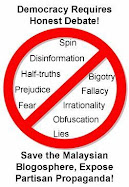
Showing posts with label Corruption. Show all posts

Thursday, September 24, 2009

If our politicians are working only for their own interests, it is because we do not make them work for ours!

Dear Readers,

Hope you all had happy and meaningful Hari Raya holidays, because now it's time to get back to the work we must all do: bringing change to our country, beginning with ourselves.

Raja Petra wrote an excellent article, "Me serve the rakyat? Nah!", published on Malaysia Today yesterday. While I can't vouch for the factuality of the specifics RPK reported as going on behind the scene of Pakatan Rakyat Selangor, on the whole it seems plausible to me. However, what struck me the most were these words (bold emphasis mine):
It is therefore not difficult to understand why there is so much chaos in Pakatan Rakyat Selangor. Not only are PKR, DAP and PAS trying to outmanoeuvre each other. Internally, within PKR, DAP and PAS, there are many factions and each is trying to kill off the other.

We have inter-party and we have intra-party wars going on. And it is all because no one is interested in bringing changes or to serve the rakyat. They are only interested in seeking power because politicians naturally lust for power.

So we, the people, need to keep them in check. If power goes to their heads they will very quickly forget that it was the people who put them there. They will forget that they are supposed to work for the rakyat. They will become just like Barisan Nasional in thinking that the rakyat are the slaves while they are the masters.

Never trust politicians. They will use us when it best suits them. Then they will turn on us and betray the trust we gave them. And that is why the need for some of us to remain as political activists and not become politicians. This is so that we can whack the politicians when they forget themselves, which will be as soon as they win the election and form the new government.

Please read the entire article here. I feel that RPK has put it in the best way possible: if we elect a particular set of politicians, and expect that they will automatically do what is right and good for our country because (we hope) that they are good people, then we are in for a big disappointment. While I believe that there are individual politicians who are principled, the prevailing political culture and system, compounded by we Malaysians' apparent apathy to values and good governance, make it difficult for them to make their voices heard over the shrill cacophony of self-interest. As Franklin D. Roosevelt told A. Philip Randolph, who had just given FDR an earful on what direction America should be taking (my bold emphasis):
"I agree with everything that you've said, including my capacity to be able to right many of these wrongs and to use my power and the bully pulpit. ... But I would ask one thing of you, Mr. Randolph, and that is go out and make me do it."
If we want our government and politicians to listen to us, and act to promote our interests and aspirations, we have to make them do it. We have to have press freedom so that what they do behind closed doors is exposed in the open. We need to tell them what we want, keep track of their promises, and hold them accountable when they don't deliver. We need to fight for what is right whenever it is right, not just when it suits us or ours. We need to unite our voices so that when we speak, they sit up and listen. We cannot do this as long as we identify ourselves by our race and religion, as Umno/BN wants us to.

Our end goal must be to establish a new political culture in Malaysia: one where the rakyat's interests come first, and one where only principled leaders have a chance of being elected to office.

I believe that the Saya Anak Bangsa Malaysia initiative is an excellent platform from which to make our politicians work for us instead of the other way around. Please read their charter here, read the SABM powerpoint presentation here and see Haris Ibrahim's speech here.

Whatever we want Malaysia to be, it's not going to happen if we just watch from the sidelines. It's time to get involved, people! ARE YOU, YOUR FAMILY MEMBERS AND FRIENDS REGISTERED VOTERS?

Sincerely,
Malaysian Heart

Monday, September 7, 2009

Y.B. Sivarasa on DSAI's prosecution - videos from Media Rakyat

Dear Readers,

This is a must see from the folks at Media Rakyat!

Sivarasa Rasiah: You The Rakyat Be The Jury (Pt 1)

Sivarasa Rasiah: You The Rakyat Be The Jury (Pt 2)

Sivarasa Rasiah: You The Rakyat Be The Jury (Pt 3)

These videos (and lots more like them) are available at Media Rakyat. In their own words:
The Universal Declaration of Human Rights indicates: “Everyone has the right to freedom of opinion and expression; this right includes freedom to hold opinions without interference, and impart information and ideas through any media regardless of frontiers”

Mediarakyat is dedicated to improve the freedom of information in Malaysia.

At Mediarakyat, you will find plenty of informative & interesting video clips concerning current events & speeches that the mainstream newspapers & TV stations may not be able to cover or reluctant to cover.

Please consider supporting them so that they may bring us the news and views that BN does not want us to know about.

Sincerely,
Malaysian Heart

Friday, August 21, 2009

"One Malaysia?" - op-ed article from the New York Times


I've just read a very interesting op-ed article by Philip Bowring, on the New York Times website. In the article titled "One Malaysia?", he (in my opinion) quite accurately describes the socio-political situation we Malaysians find ourselves in, in the aftermath of GE-12 and the first 100 days of DS Najib's government. How can one not concur when he writes, "Malaysia badly needs a break from 52 years of sometimes authoritarian and corrupt rule by a coalition of race-based parties headed by the United Malays National Organization (UMNO), which controls most levers of power and money"?

Bowring isn't accurate in everything; for example, he describes Altantuya's murderers as DS Najib's "security guards" rather than as police officers serving in PDRM's Unit Tindakan Khas. However, his last three paragraphs more than make up for it (bold emphasis mine):
Ultimately, the race issue prevents wholehearted cooperation among the opposition parties in Anwar’s coalition. Some of the Islamists hanker to make common cause with UMNO to strengthen Malay unity and defend pro-Malay, pro-Islamic discrimination. This in turn fits well with allegations by senior UMNO figures that Anwar is a traitor to his race by aligning with the Chinese and Indian minorities.

The notion that Malays and Muslims are under threat from minorities is absurd. But it helps keep Malays loyal to UMNO even while the ruling coalition can claim that it is both multiracial and moderate. The coalition, however corrupted, is still seen by many as representing moderation and stability. UMNO may have pandered to Islamist demands, but few would accuse its leaders of piety or puritanism.

Najib’s slogan is “One Malaysia,” an attempt to portray his government as a unifying force. Its actual policies may remain racially skewed in favor of Malays and oppressive of dissent. But given the opposition’s divisions, and the Malay sense of entitlement that makes multiracial politics so difficult, the slogan may work to keep UMNO in power for another decade.

Spot on, wouldn't you say? What are we doing about it?

Please do read the entire article here. You may need to register with nytimes.com first, which is free and takes only a few minutes. You can find more articles by Philip Bowring here.

Thursday, August 20, 2009

How to read partisan blogs 1: Shamsul Yunos and his "anger" towards lawyers


Definition of partisan adj.-
  • From The American Heritage Dictionary of the English Language, Fourth Edition: devoted to or biased in support of a party, group, or cause
  • From the Collins Essential English Dictionary, 2nd Edition 2006: prejudiced or one-sided
Dear Reader,

Of late, I have been writing quite a bit (most recently here) about why I believe that our Malaysian blogosphere has become extremely partisan, and increasingly bereft of honest argument and reasoned debate. When I surf Malaysian blogs and online news, I often get an uneasy feeling that there is something very wrong with the ideas being "sold". Unfortunately, it's not always easy for me to put my finger on what's wrong (and no, it's not the tapai pulut I had this morning). I realise that I need to be better at thinking critically; therefore, I am starting a series of postings in which I shall attempt to analyse and describe the biased, prejudiced and one-sided arguments that I find in our Malaysian blogosphere. Will you to join me in this endeavour?

Let's be very clear on one thing - there is absolutely nothing wrong with a blogger or writer having strong political beliefs and affiliations, or with expressing them vigorously and with passion. However, as I have stated before, we have a responsibility to argue our cases justly and honestly; if not to our readers, then at least for the sake of our own conscience. Democracy needs a forum for honest discussion and open debate on issues of National interest; telling one's side of the story is fine, but pretending to tell both sides while misrepresenting the other is dishonest.

For this first installment, I'd like to analyse a post by Shamsul Yunos, who blogs at "My Anger, it May Be Yours Too". In his recent entry, "Did you know lawyers are special?", he criticises the Malaysian Bar Council for saying that lawyers should not be arrested while on duty. This statement was made by Bar Council president Ragunath Kesavan on 16 August 2009, during the public inquiry by Suhakam into the arrest and detention of five lawyers of the Kuala Lumpur Legal Aid Centre at the Brickfields Police Station on 7 May 2009. The lawyers were arrested when they tried to see their clients, who were among 14 arrested that day for taking part in a candlelight vigil (for arrested political scientist and activist Wong Chin Huat), outside said police station. The Bar Council's description of what transpired that day is available here, and you can read the five arrested lawyers' own accounts here, here, here, here and here. The only statement from the police (regarding anything related to the arrests) that I could find was in this video.

Let's get a few facts straight first:
  • Even if the 14 arrested individuals had commited a crime by holding the vigil, they had the right of access to a legal practitioner of their choice, as per Section 28A (4) of the Criminal Procedure Code (CPC) and Article 5 of the Federal Constitution. Granted, that Section 28A (8) of the CPC allows the police to refuse lawyers access to their clients, but it should be invoked only in extraordinary circumstances; such as when the delay in questioning the suspect may cause the occurrence of another crime or cause danger to others, e.g. when the client may pass harmful information to an outsider via the lawyer, or hide evidence, such as in kidnap cases. When the police were asked for the grounds on which they were invoking that clause, they were unable to provide an answer. To date, there has been no explanation from the police whatsoever as to why they invoked Section 28A (8) of the CPC.
  • The lawyers arrested were trying to provide their clients with legal counsel in their professional capacity as members of the Bar Council's Legal Aid Centre; they were not part of the candlelight vigil. Although lawyers do take part in protests, they know how to separate their professional duties from their activism. They were in no shape or form a threat to public order or safety, or obstructing justice, which could have justified their arrest that night. In applying to see their clients in the police station that night, they were merely fulfilling their obligations as advocates and solicitors.
  • The Bar Council did not call for blanket immunity for lawyers while on duty. They are neither seeking nor expecting preferential treatment nor exemptions from the law. They seek instead to uphold the fundamental right of lawyers to have access to their clients, a right which was arbitrarily denied by the police when they refused to let the lawyers see their clients, and arrested them instead.
  • The role of the police in a democratic country, is to enforce the law and ensure public safety and order. To enable our police to fulfil their responsibilities, they are delegated wide discretionary powers, e.g. to deny permission to assemble and to issue orders to disperse. However, they must never forget that the raison d'etre of law enforcement is to uphold our human rights (including the right to assemble peacefully), not to deny them arbitrarily or for political reasons. They must also never forget that they are public servants, and that they are accountable for their actions and decisions.
So, given the above, how did Shamsul Yunos choose to comment on the Bar Council's statement? If you have read his entire post, you would have seen how he has used negative connotations and outright slurs against lawyers throughout it. In a post 313 words long, he managed to:
  • Liken lawyers to "particularly odorous boogers" to be flicked out of a moving car onto gravel
  • Imply that they drink lots of alcohol
  • Accuse them of lying for a living
  • Imply that they are too cowardly to stand up for what they believe in
  • Characterise them being wealthy and stingy
  • Accuse them of speaking with "forked tongues", without thinking first
What Shamsul Yunos has done is to use the techniques of propaganda, namely:
  • Ad hominem arguments
  • Appeal to prejudice
  • Demonizing the enemy
  • Name-calling
  • Stereotyping
Techniques like these work to stir up negative feelings and attitudes (e.g. disgust) towards the targets (in this case lawyers), by appealing to the emotional and irrational side of our nature. They make the other parts of his case easier to accept.

Let's look at Shamsul's more "substantive" arguments. The first thing to note, is that he has (intentionally or not) neglected to quote from, refer to or even provide links to Ragunath's statements as reported in the news. Neither has he mentioned the context in which the statement was made, namely the arbitrary denial of a fundamental human right, the arrests of the five lawyers, and Suhakam's public inquiry into it. Why is this important? When he first refers to the statement by BC president, he follows it with "What the F does that mean?" Is he trying to imply that the Bar Council's position is unclear, unreasonable or difficult to understand? Would the Bar Council's position have been in any way unclear to anyone who had read their statements and was aware of the issues involved?

Next, he uses a "straw man" argument, i.e. by substituting a superficially similar (and weaker) proposition (the "straw man") for his oponents' real one, then refuting it, without ever having actually refuted their original position. Shamsul does this by first conceding that lawyers should not be arrested if they are not breaking any laws. Then he writes, "but I hardly think that anyone in this country should get time out just because they are on duty." The straw man that he is putting up here is that the Bar Council called for blanket immunity for all lawyers on duty, even if they break the law. A glance at this headline shows how grossly Shamsul has misrepresented the Bar Council's position, and again, he neglects to consider the human rights issues involved. Knowing the whole truth reveals Shamsul Yunos' argument for what it is.

Instead of honestly discussing the possibility that it's in the public interest that lawyers and their clients have certain rights and privileges, he goes on to use a rhetorical question to make light of the issue; he sarcastically suggests that the Bar Council asked for special treatment ("different laws" as he put it) because lawyers believe that they are superior to others.

So, what are we to make of the post in question? Should we dismiss it as the prejudiced pronouncements of a partisan propagandist? Well, Shamsul Yunos does not want us to think so; as he maintains (in response to a reader's comment to a different post) here, "I put forth both sides of the story". Yeah, right!

One thing that disturbs me very much, is that in between the put downs, slurs and hyperbole, Shamsul makes a sinister, chilling statement with dangerous implications for human rights, freedom and justice in Malaysia. He writes: "If lawyers think arrest is a risk they do not want to face, then do not accompany people who the police may want to arrest. hey a champion must make scarifices, a warrior must be brave..."

Take a moment to consider exactly what he is saying. Is he implying that if lawyers work for or defend people whom the police (or the government) do not like or approve of, then they should be prepared to face arrest and persecution from the authorities?

As a result of our 12th general elections (GE-12), Malaysia is now at a crossroads, from where, for the first time in a long while, we have a choice of taking a path to a future that we want for ourselves & our children. Malaysians from all walks of life have been increasingly vocal in expressing our dissent against racism, bigotry, corruption, oppression, bad governance, tainted law enforcement and judiciary; both individually as well as via mass protests and demonstrations.

However, not everyone is happy that we have this choice, and there are those who would prefer that we return to the days before GE-12, and even further back, to Mahathirism. I believe that there are efforts being taken that, if we are not vigilant, will roll back the progress that we have made of late. These efforts include inhibiting democratic expression and eroding the foundations of our basic human rights, by various means. Our laws and legal system (such as it is), and our lawyers, are vital elements in the defense of our human rights and freedoms. Equal protection and access to justice would be just an empty slogan without the right to legal counsel. Are people like Shamsul Yunos part of an effort to reduce our legal community's effectiveness (and motivation) in standing up for human rights? I believe so.

So, who is Shamsul Yunos? The first entry on his blog dates back to 27 April 2008 (incidentally, 50 days after the GE-12). According to Rocky, who introduced Shamsul's blog here, and regularly refers to it in his own posts, Shamsul Yunos is a journalist. Googling for "Shamsul Yunos", I found (assuming that they are all one and the same person) that he writes for the Malay Mail. I also found that a Shamsul Yunos attended the Asia Media Summit 2008, held on 27 - 28 May 2008 in Kuala Lumpur. In this list of delegates, he is referred to as a Special Writer from the Ministry of Information, Malaysia. I do not know what exactly a "Special Writer" in the Ministry of Information is, but if it's possible to define one from what one writes, then perhaps we should compare how he has written about the Bar Council's position with this description:
A propagandist, in the strict sense, is not interested in the truth for its own sake, or in spreading it. His purpose is differ­ent. He wants a certain kind of action from us. He doesn't want people to think for themselves. He seeks to mold their minds so that they will think as he wants them to think, and act as he wants them to act. He prefers that they should not think for them­selves. If the knowledge of certain facts will cast doubts in the minds of his hearers, he will conceal these facts.

From The Art of Making Sense: A Guide to Logical Thinking by Lionel Ruby
What are the key lessons to draw from reading Shamsul Yunos' post? IMHO, they are:
  • Always look for the other side of the story and its context, from another source. Do not expect that Shamsul has provided it for us
  • Look for propaganda techniques designed to evoke an emotional and irrational response to the subject of the story
  • Look for dishonest arguments, e.g. the "straw man", and rhetorical questions used to divert attention away from real issues.
  • Always look for affiliations and links to organisations. Such affiliations are not evidence of propaganda per se, but are a useful guide for us to look for potential bias and vested interest
The next time you read Shamsul Yunos, or any other partisan blogger, do look out for these tricks. Better yet, blog about it and let others know too! According to Rocky, Shamsul will be contributing articles daily from Permatang Pasir for The Malay Mail. Will he be putting forth "both sides of the story" from there too? Do feel free to share you analyses of Shamsul Yunos' reports in the comments section.

Sincerely,
Malaysian Heart

Friday, August 7, 2009

Police Misconduct and the Mainstream Media's Response to it: Malaysia and India


An Indian police officer beats a demonstrator near an August 2008 procession in Jammu (© 2008 Reuters, taken from page 2 of photo feature accompanying HRW report).

Kuala Krai MP Dr Hatta Ramli's shirt gets ripped in a scuffle outside the National Mosque during the anti-ISA rally on 1/8/09 (taken from the Malaysian Insider).

Malaysian policeman during anti-PPSMI demonstration on 7/3/09 (taken from here).


Human Rights Watch, an international non-governmental organization that conducts research and advocacy on human rights, has released a report on the state of the Indian Police Service. The report, titled "Broken System: Dysfunction, Abuse and Impunity in the Indian Police, is based on interviews with more than 80 police officers of varying ranks, 60 victims of police abuses, and numerous discussions with experts and civil society activists. You can read the press release and download the report itself from this webpage.

While it makes compelling reading for anyone interested in human rights and justice, reading the report as a Malaysian is heartbreaking; in so many ways it describes the trouble with our own PDRM in Malaysia. Some 'highlights' from the report:

Practices
The Indian Police Service practices arbitrary arrest and detention, torture and extrajudicial killings. They break the laws they are supposed to protect, and believe that unlawful methods, including illegal detention and torture, are necessary tactics of crime investigation and law enforcement. Therefore, they use "short-cuts" and their old methods - abuse and threats, hold suspects illegally and coerce them to confess, frequently using torture and ill-treatment. Sound familiar?

Here is an example from the report, how a fruit vendor in Varanasi described how police tortured him to extract confessions to multiple, unrelated false charges: :
"[M]y hands and legs were tied; a wooden stick was passed through my legs. They started beating me badly on the legs with lathis (batons) and kicking me. They were saying, ‘You must name all the members of the 13-person gang.' They beat me until I was crying and shouting for help. When I was almost fainting, they stopped the beating. A constable said, ‘With this kind of a beating, a ghost would run away. Why won't you tell me what I want to know?' Then they turned me upside down... They poured water from a plastic jug into my mouth and nose, and I fainted."
Underlying Causes
The Indian Police Service, hence it's ethos, laws and regulations originated from the Imperial Police, the colonial-era police force whose primary objective was to help the British control and oppress the population with impunity, not protect their human rights. As the report states "[t]he institutional culture of police practically discourages officers from acting otherwise, failing to give them the resources, training, ethical environment and encouragement to develop professional police tactics".

Colonial-era police laws enable state and local politicians to interfere routinely in police operations, sometimes directing police officers to drop investigations against people with political connections, including known criminals, and to harass or file false charges against political opponents.

Other contributing factors are overwhelming workloads, insufficient resources, abysmal conditions for police officers, lack of sufficient ethical and professional standards and appreciation of modern criminology. Overall, the report seems to identify the system rather than individual officers or commanders as the main underlying cause.

Other Similarities
In 2006, a landmark Indian Supreme Court judgment mandated the reform of police laws. But the central government and most state governments have either significantly or completely failed to implement the court's order, suggesting that officials have yet to accept the urgency of comprehensive police reform, including the need to hold police accountable for human rights violations. Shades of our IPCMC?

It's not surprising that the Indian police are overstretched and outmatched by criminal elements, and unable to cope with increasing demands and public expectations. When faced with real terrorists during the Mumbai attacks, their immediate response did not prevent substantial loss of life.

HRW's Conclusions and Recommendations
The report concludes that the system of policing in India facilitates and even encourages human rights violations, and that successive governments have failed to deliver on promises to hold the police accountable for abuses and to build professional, rights-respecting police force.

The report then recommends two main thrusts: First, renewed commitment by national and state officials to discipline or prosecute as appropriate police officers who commit human rights violations is essential, with benchmarks to measure progress in implementing the commitment, and second, an overhaul of police laws and regulations, and institutional structures and practices that facilitate the abuses.

According to Brad Adams, Asia director at Human Rights Watch, "conditions and incentives for police officers need to change," and, "Officers should not be put into a position where they think they have to turn to abuse to meet superiors' demands, or obey orders to abuse. Instead they should be given the resources, training, equipment, and encouragement to act professionally and ethically." He added that "it's time for the government to stop talking about reform and fix the system."

For the detailed recommendations, see this section of the report.

If you are not convinced that our PDRM and India's notorious police have similar problems, just read this account below, fellow Malaysian, then we can cry tears of shame together:

[P]olice arrested Gita Pasi in August 2006 in relation to an alleged kidnapping of a Yadav caste woman by a member of the local Dalit community. She died at the station and police claimed it was a suicide. According to Pasi’s brother-in-law, the police claim was implausible:

"She was kept in the police station all night. In the morning, when we went to meet her, they said she had killed herself. They showed us her body, where she was hanging from a tree inside the police station. The branch was so low, it is impossible that she hanged herself from it. Her feet were clean, although there was wet mud all around and she would have walked through it to reach the tree. It is obvious that the police killed her and then pretended she had committed suicide."

Mainstream Media Response
It is unfortunate that the similarities between Malaysian and Indian police forces are not complemented by similarities between our news media. I found the way in which the Indian mainstream media covered the story very different to how our own would have treated it. While the story naturally got international coverage from the likes of CNN and the BBC, the Times of India, Hindustan Times, Deccan Chronicle and news portals such as Rediff.com not only carried the story in detail and without spin, but also provided a forum for active debate on the issue. There were no Indian MSM denunciations (that i could find) of Human Rights Watch as anti-Indian, anti-religious, imperialist, neo-colonialist, western or zionist.

However serious the challenges that democracy, human rights and justice face in India, their news media seems prepared to play their part, by upholding a journalists duty. As long as our MSM are owned by interested parties, and (more importantly) willing to sacrifice their journalistic integrity to spin stories and spread propaganda for their poilitical masters, we cannot reasonably expect the same from any of them. They will keep on plying their trade quite profitably, so long as we Malaysians keep availing ourselves of their services - Hartal MSM!

Friday, July 24, 2009

Is This the Standard of Journalism Practiced by the New Straits Times?


(screenshot of article taken at 1650hrs, 24/7/09)

(Disclosure: I am a member of Hartal MSM*, an advocacy group that calls for a Paper-free Tuesday -- "No buy, No lies")

  1. Journalism's first obligation is to the truth.
  2. Its first loyalty is to citizens.
  3. Its essence is a discipline of verification.
  4. Its practitioners must maintain an independence from those they cover.
  5. It must serve as an independent monitor of power.
  6. It must provide a forum for public criticism and compromise.
  7. It must strive to make the significant interesting and relevant.
  8. It must keep the news comprehensive and proportional.
  9. Its practitioners must be allowed to exercise their personal conscience.

From "The Elements of Journalism": What Newspeople Should Know and the Public Should Expect


When a news organization's editorial policy is dictated by its owners, the quality of its journalism is often the first thing to go out the window (followed closely by its credibility, reputation and circulation figures). The general level of integrity and professionalism in our news media notwithstanding, I have to say that this "online exclusive" op-ed piece from the New Straits Times (22/7/09), entitled "They got their Royal Commission of Inquiry but will they stop their lynching?", is as egregious a case of journalistic misconduct as I have ever come across. Lest I be accused of making that claim just because I disagree with the article in question, please allow me share with you my reasons for saying so:

1) The writer made a significant error of fact by claiming that the purpose of the Royal Commission of Inquiry was "to probe the chary [sic] death of Teoh Boon Hock [sic]".

This is untrue. PM Datuk Seri Najib Tun Razak said (bold emphasis mine): "The Royal Commission will be set up according to specific terms, which is to scrutinise and study the procedures related to interrogations that are used by the MACC. It will also identify if there were any violations of human rights during Teoh’s interrogation."

The PM also made it clear that Teoh Beng Hock's death would NOT be investigated by the RCI, but by an inquest. He thus rejected the most critical component of what Teoh's family, Pakatan Rakyat leaders and civil society have been demanding all along.

Why is this error significant? Because the writer uses it to impugn the character and motives of Pakatan Rakyat and its leaders throughout the article, beginning with the headline itself. A major thrust of the article is to show that even when their demands have been met, PR leaders (ostensibly for selfish political reasons), will continue to criticize the RCI. Without this "misinterpretation" of the facts, his thesis cannot stand.

The full import of the PM's statement should have been quite obvious to the writer. He has misrepresented Pakatan Rakyat's position, and as of 1650 hrs on 24/7/09, this remains uncorrected.

2) The writer used at least two of the 38 dishonest tricks commonly used in argument, specifically:
a) he used emotionally loaded words, selectively. Against Pakatan Rakyat leaders, followers and their actions, he had this to say, without any supporting evidence (my emphasis in bold):
  • band of noxious supporters
  • toxic Pakatan demonstrations
  • defiant rants
  • this mob
  • sly pre-emption
  • Pakatan’s instigation
  • parrot his all-time favourite bellowing
  • pressing for a RCI
  • howls of protest
  • partisan party sycophant
  • sly pre-empts
  • Another sly pre-empting ploy
  • last week’s rampage
  • Pakatan Rakyat minions
  • brutish smugness
  • mob fury
  • lynching, Malaysian-style
For the cabinet and government leaders, he has this instead:
  • most pragmatic decision
  • strongly endorsed the setting up of the RCI
b) he attributed prejudices or dishonourable motives to his "opponents", again without offering any evidence in support:
"They were almost certain of getting a favourable Cabinet response but the hyperboles and sly pre-emption that senior Pakatan leaders discharged seemed to have given the appearance that the goading provoked the Cabinet into agreeing to the RCI."
"But let’s not be surprised that Pakatan would claim credit for their RCI ingenuity."
"Pakatan leaders’ pressing for a RCI had a disingenuous purpose:... Pakatan people will be nudged aside from the glare of suspicion..."
"Now anticipate the howls of protest, even if it makes sense to expand the scope of the RCI’s inquiry to include all possibilities."
"Kit will find other specious means to further pile the burden of attestation on Najib to prove that the RCI is “absolutely independent” and will do their job fearlessly."
"Pakatan Rakyat minions will insist no less than a guilty verdict, that some MACC perp pushed Teoh Beng Hock out of the 14th floor to his death for no reason other than wanting to torture the young man.
3) To further his attack on his "opponents", the writer has subverted the meaning of words, obscuring the truth. For example, he describes Tunku Abdul Aziz Ibrahim, a former vice-chairman of Transparency International’s Board of Directors no less, as a "sycophant", i.e. "a servile self-seeker who attempts to win favour by flattering influential people". To be sure, Tunku Aziz is a member of the DAP, but has the writer any evidence to show that Tunku Aziz has ever attempted to win favour by flattering influential people in DAP, Pakatan or anywhere else? If the favour of "influential people" is what Tunku Aziz sought, would the DAP have been the right party for him to join? One would have thought that there might have been much more "favourable" opportunities elsewhere, say, working for certain news media organisations.

One more example: the writer characterised Pakatan Rakyat's response to Teoh's death as a "lynching, Malaysian-style". To "lynch" is to punish violently or to execute, without due process, for real or alleged crimes. Another definition is "to punish (a person) without legal process or authority, especially by hanging, for a perceived offense or as an act of bigotry." It is a crime punishable by law in Malaysia, and it is what the writer accuses Pakatan Rakyat of doing to the MACC. Can he show how, and by what stretch of the imagination, can Pakatan Rakyat's actions thus far be construed as a lynching?

The irony is that the exact opposite may be argued, without any need for verbal obfuscation. Teoh Beng Hock was either a witness or a suspect in an alleged crime, and was, prima facie, in the custody of the MACC. If the reports of Halimi Kamaruzzaman's, Tan Boon Hwa's and Dariff Din's experience of the MACC's interrogation methods are reliable, then there is probable cause to suspect that Teoh too, may have been the victim of high handed interrogation tactics. Did Teoh's interrogators limit themselves to asking questions? Was psychological or physical violence used on him? Is it true that during his 10 hour interrogation, "officers dragged him to a window on the 14-story building and threatened to throw him out," as the Phillipine Daily Enquirer's website, quoting anonymous, "well-placed sources and officials close to the MACC", reports?

Considering the state of law enforcement and criminal investigation in Malaysia, with our history of suspicious deaths in custody, routine denial of access to counsel, allegations of politically motivated selective prosecution, the lack of real transparency and accountability, and our government's apparent inability to institute reforms (such as the IPCMC), isn't it reasonable for Malaysians to be asking those questions? All this, plus the inescapable fact that whatever was done to Teoh was done in OUR NAME, makes it a moral imperative that we actively work to uncover the circumstances surrounding his death. Asking our public servants tough questions, exploring the possibility that they have behaved criminally, and being very skeptical about the answers they give us, is not lynching, it is demanding that they be accountable to us.

By turning the very meaning of this word on its head, this "journalist" from the NST has insulted the memory of all who have suffered lynching at the hands of the powerful. He has made a mockery of the idea that our government and law enforcement authorities are accountable to the Rakyat; he seems to have chosen to serve power, rather than be an independent monitor of it.

With Malaysia at the crossroads in the aftermath of 8/3/08, advocacy journalism has become a "weapon" in the political "war" to determine which path our country takes. It is a genre of journalism that intentionally (and transparently) adopts a non-objective viewpoint, usually for a social or political purpose. It is certainly not new, and it is not disreputable per se; The Economist is an example of a publication that practices it quite well.

However, while advocacy journalists may justifiably eschew their newsroom colleagues' credo of objectivity (i.e. being neutral and not taking sides in their reporting), this does not absolve them of all standards of ethical journalism. Here is the bare minimum that they have to meet (adapted from here and here):
1) They must acknowledge and declare their editorial position and bias up front. Doing so will inform readers as to where the writer is coming from and allows them to employ their critical faculties accordingly. Working to promote a particular point of view without disclosing one's true stance is shilling.

2) They must be truthful, accurate, credible and ensure that every statement they make is factual and based on evidence from neutral sources. In other words don't spread propaganda, don't take quotes or facts out of context, "don't fabricate or falsify", and "don't judge or suppress vital facts or present half-truths". Requiring that media outlets refrain from spreading untruths and falsehood is not too much to ask for, is it?

3) Even if they do not provide equal time for their opponents' views, they must at least understand & address their opponents' relevant points & criticism - they must never ignore, trivialize or distort them. They must be fair and thorough.

4) They must use honest arguments & never resort to the crooked thinking and dishonest tricks commonly used in arguments. Avoid slogans, ranting, and polemics. Instead, "articulate complex issues clearly and carefully."

5) They must not allow their bias to turn into rose coloured glasses, or worse, a blind spot. They must not spare their own cause the tough, critical questions and scrutiny.
Without adhering to these most basic of standards, the resulting media "product" will be nothing more than propaganda, and bad one at that.

Had it come from a political party's media mouthpiece, the article might have been just bearable. After all, political propagandists and shills may rightly claim that they are not bound by any ethics, and are not obliged (or interested) to help citizens seek the truth. They may thus abandon even the pretence of reasoned discourse and honest logic, and to please their masters, may be as chauvinistic and as partisan as they please.

However, coming from the New Straits Times, the news outlet that is Malaysia's oldest newspaper still in print, one which claims that "Our goal is to be the preeminent provider of news, information and entertainment and to achieve total customer satisfaction through our professional and highly regarded workforce that values quality, integrity, innovativeness and personal service", it is nothing short of an abject disgrace.

It stands to reason that the NST's lofty goal will remain out of its reach so long as its journalists (and editors) choose to behave like members of the oldest profession, and not as members of an honourable one. Unfortunately, it also stands to reason that they will keep on plying their trade quite profitably, so long as we Malaysians keep availing ourselves of their services.

Sincerely,
Malaysian Heart

* Hartal MSM is a mediawatch group which had its beginnings in December 2007 in the People's Parliament, an initiative convened by civil rights lawyer Haris Ibrahim. The group seeks to promote a free and fair media as an impetus to Malaysia's stalled nation-building process.

Wednesday, July 22, 2009

Fair Winds and Following Seas, Captain


We belong to God, and to God we will return.

The Ancient Mariner, Capt. Muhammad Yusof b. Haji Ahmad, passed away peacefully on 19 June 2009. He was 62, and leaves behind his beloved wife and four children.

Capt. Yusof started blogging as the Ancient Mariner on 14 November 2006, with a post entitled "Well, steady as she goes and full speed ahead ...", making an interesting observation that the word "blog" had nautical associations too. Ever since that first entry, he sure went "full speed ahead" with his blog, steadily posting up to 25 entries every month. He claimed to blog strictly for his own pleasure, but that did not stop him from informing, educating and certainly entertaining us. Although his modesty prevented him from claiming it, his writing most definitely made us think as well.

His blog entries came with interesting vignettes and anecdotes from his life at sea and on land, including warm descriptions of the people he had known, the places he had been to, and the books and poetry he had read. They attest to his gentleness and quiet erudition, and evoke memories of a time long since gone, when civility and courtesy was the mark of an Officer and a Gentleman.

That never prevented him from speaking his mind and rocking the boat, though. Far from it, he made many very sharp and accurate observations of life in Malaysia and possessed an equally sharp wit, which he kindly tempered with his good nature and humour that pervaded his blog.

He was very socially conscious. He frequently posted entries that touched on justice, democracy, civic duty and fairplay for all Malaysians (and even Singaporeans). He was never the chauvinistic partisan in his politics; even-handedness and noble principles was the cynosure by which he charted his course.

In an entry early in his blogging career, he wrote:
"I believe most of my blogging contemporaries (read: my age group) indulge in political commentaries. However, at this stage of my life or in the September of my years, to quote Sinatra, I no longer weigh the world's problems heavily on my shoulders nor do I share everyone's enthusiasm for a daily dreary fare of bellyaching and nit picking a la Naipaul* and his ilk. I honestly believe that we truly deserve the government that we have got. Period."
However, when corruption and injustice reared its ugly head, Capt. Yusof embraced his civic duty with determination and vigour. Soon after news of the PKFZ scandal broke he wrote this:
"...if you see something which needs to be done, something which affects you, your family, and even your country, you are not going to think, ah, what will the neighbours or your friends think. You are just going to do it."
Our problem, "the fire" as he called it, is this:
"Of late we are seeing the country going to the dogs with greedy politicians, corrupt police and judiciary, racial disintegration, religious bigotry and worse, an apathetic and a very gullible citizenry. Our founding fathers must surely be turning in their graves right now."
He ended by sounding this clarion call for us Malaysians to act:
"So all hands on deck for we cannot remain on the sidelines forever, on the outside looking in, nor can we just engage in ad hoc fire fighting. The proverbial ball, as they say, is in our court. The time and the place, my friends, is here and now ... "
Ever the consummate operations man who walks the talk, Capt. Yusof dedicated himself to exposing the PKFZ scandal, making it his personal mission. In a series of hard hitting blog entries (including a compelling letter to the PAC) starting from 25 July 2007 right up to 7 July 2009 (just 12 days before his passing), he laid bare the hanky-panky and shady dealing that went on, calling the perpetrators "modern day pirates now robbing this country blind". He acted without fear or favour; "old friend" Datin Paduka O.C. Phang (then PKA GM & PKFZ Chairman) and schoolmate, Datuk Shahrir Samad (then PAC chairman) were not spared questions & criticism.

Capt. Yusof used his extensive network of contacts and knowledge of Port Klang to organize, analyse, share and interpret the relevant data and news reports, greatly helping us to make sense of what was going on. He regularly posted updates, sometimes "scooping" the mainstream media and breaking the news before anyone else.

A powerful tool he used was to frame series of sharp pointed questions regarding the scandal, many of which remain unanswered by the authorities. His credibility and authoritativeness even led opposition leader YB Lim Kit Siang to consult him before tabling a motion in Parliament to debate the PKFZ scandal.

With his passing, the Malaysian blogosphere has lost a steadfast, principled and dedicated voice for justice, rule of law and good governance. He will be fondly remembered and deeply missed. May Malaysia be blessed with citizens as worthy as Capt. Yusof.


Al-Fatihah
in respectful memory of
Allahyarham Capt. Muhammad Yusof b. Haji Ahmad

Gurindam Fasal yang Kelima from Gurindam Dua Belas
by Raja Ali Haji (Capt. Yusof's illustrious forebear from Riau)

Jika hendak mengenal orang berbangsa,
lihat kepada budi dan bahasa,

Jika hendak mengenal orang yang berbahagia,
sangat memeliharakan yang sia-sia.

Jika hendak mengenal orang mulia,
lihatlah kepada kelakuan dia.

Jika hendak mengenal orang yang berilmu,
bertanya dan belajar tiadalah jemu.

Jika hendak mengenal orang yang berakal,
di dalam dunia mengambil bekal.

Jika hendak mengenal orang yang baik perangai,
lihat pada ketika bercampur dengan orang ramai.


(An English translation here)


Raja Ali Haji's wise words describe our dear Captain so well. Fair winds and following seas, Captain; may there be no moaning of the bar, when you put out to sea.


Friday, June 12, 2009

Pakatan Rakyat, Good Governance, Transparency and Accountability - Updated

Governments are elected & instituted by the Rakyat not as ends in and of themselves, but as the means by which the Rakyat's rights, interests, freedoms and safety are secured & protected. This is the only raison d'etre of any government.

Any government that seeks to serve the Rakyat must practice good governance, which according to the UNDP, is:
"The exercise of economic, political and administrative authority to manage a country's affairs at all levels. It comprises of the mechanisms, processes and institutions, through which citizens and groups articulate their interests, exercise their legal rights, meet their obligations and mediate their differences."
The characteristics of good governance are participation, rule of law, transparency, responsiveness, equity and inclusiveness, effectiveness, efficiency, accountability and strategic vision and consensus orientation. Good governance ensures that corruption is eradicated, the views of minorities are taken into account and that the voices of the most vulnerable in society are heard in decision-making and implementation. It is also responsive to the present and future needs of society, balancing between growth and distribution, present and future resource use.

Of these characteristics, I would like to touch upon just two key ones where I believe that Pakatan Rakyat governments are sorely shortchanging the Rakyat; namely transparency and accountability.

Case in point is the issue of the awarding of waste management contracts in Selangor by Alam Flora. On 21 & 25 May '09, PKR's Petaling Jaya Selatan division’s deputy chief and PJ City Councillor Mr. A. Thiruvenggadam, claimed that:
1. "No job offers have given to the Indian community. No contracts have also been allocated for the Indian businessmen in the state"
2. "the state government divides waste-concessionaire Alam Flora contracts to political parties - 40 per cent to PKR, 30 per cent to PAS and 30 per cent to DAP"

First, let's get some things straight. Mr. Thiruvenggadam is wrong to call for special treatment for one community. He was appointed to represent PJ citizens of all communities, not just those of his own ethnic group. One of the key deliverables for PR (please correct me if I am wrong) is replacing the racial politics of BN with a new Malaysian politics. Mr. Thiruvenggadam's demands go against that key deliverable.

Furthermore, how much is awarding contracts to a vendor from a particular community going to help the whole community? I don't mean to impugn Mr. Thiruvenggadam's motives, but did he have any preferred vendor in mind?

Government contracts are to be awarded transparently based on merit in accordance with good governance to maximise the benefit to the Rakyat. They are not to be divided amongst the party faithful as the spoils of electoral victory. Even if affirmative action to benefit the underprivileged & marginalised is a government policy (as it should), there still should be transparency & accountability. Indeed, as Mr. Thiruvenggadam himself alludes to in his statement, there are humongous issues about balanced development & marginalisation which need to be urgently addressed by the State government. However, to think that a race based spoils system will solve those problems is worse than folly.

In that respect, although YAB Tan Sri Khalid could have been more diplomatic in dealing with stakeholders, his principled stand & his political secretary Nik Nazmi Nik Ahmad's statement to Malaysiakini is commendable. Clearly, PR needs to ensure that all its leaders understand the aims & principles of their struggle, and they should start by reading & understanding their respective manifestos first. No more gravy trains ala BN.

Enough about demands for special treatment. My main concern here is about Pakatan Rakyat leaders & how they operationalize good governance. Has good governance ever been in their agenda? Is the Pope Catholic? From day one, PR has been banging the drum of good governance as a tenet of their campaign, and as a unique selling proposition to differentiate themselves from BN. Let's look at the evidence of this (bold emphases are mine):

1. PKR's manifesto mentions good governance 2 times & transparent/cy 8 times, and promised to "Promote a fully transparent culture of openness in the awarding of government contracts and tenders, and granting awards based not on connections, but on competitiveness and track records."

2. PAS' manifesto mentions transparent/cy 7 times, and promised to "Put in place Best Practices in all Government departments, agencies and Government-Linked Companies as to provide transparency and accountability to uproot graft and corrupt practices. Public procurement must undergo open tender and those that involve mega projects must be subjected to an Independent Tender Board placed under the jurisdiction of the Parliament."

3. DAP's manifesto promised to "implement open and transparent tenders for all government contracts"

4. In the heady days after 8/3/08, this is what newly elected Petaling Jaya representatives had to say after their first meeting with the mayor and the heads of departments of the Petaling Jaya Municipal Council:


YB Elizabeth Wong: “We also informed MBPJ that our new state government is run on the basis of greater transparency and that is something we expect to see from the local council in terms of awarding contracts, tenders and development projects,

YB Sivarasa Rasiah:“Our new state government is built on a platform of more governance with zero-tolerance on corruption,”.

Obviously, there is no shortage of talk in PR about good governance & transparency. How about the walk? Let's see how they have responded to Mr. Thiruvenggadam's allegations:

Selangor MB: Show proof of impropriety in contracts allocation
PKR: Solid waste management allegations untrue
PKR rubbishes secret pact to dish out Alam Flora contracts
Contracts awarded on merit, says Liu

PR leaders' reactions to Mr Thiruvenggadam's allegations do not reflect their promises for transparency & good governance. No concrete actions (to my knowledge) have been taken as yet. Basically, all they have done is to deny any wrongdoing, assert that contracts are awarded on merit, and ask for proof of impropriety. In my humble opinion, this is woefully insufficient & inadequate. Mr. Thiruvenggadam's credibility notwithstanding, his allegations are too serious to be brushed aside with mere denials & assertions.

What is infinitely worse is this: Sivarasa: No harm making recommendations to Alam Flora. Although here (PKR denies Alam Flora contracts dished out to parties) YB seems to be against politicians choosing vendors, five paragraphs later he says this:"Individuals, and including leaders of political parties will make recommendations and we see no harm in that absolutely. That is quite normal and not a problem for us." In effect, YB Sivarasa seems to be saying that it is OK for politicians to recommend vendors to the contract awarding bodies. With all due respect YB, I beg to differ. It is immaterial that "This is a situation unlike a tender system in which firms with the lowest quotation gets the contract" or that "The decision-making at the end of the day lies in Alam Flora’s hands". Any selection of vendors and contractors is a situation where corruption can potentially occur. Therefore it must be done by the appropriate competent authority & must be done transparently, accountably & with the Rakyat's interests foremost, without undue interference from politicians. Incumbent politicians & elected reps favouring one vendor over another (and making it known to the authority via their recommendations) is interference in the selection process and is the first baby step down the slippery slope to political patronage, corruption, cronyism & nepotism.

I say again: politicians & elected representatives are there to ensure that the Rakyat's rights, interests, freedoms and safety are secured & protected. They have no business recommending any one party over another for contracts, jobs, titles, awards, sinecures, free nasi lemak, or any other favours. In some countries it is even against the law to do so.

DAP has made a statement calling for transparency & open tenders:
DAP: We would be no different from BN
DAP calls for competitive tenders in Selangor
Media Statement by Tony Pua in Petaling Jaya on Tuesday, 9th June 2009

That's a start, but DAP is a partner in Selangor's coalition government, with 3 out of 10 exco positions and 13 out of 36 PR state assembly seats. They need to do a lot more than just issue statements like a third party neutral observer. As for PAS, as far as I am aware, they have been missing in action on this issue.

Some of those statements by PR's leaders (especially YAB Tan Sri Khalid's request for proof, which is eerily reminiscent of old BN attitudes) seem to suggest that they have forgotten that they are accountable to the Rakyat. So, here's a thought. How about you (PR government) show us (the Rakyat whom you are supposed to be serving) why we should believe anything you say? Justice must not only be done, it must be seen to be done. The onus is on you, PR, to prove to us what you assert. Nothing but full transparency & disclosure will convince us.

You can start by doing this:
1. Make public the details of all waste management contracts awarded during the tenure of PR governments & the last BN government. Include the details of successful vendors including their political affiliations and contributions (if any). How many contracts were awarded by BN & PR respectively?

2. Make public the contracts, relations & transactions between PR state & local authorities and Alam Flora regarding the awarding of waste management contracts, including the contract terms, matrix of responsibilities & accountabilities. How many percent of contractors are chosen by Alam Flora & State government respectively? Who choses for the State government, the politicians or civil servants? Where does the buck stop?

3. Make public the entire procurement process for waste management services, including pre-qualification criteria & selection processes, as well as any & all attempts to influence those processes by elected representatives and PR leaders. Expose the "tremendous competition to get the contracts renewed, with many firms unabashedly trying all ways and means, including using the political route and instigating state assemblymen and other politicians". Disciplinary action must be taken against those proven guilty. If everything is above board (as you say it is), prove it & clear your names.

4. Fully implement what you promised in your manifestos as well as the recommendations of Transparency International, as contained in the handbook "Curbing Corruption in Public Procurement" available here, for all public procurement in PR governed states. For goodness sake, realize that you will never get good results by fiddling around with a flawed legacy system. Cut the Gordian Knot, uproot the corruption & plant good governance, as you had promised. And if Alam Flora or any other concessionaire or party places unreasonable obstacles to this, please be so kind as to let the Rakyat know about it. We are not as stupid as politicians seem to think we are.

Complete steps 1, 2 & 3 within 5 working days. Complete Step 4 within 3 months from now. Can you do that?

Everyone knows that it's not easy changing a system that has been going on for 50 years. But PR leaders must never forget that is exactly the reason why we voted them in - we want them to lead the change. That we are in this situation more than a year after PRU-12 is simply unacceptable. PR need to quickly get their act together & deliver on their promises, or else they must step aside and allow others who are more committed and/or capable to do the job!

Sincerely,
Malaysian Heart

UPDATE 18:15 12/6/09
Report from The Nut Graph - Audit committee to monitor contract in Selangor:


- The Selangor government will form an audit committee to monitor its waste management contracts to ensure that Selangor citizens are provided with value-for-money services

- ... this would curb the unhealthy and unethical practice of awarding contracts to brokers instead of genuine operators, which he said was rampant under the previous administration.
This is encouraging news. The Selangor state government must ensure that:
  1. the workings of the audit committee are open to public scrutiny & oversight
  2. There is no hint of political patronage in the awarding of contracts
  3. state officials, civil servants, elected & appointed reps & political leaders do not interfere in the contractor selection process
  4. good governance, transparency and accountability are fully implemented in the state
The Rakyat will be watching...


Read reactions from others here:
The Barisan Nasional disease
Selangor MB: Open tender system cannot be implemented within a year
Alam Flora contracts
40-30-30?