Showing posts with label Malaysia. Show all posts

Thursday, October 22, 2009

My experience as a MAFREL election observer at Bagan Pinang

During the recently by-elections in Bagan Pinang, I had the privilege of volunteering as a MAFREL election observer. For someone whose only involvement with elections had been to vote once every 5 years, the experience was very enlightening and educational. Here is what happened:

I first read that MAFREL (Malaysians for Free and Fair Elections) needed volunteers to act as election observers in Zorro's blog, and decided to sign up. I emailed En. Arphan, who is the honorary secretary of MAFREL, and was sent a registration form to fill up and return. This was followed by a Elections Commission (SPR) form applying for observer status. I finally got to meet him when I delivered the form all signed and sealed.

En. Arphan is a gentleman of the old school, of whom there are very few left; he is the epitome of cordiality and good cheer, and always has time to spend with a friend, even one newly made. Here he is:

A gentleman through and through. Even an attack of gout did not prevent him from fulfilling his duty at Bagan Pinang!

Once the required pass was obtained, and we volunteers were instructed to report for a briefing at MAFREL's operations center in PD, on the morning of 10 October, the eve of the elections. I left home early, and managed to conduct a quick recce of the polling station I was assigned to, and made it to the briefing on time.

The operation centre was a modest single storey terrace house in Teluk Kemang (which I believe was lent by a well wisher). Soon, there assembled a very diverse group of Malaysians, with diverse (even opposing) political views, but all dedicated and united in the desire to see free and fair elections in Malaysia. Some even drove all the way from Kelantan!


Tuan Syed starting off the briefing

MAFREL Chairman Tuan Syed Ibrahim Alhabshi began his briefing by welcoming all the volunteers and introducing us to MAFREL's objectives, which are to:
  1. Build confidence in democracy
  2. Raise awareness and understanding of elections that are truly free and fair
  3. Advocate for the adoption of better laws and procedures governing elections
  4. Promote orderly elections free of corruption, abuse of power, violence, intimidation, harassment & fear
  5. Help detect and report any breach of election regulations and procedure
In order for democracy to be meaningful, elections have to be free and fair (for a good definition of "Free and Fair Elections", see this declaration by the Inter-Parliamentary Union. Read also their excellent book here). Independent, non-partisan observers can play a vital role in ensuring that, especially when the officials running the elections are civil servants beholden to one of the contesting parties.


Our Mission Leader, Kapt. (B) Maizon, being introduced

One more thing that he made clear was that as volunteers, we were "sukarela" as well as "dukarela", i.e. there were no funds for allowances, reimbursements etc., and we would have to bear our own expenses. However, those assigned to remote polling stations would be provided with a packed lunch. In practice, food was shared generously, and our leaders graciously took it upon themselves to bear the cost of meals together.
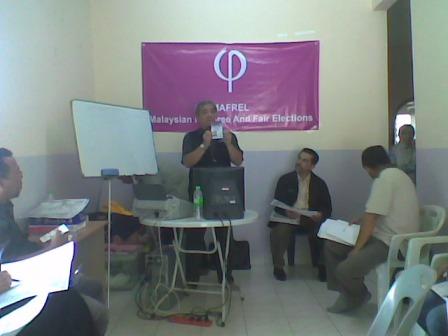

En. Arphan explaining the use (and abuse) of the SPR pass

As MAFREL election observers, our authority is of a moral rather than legal nature. Our effectiveness depends on how well we engage with the Presiding Officer (PO) and build credibility and trust.
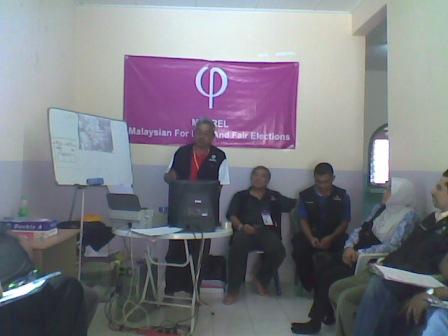

En. Azmi, veteran MAFREL observer all the way from Kelantan. He shared with us his wealth of practical experience.

En. Azmi, who is a veteran of numerous MAFREL missions, gave us a rundown of the common issues we would face, and how to solve them. What was most interesting was the various tricks to watch out for; after listening to him, we felt qualified to be "Ghostbusters"!


Mission Coordinator Kol. (B) Shaharuddin showing us where our assigned polling stations were on the map

After the briefing was over we took a group photograph, then quickly got into our teams and organised ourselves for the journey to our respective polling stations the next day.


The Bagan Pinang Observers Team ready for action!


Our leaders: (from left) Tuan Syed, Kol. (B) Shaharuddin, Kapt. (B) Maizon, and En. Arphan

Over lunch, I took the opportunity to ask our seniors about their motivation for getting involved in MAFREL. What came through strongly was a common need to help the cause of democracy, without getting into partisan politics. I also perceived a shared realisation that democracy would be best served by a strong adherence to fairness and principles. Something that is being planned are voter registration/education activities. You can read more about MAFREL's plans here.

Having already recced my polling station in the morning, I had the rest of the afternoon free. I decided to trek up to the Tanjung Tuan lighthouse, which you can read about here.

As all campaigning was supposed to cease at midnight, there was the customary final surge of ceramahs that evening. We decided to attend the nearest one, which happened to be one where DSAI would be making a speech. The crowd was big and loud, and the speakers were even louder! One could see people from all walks of life amidst the carnival atmosphere. (Guess who was also there? Zorro, the doyen of the Barisan Rakyat bloggers, and members of the Special Bunch!)


The Grand Finale of PR's Bagan Pinang campaign - just before the 12.00 am deadline to stop!

After the ceramah was over, it was back to our "Markas", with the living room where the briefing was held earlier now doubling as a makeshift dormitory. Word to the wise: bring a tikar and bantal for the next mission!

Next morning, there was a rush for the bathroom, then get into our cars and drive to the polling station!

My partner and I got to the polling station in time, and introduced ourselves to the PO and police officers on duty. At 0800 hrs sharp, the polling began. It was humbling to see before us the exercising a human right that went all the way back to the dawn of democracy in Athens.

Outside the polling station, the excitement was palpable. All sides tried to get away with breaches of polling regulations and etiquette; my partner and I were kept quite busy!

Our final duty was to observe the counting. Once that was done, all that was left was to head back to op centre, and submit our reports for the day.

It was a long and tiring day, but it felt good to have done a little bit for Democracy. I'm looking forward to learning more about our elections, and to participating in the next ones. Let's never forget that "Vibrant Democracy Requires Eternal Vigilance!"

Sincerely,
Malaysian Heart

Saturday, October 10, 2009

Who I am, and why I blog

Recently, a young Malaysian, who is researching citizen journalism and citizen blogging in Malaysia, emailed me with some questions to answer. After sending him/her my reply, I realised that what I wrote was a statement of why I blog, and of who I am as a blogger. I reproduce here his/her questions and my responses to them, as a statement of principles.

1. What prompted you to start blogging?
Social and political developments in Malaysia. March 8 2008 gave me a lot of hope that Malaysia was on the right track as far as our social and political growth was concerned. However, by end of 2008, cracks began to appear in the Pakatan Rakyat coalition, and Umno/BN began to make succesful attacks on the idea of a two party system, and on multiracial and multireligious cooperation in Malaysia. These attacks were also made through their Main Strean Media (MSM) and bloggers, often with dodgy evidence and very flimsy reasoning. I felt that I could do something to counter them, and to share with others my own opinions on how Malaysia should go forward.
Why is there a need to self-publish?
Before the advent of blogging, there were few economical avenues for ordinary citizens to get their views heard: letters to the editor in the MSM, or join (or form) an association and issue press statements (again to the MSM). At the end of the day, the MSM and their owners decide if your views are worthy of publication, and if your views are consistent with their agenda. Blogging allows me to avoid that "censorship", and to share my views quickly.
2. How would you categorize or describe your blog? (Is it a watchblog, political blog, community blog?)
I blog about the importance of human rights, freedom and justice in a democracy, and I blog about whenever these are threatened. The people and institutions whose actions I write about are politicians, government, MSM and other bloggers. So I guess that my blog is a socio-political watchblog.
3. Who/What are you sources of information?
1) What I personally observe and record at the events I attend, 2) tip-offs from friends and sources, which I verify first, 3) news from other bloggers and MSM, 4) the internet
Do you read news and blog about it afterwards?
Yes, but only if it is pertaining to what I write about: human rights, freedom and justice in a democracy
4. What do you understand about ‘citizen journalism’?
As I understand it, Citizen Journalism is ordinary citizens gathering news and presenting it along with their own views, using technology to reach a wide audience. IMHO, It's a democratisation of news (and views) gathering and dissemination.
5. Do you think you are practicing citizen journalism? Would you consider yourself a citizen journalist?
Yes, and yes
6. What do you hope to achieve through blogging? (Eg: To create awareness among the public?
1) persuade Malaysians as to the importance of human rights, freedom and justice in a democracy, and of the principles and values that underly them, 2) Create awareness about the ways in which MSM and other bloggers spin, lie and abuse logic to create inter-racial tension and fear for political purposes, 3) Motivate Malaysians to work together for a better future for our country
7. How would you define Malaysia’s current mainstream media?
Our MSM is 100% owned by either political parties or corporate interests. Therefore, the news they report reflects their owners' need for political and pro-corporate propaganda, not Malaysian's need for news and views on human rights, freedom, justice, good governance, transparency and democracy.
Do you still believe in their news reporting?
No. I always look for how they may be spinning the news in their interest. So should everyone else.
8. Bloggers are sometimes misunderstood for spreading non-objective (bias) commentaries. What is your take on that?
There is no misunderstanding there. There are bloggers who are very non-objective. Indeed, it may be questioned if true objectivity is even achievable. The key is for 1) Malaysians to be able to read everything critically, and 2) for all media (MSM and bloggers) to be transparent about what their position or slant is, and what they are advocating. I myself subscribe to the principles of Advocacy Journalism.
9. Are there topics/news that you choose not to blog about?
No. I believe that all topics that are in the citizens' interest can (and should) be written about responsibly.
Do you practice self-censorship?
If you define self censorship as "the act of censoring or classifying one's own work (blog, book(s), film(s), or other means of expression), out of fear or deference to the sensibilities of others", then my answer is no. However, I do subscribe to the Society of Professional Journalists' Code of Ethics, and take pains to "Minimize Harm - Ethical journalists treat sources, subjects and colleagues as human beings deserving of respect". I also choose to present my arguments in a way that (I believe) will be understood and accepted by my intended audience (Malaysians).
10. Some professional journalists do not approve citizen journalism because they believe that only trained journalists can write objectively and ethically. What do you think?
Looking at the way some professional journalists in Malaysia write, it's obvious that professional training is no assurance that a person will write objectively and ethically. IMHO, a citizen journalist can do just as well (if not better, because he/she has no editor to report to) as long as he/she is committed to ethical and objective writing and takes the trouble to learn and practice it.
p.s: Out of curiosity, is there a reason to remain anonymous? It would help me understand bloggers better.
I choose only to identify myself as Malaysian, because our current situation is one where people judge what one writes by one's religion, age, gender, ethnicity, socio-economic status etc. I would like my arguments to stand or fall on their own merits, not my identity. As an anonymous blogger, I feel more motivated to research and provide evidence for whatever I write, because being anonymous does not provide the automatic credibility (or incredibility) that some readers are content with.

I really hope that Malaysians will achieve a stage of maturity where they can read and evaluate arguments for what they are, and not be swayed by the name (and the religion, age, gender, ethnicity, socio-economic status) of who is saying it.
Sincerely,
Malaysian Heart

Today is World March Kuala Lumpur – Street Party!


Today, 10 October 2009, is World March Kuala Lumpur – Street Party! From The World March for Peace and Nonviolence's website (www.theworldmarch.org):
The World March for Peace and Nonviolence was launched during the Symposium of the World Center for Humanist Studies held at the Park of Study and Reflection in Punta de Vacas, Argentina, on November 15, 2008.

The World March aims to generate consciousness of the dangerous global situation in which we are living, a situation marked by the heightened probability of nuclear conflict, a renewed arms race, and the violent military occupation of foreign territories.

The World March is a proposal for an unprecedented social mobilization, advanced by the Humanist Movement through one of its organizations, World Without Wars.

Since its initial proposal things have developed very quickly. In just a few months the World March has received the endorsement of thousands of people, pacifist and nonviolence groups, a variety of institutions, and renowned figures from the worlds of science, culture, and politics, who are sensitive to the urgency of the moment. It has also inspired an enormous diversity of initiatives in more than 100 countries, becoming a rapidly growing human phenomenon.

And
The World March for Peace and Nonviolence is already inspiring various initiatives and activities, and these will multiply in the coming months. One will be the symbolic march of an international and intercultural team whose journey will pass through six continents. It will start on October 2, 2009 -- the International Day of Nonviolence -- in Wellington, New Zealand, and will culminate on January 2, 2010 at the foot of Mount Aconcagua in Punta de Vacas, Argentina. During this time, in hundreds of cities around the world, there will be marches, festivals, forums, conferences, and other events to create consciousness of the urgent need for Peace and Nonviolence. And throughout the world, the campaigns to gather endorsements for the March will multiply this signal beyond what is now imaginable.

For the first time in history an event of this magnitude is being set in motion through the initiative of the people. The true strength of the World March is born from the simple, conscious act of those who endorse this dignified cause and share it with others.

What's happening in KL? From Pahlawan Volunteers, who are organising and promoting WMKL:
OPEN TO ALL PEACE LOVING CITIZENS OF THE WORLD
Participate in The World March for Peace and Nonviolence.
Be one of the brave and help us to create a new, non-violent global consciousness.

Starting from 2nd October 2009 (the anniversary of Gandhi’s birth) in New Zealand to 2nd January 2010 in Argentina, WMKL is the Malaysian leg of the FIRST EVER World March that will travel the world asking for the end of wars, the dismantling of nuclear weapons and for an end to all forms of violence (physical, economic, racial, religious, cultural, sexual and psychological). More details at http://www.theworldmarch.org/

In Malaysia, five NGOs are joining hands to organize this fun filled event, which will include a Lantern Walk themed “Reclaiming the Night” and Street Festival at Jalan Bangkung, Bukit Bandaraya and Peace Dance at Leonardo’s Wine Loft on 10th October 2009, from 6pm-10pm...

* WAO http://www.wao.org.my/ ,
* NUR SALAM http://www.facebook.com/group.php?gid=38427820909 ,
* VOICE OF THE CHILDREN http://voc.jimdo.com/ ,
* SPCA http://www.spca.org.my/ and
* WORLD WITHOUT WARS http://www.theworldmarch.org/index.php?secc=MSG

Event details as follows:
DATE: SATURDAY, 10TH OCTOBER 2009
VENUE: Jalan Bangkung, Bukit Bandaraya

6:00PM–10:00PM: Street Festival at Jalan Bangkung with performances by Malaysian artists, exhibitions by NGOs, stalls selling food, ethnic items etc.

8:30PM-9:00PM: “Reclaiming the Night” Lantern Walk starting from Jalan Bangkung.
(Bring along your Tanglung and join us for this historic walk for peace and non violence.)

9:00PM-12:00AM: Peace Dance at Leonardo’s Wine Loft.
(Retro dance party. Come dressed in the 60s and 70s style.)
--------------------------------------------------------------

Join us to spread this message of Peace and NonViolence.

1. Spread the word – send out this invitation to all your contacts via email, share on your Facebook, Twitter etc.

2. Come for the event on 10th October – Bring your family and friends and join the Lantern Walk (bring your own lantern) to “Reclaim the Night” and celebrate the world march for peace and non violence. Enjoy yourself at the street festival – there will be exhibitions by participating NGOs, exciting performances, food stalls etc. Then party at the Peace Dance at Leonardo’s.

3. Set up a stall or perform at the festival.
( Contact Ed Soo – h/p no.: 016 280 3321 or email: edsoo@edsoo.com.my )

4. Make a donation to the NGOs.
(There will be a donation booth set up on the day. Cheques can be made out the organizations you wish to support. All donations are tax exempted.)

YES WE CAN make a difference!
--------------------------------------------------------------

Promoted with love by Pahlawan Volunteers
"Negara Kita, Tanggungjawab Kita" - From Conviction to Action

► JOIN Pahlawan Volunteers group @ FB
http://www.facebook.com/group.php?gid=33559455073

► JOIN THE CAUSE: Saya Anak Bangsa Malaysia
To remind ourselves Who We Really Are and What We Choose To Be
http://apps.facebook.com/causes/80669?h=plvn&recruiter_id=14355129
Will you be there?

P.S. You can follow the World March's progress on their blog here.

Monday, October 5, 2009

Did Hishamuddin Hussein and Syed Hamid Albar lie about Waythamoorthy's passport?


SAD FAREWELL: A picture of Waythamoorthy and his daughter, taken after their breakfast in Singapore,
before he departed for UK yesterday (photo and caption from this Malay Mail report datelined 28/9/09)


One of the standard responses of Umno/BN to any people's power movement that they find threatening, is to to impugn the movements motives and cast aspersions on the honour and credibility of its leaders via lies and propaganda. The Hindraf phenomenon have been (and still are) treated the same: they have been called terrorists, traitors, embezzlers and so on by our government and its mouthpieces. One such smear was the attempt to paint Hindraf leader P. Waythamoorthy, who is in exile in the UK, as a dishonest man who exiled himself just to enjoy a comfortable life in London living on Hindraf's money. Part of that smear is the lie that Waythamoorthy had willingly surrendered his passport to the Malaysian High Commission in London, and lied about it having been revoked by the Malaysian authorities.

These are the news articles that reported what Syed Hamid Albar (the former home minister) and Hishamuddin Hussein (the present one), said:
These are some of the specific things they said:

Hishamuddin showing a copy of Waythamoorthy's passport to the media (photo from here).
Hishamuddin has said the following:
Reported here: "Dia sendiri yang datang serahkan dan bukan kita yang pergi rampas. Bahkan paspot itu masih lagi sah digunakan dan di dalam simpan pejabat Pesuruhjaya Tinggi kita di London," and added, "Beliau sewajarnya berhenti dari menuduh kita macam-macam...beliau boleh ke pejabat kita (Pesuruhjaya Tinggi Malaysia) untuk ambil paspot yang dipulangkan oleh beliau sendiri itu pada bila-bila masa. Mungkin beliau merasa malu sendiri" .
Reported here: “Yes, he was the one who surrendered the passport,” he [Hishamuddin] confirmed. He added that Waythamoorthy should stop claiming that the government is stopping him from getting his passport. “Why should we apologise to him? Would you? Of course, not,” he said. Hishammuddin also added that Waythamoorthy could be too ashamed to go and get his passport because he had surrendered the document himself. “Maybe he received a better offer at that moment, he felt that the grass is always greener on the other side but when he went to the other side, he felt that it was not worth it. "Maybe he was ashamed because he himself surrendered the passport. That is why he claimed that we did not allow him to have his passport,” he said.."


Syed Hamid Albar (photo from here)
Syed Hamid has said the following (reported here):
"In other words, the Malaysian government has never made any cancellation to the mentioned travel document," said Home Minister Syed Hamid Albar Syed Hamid in a statement today.
On 3 October 2009, Waytha's wife Mrs. Shanti, his brother P. Uthayakumar and lawyer N. Surendran held a press conference at Hindraf's office where they (again) presented evidence to prove that Malaysian authorities had informed the British authorities that Waythamoorthy's passport had been cancelled, and had requested them to impound and return it to the Malaysian authorities.

Here is the letter they gave reporters, which you can download in pdf format from the link below:

I reproduce here the 4 questions asked by Waytha's lawyers, and the answers received from the UK Border Agency:
1. The precise date when the British Embassy in Kuala Lumpur was notified of the cancellation?
A: The letter from the Malaysian authorities to the High Commission was dated 14 March 2008.

2. Which Malaysian authority notified the British Embassy (was it, for example, the Immigration authorities, Foreign Office or Home Ministry, or any other department)?
A: l can confirm that the Home Office does hold information that is relevant to this part of your request. However, we have decided not to communicate this information to you in accordance with the exemption under Section 27 (2) of the Freedom of Information (FOl) A[ct] 2000, which covers confidential information obtained from a State other than the United Kingdom or from an international organisation or international court. I have explained more about this exemption below.

3. Whether any particular reason was given for the said cancellation
A: The passport was cancelled as the Malaysian authorities were seeking your client’s arre[st] to face criminal charges.

4. When was the request made by the issuing authority for the return of the passport and was there any reason given for this request?
A: A request was made by the Malaysian authorities for the return of your client’s passport on 2 July 2008 no reason was given for why they wanted the passport returned to them, Malaysian passports are of the property of the issuing authority and not of the individual holder and therefore this is why we intend to return the passport to them.
Based on this and other evidence, we can draw a timeline of events surrounding the issue of Waytha's passport. I have emphasised our minister's statements in bold:
  • 25 November 2007 - Hindraf rally in KL
  • 28 November 2007 - Waythamoorthy leaves Malaysia to avoid possible detention under the Internal Security Act and to obtain international support for HINDRAF's cause. He goes to India, then to London.
  • 13 December 2007 - Uthayakumar and 4 others detained under ISA
  • 14 March 2008 - British High Commision in KL receives letter from Malaysian authorities, informing them that Waytha's passport had been cancelled because the Malaysian authorities were seeking Waytha's arrest to face criminal charges
  • 17 April 2008 - Waytha goes to Geneva to brief the United Nations High Commissioner’s office on Human Rights
  • 19 April 2008 - Waytha moorthy returned to London from Geneva, but was informed that the Malaysian government had revoked his passport, and therefore refused entry at Gatwick airport. Waytha asked the British authorities to seek a confirmation with the Malaysian government that his passport was, indeed, being revoked. Waytha spent 2 days at Gatwick.
  • 21 April 2008 - UK Border Agency British immigration confirmed that Waytha's passport was revoked by the Malaysian government, and they (UK Border Agency) impounded his passport upon the Malaysian authorities' request. It was only then that Waytha decided to seek political asylum, which was duly given by the British authorities.
  • 26 May 2008 - Malaysian Insider article: Syed Hamid: Hindraf chief's passport never revoked
  • 2 July 2008 - Malaysian authorities requested the British authorities (in writing) for the return of Waytha's passport to them.
  • 22 October 2008 - Bernama article: Hindraf Leader P. Waytha Moorthy's Passport Was Never Revoked: Syed Hamid
What are we to make of this? It seems to me that either the UK Border Agency is lying, or our ministers are. It's sad that some Malaysians have swallowed whole the disinformation and lies of Umno/BN, and parrot them in the online discussions and comments sections without question.

Sincerely,
Malaysian Heart

P.S. The only news organisations (which I could find) had reported the press conference were:
Malaysiakini: Proof of lies, claims Waytha's lawyer
Malaysian Insider: Uthayakumar claims proof Hishammuddin lied

(UPDATED) The Nut Graph had this story on 9/10/09: No pass for Waythamoorthy

What happened to the others? What's the point of paying them RM 1.50 or RM 1.20 every day if they choose not to report the news that matters?

Friday, October 2, 2009

What lessons can Malaysians learn from Mahatma Gandhi and Satyagraha?


Mohandas Karamchand Gandhi
2 October 1869 – 30 January 1948
photo from here

Today, 2 October 2009 is the 140th anniversary of the birth of Mahatma Gandhi. In India it is celebrated as Gandhi Jayanti, and internationally it is celebrated as the International Day of Non-Violence. Besides commemorating the birth of such a human being, what lessons can we learn from his life and struggle, and why would they be of use to us?

In my humble opinion, the Mahatma's greatest achievement was in leading oppressed people to freedom. This is a very difficult undertaking, requiring great courage and ability, physical, intellectual, emotional and moral. The oppressors whom he faced were very powerful and ruled with an iron fist, yet the Mahatma was able to bring about change in a peaceful and ethical way. In a world where "one man's terrorist is another man's freedom fighter", and where the ends are held to have justified the means, the Mahatma stands out as a shining example of how one man can make a difference for the better. As Albert Einstein said of him, "Generations will scarce believe that such a one as this ever in flesh and blood walked upon this earth."

What were the personal characteristics that set the Mahatma apart? I believe that he had a very strong sense of values and principles by which he lived and by which he guided the struggle. Among these principles were (adapted from Wikipedia):
  • Truth: Gandhi dedicated his life to the wider purpose of discovering truth, or Satya. Gandhi summarized his beliefs first when he said "God is Truth". He would later change this statement to "Truth is God". Thus, Satya (Truth) in Gandhi's philosophy is "God".
  • Non-violence: Although Mahatama Gandhi was not the originator of the principle of non-violence, he was the first to apply it in the political field on a huge scale. In his own words, "There are many causes that I am prepared to die for but no causes that I am prepared to kill for."
  • Simplicity: Gandhi earnestly believed that a person involved in social service should lead a simple life. His simplicity began by renouncing the western lifestyle he was leading in South Africa. He called it "reducing himself to zero," which entailed giving up unnecessary expenditure, embracing a simple lifestyle and washing his own clothes.
  • Faith: Gandhi was born a Hindu and practised Hinduism all his life, deriving most of his principles from Hinduism. As a common Hindu, he believed all religions to be equal, and rejected all efforts to convert him to a different faith. Gandhi believed that at the core of every religion was truth and love (compassion, nonviolence and the Golden Rule). He also questioned what he saw as hypocrisy, malpractices, and dogma in all religions, including his own, and he was a tireless advocate for social reform in religion. Later in his life when he was asked whether he was a Hindu, he replied: "Yes I am. I am also a Christian, a Muslim, a Buddhist and a Jew."
These principles became the core of Satyagraha, the philosophy and practice of nonviolent resistance that led to freedom. Gandhi described it as follows:

I have also called it love-force or soul-force. In the application of satyagraha, I discovered in the earliest stages that pursuit of truth did not admit of violence being inflicted on one’s opponent but that he must be weaned from error by patience and compassion. For what appears to be truth to the one may appear to be error to the other. And patience means self-suffering. So the doctrine came to mean vindication of truth, not by infliction of suffering on the opponent, but on oneself.[2]

"The Satyagrahi’s object is to convert, not to coerce, the wrong-doer." Success is defined as cooperating with the opponent to meet a just end that the opponent is unwittingly obstructing. The opponent must be converted, at least as far as to stop obstructing the just end, for this cooperation to take place.

When using satyagraha in a large-scale political struggle involving civil disobedience, Gandhi believed that the satyagrahis must undergo training to ensure discipline. He wrote that it is “only when a people have proved their active loyalty by obeying the many laws of the State that they acquire the right of Civil Disobedience.”[11]

He therefore made part of the discipline that satyagrahis:

  1. appreciate the other laws of the State and obey them voluntarily
  2. tolerate these laws, even when they are inconvenient
  3. be willing to undergo suffering, loss of property, and to endure the suffering that might be inflicted on family and friends[11]
Gandhi also proposed this series of rules for satyagrahis to follow in a resistance campaign:[8]
  1. harbour no anger
  2. suffer the anger of the opponent
  3. never retaliate to assaults or punishment; but do not submit, out of fear of punishment or assault, to an order given in anger
  4. voluntarily submit to arrest or confiscation of your own property
  5. if you are a trustee of property, defend that property (non-violently) from confiscation with your life
  6. do not curse or swear
  7. do not insult the opponent
  8. neither salute nor insult the flag of your opponent or your opponent’s leaders
  9. if anyone attempts to insult or assault your opponent, defend your opponent (non-violently) with your life
  10. as a prisoner, behave courteously and obey prison regulations (except any that are contrary to self-respect)
  11. as a prisoner, do not ask for special favourable treatment
  12. as a prisoner, do not fast in an attempt to gain conveniences whose deprivation does not involve any injury to your self-respect
  13. joyfully obey the orders of the leaders of the civil disobedience action
  14. do not pick and choose amongst the orders you obey; if you find the action as a whole improper or immoral, sever your connection with the action entirely
  15. do not make your participation conditional on your comrades taking care of your dependents while you are engaging in the campaign or are in prison; do not expect them to provide such support
  16. do not become a cause of communal quarrels
  17. do not take sides in such quarrels, but assist only that party which is demonstrably in the right; in the case of inter-religious conflict, give your life to protect (non-violently) those in danger on either side
  18. avoid occasions that may give rise to communal quarrels
  19. do not take part in processions that would wound the religious sensibilities of any community
Why are these lessons relevant to us Malaysians? Isn't our situation in Malaysia in some ways similar to that faced by Gandhi in India? We too live in a multiracial and multireligious country, we too are ruled by what is essesntially a colonial government - one where the hard work and resources of the rakyat are expropriated for the use of those in power and their cronies. We too are denied our basic human rights, and we too are kept in control by law enforcement system that serves it's political masters, not justice (ironically, the descendant of the same law enforcement that Gandhi suffered). Perhaps our most striking similarity is that we too are oppressed because we have not been able to transcend our racial and religious divisions; our oppressors have effectively divided and ruled over us because of it.

I believe that if we Malaysians want to bring much needed change to our country in a sustainable, peaceful and ethical way, we need to practice the Mahatma's principles. Where do we start? In the words of the Mahatma himself: "You must be the change you want to see in the world."


Gandhi at Dandi, South Gujarat, picking salt on the beach at the end of the Salt March, 5 April 1930. Photograph from here

Raghupati Raghava Raja Ram, the Mahatma's favourite bhajan

Mahatma Gandhi speaking: God is Life, Truth, Light, Love and The supreme Good

Sincerely,
Malaysian Heart
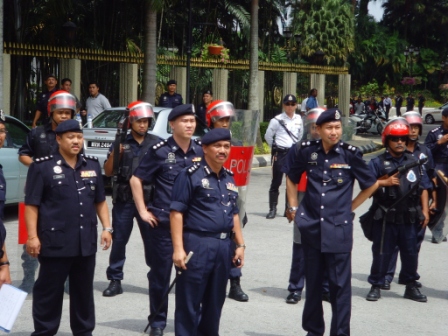
Murugiah's attempt to stifle legitimate political discourse (and give BN an edge in Bagan Pasir) must be opposed!

From the New Straits Times 4 days ago (bold emphasis mine):

Instant detention threat for talk on cow's head

2009/09/28

PORT DICKSON: Anyone bringing up the Shah Alam cow's head incident during the Bagan Pinang election campaign will be detained immediately and could face charges of inciting racial tensions.

The warning was made by Deputy Minister in the Prime Minister's Department Datuk T. Murugiah, who said that it applied to Barisan Nasional and the opposition.

"We will assign officers to keep tabs on all ceramah and other activities during the campaign and they will alert the police immediately if the issue is raised."

Murugiah is the deputy minister in charge of the National Unity and Integration Department.

"We want a clean and fair campaign and to ensure no racial or religious issues are raised to incite the people."

The real purpose of this threat is to protect Umno/BN from the political fallout resulting from the deep outrage Malaysians from all walks of life felt at the Umno/BN inspired cow's head incident. Futhermore, it is a pernicious attack on free speech in Malaysia and the right of Malaysians to freely discuss and exchange ideas on matters of national interest. If this threat is left unopposed, it will set a dangerous precedent for the future of political discourse in Malaysia: that the party in government can decide what we Malaysians can and cannot speak about.

To see that this threat has nothing whatsoever to do with preserving racial harmony in Malaysia, let's take a closer look at it, by examining some definitions first:
  • Incite - to stir up or provoke to action
  • Tension - a situation or condition of hostility, suspense, or uneasiness
  • Racial - Arising from or based on differences among human racial groups
Put them together in this context, and "inciting racial tensions" means stirring up or provoking hostility, suspense or uneasiness between groups of Malaysians based on their race. The result of "inciting racial tensions" is that Malaysians would feel (and perhaps behave with) hostility, enmity and agression towards other Malaysians, just because they are from a particular other race.

Next, let's look at the cow's head incident. Was it a racial (or religious) incident, or was it a political one? Is it credible that the Malay/Muslim residents of Section 23 spontaneously decided to insult their Hindu neighbours? While there had been dissatisfaction over the temple for some time, the aggressive, thuggish behaviour only began after GE-12, when Pewaris, one of Umno/BN's "astroturf" organisations, got involved. After the incident itself, Hishamuddin and Mukhriz Mahathir provided justification and sympathy for the protesters, and Perkasa, another Umno/BN proxy, took up their case as a "jihad".

No, the cow head incident was not about race or religion per se, but Umno/BN would like it to have become one. It was just one of a series of activities inspired and encouraged by Umno/BN to destabilise Pakatan Rakyat led state governments, and in the longer term to polarise Malaysians racially and by religion. Although we Malaysians have not yet reached the stage of accepting and truly cherishing our diversity, we have been living and praying side by side and in relative peace and with mutual tolerance for centuries. Whenever there has been serious inter-racial conflict (e.g. 13 May 1969), it's easy to identify the political hands behind it.

However, this time it backfired badly on the perpetrators. Malaysians of all walks of life were horrified, and in a heartwarming demonstration of good values, principles and unity, civil society groups and opinion leaders of all races and religions rose as one to condemn the antics of the cow head protesters (and their backers). Unfortunately, Malaysia had already become a laughing stock in the world media.

Umno/BN were caught on the back foot, and realising how damaging the truth would be to them, they tried to expunge the evidence by getting the MCMC to go after Malaysiakini to remove the videos of the incident itself, and Hishamuddin's support for it, with the ridiculous excuse that the video was offensive to Hindus. In reality it was the spitting and stamping on the cow's head, as well as the threats of violence that was offensive to all Malaysians. All that the videos could do was to embarass Hishamuddin, and further damage Umno/BN's credibility as a party with values and principles for all Malaysians.

Now, is it important that Malaysians know what Umno/BN has been up to? Of course it is. We have the right to know how our government and politicians try to manipulate and divide us by race and religion so that they may hang on to power uninterrupted. We voters need to know the truth about the perfidy that pervades Umno/BN, so that we can boot them out in elections.

Would telling the truth about the cow head incident be "inciting racial tensions"? Only if the facts were twisted to imply that Malays and Muslims as a group are behind it, and meant to insult Hindus, and that Hindus should feel enmity towards all Malays and Muslims in turn. Given the fact that it was Umno/BN inspired, and that many Malay and Muslim Malaysians have strongly spoken out against it, this would be factually wrong. Anyone who argued so would be in the same category as the cow head protesters, their supporters, and people like Ridhuan Tee and Awang Selamat; they would certainly be inciting racial tension (whether all these people should be charged with sedition is another matter altogether).

Would it be in PR's interest to incite racial tensions in this way? They would have to be stupid to do so. The PR candidate in Bagan Pinang is a Malay from the Muslim party PAS. How would PR best explain the incident to the voters? By exposing Umno/BN's hand in the incident, and making it clear that it was about politics, not about race. Report the truth and let the facts speak for themselves; res ipsa loquitor, and the only ones who would deserve the rakyat's enmity would be Umno/BN dalang behind the incident.

Would doing this incite racial tension? Not in the least, but it would effectively kill off support for Umno/BN amongst reasonable peace loving Malaysians, including the Indian community who form 20% of the voters in Bagan Pinang. That is what Umno/BN is afraid of, and that is why they sent Murugiah to issue the threat. The last thing they want is a "clean and fair campaign", where Umno/BN's shenanigans can be laid bare for voters to see, and they have no qualms about abusing their position in government to threaten the rakyat.

So, how should we respond to this politically inspired "order" that is masquerading as concern for racial harmony? IMHO, we have to expose it. We need to organise ourselves so that the facts about the cow head incident are as widely known to every voter in Bagan Pinang, by all means possible. We must take great pains to show why it has nothing to do with race and religion per se, and everything to do with Umno/BN using racial and religious issues for political gain; i.e. politics as usual, Umno/BN style.

One more thing we must do. We must never let the idea, that the party in government can dictate political discourse, become accepted practice here. IMHO, we must call their bluff and challenge it by peacefully disobeying such an unjust order. We need a large multiracial and multireligious group of Malaysians who are willing to speak the truth and give the voters of Bagan Pinang the facts about the cow's head incident. These people must be prepared to be detained; and there must be sufficient others ready to take their place and be arrested in turn. Let's see how many of us Najib's 1Malaysia can arrest, and if it is willing to face the acute embarassment that will result once the free newsmedia start exposing it for the two-faced scam that it is.

Sincerely ,
Malaysian Heart

Sunday, September 27, 2009

Justice for Kugan petition to DYMM YDP Agong 26/09/09 - what I observed

This is what I observed at the peaceful assembly in front of the Istana Negara on 26 September 2009, which was called by Hindraf and the Human Rights Party Malaysia to deliver a petition to the the DYMM Yang Di-Pertuan Agong. The petition, which you can download and read here, pleads to the YDP Agong for justice for Kugan and his family. Eight months after his death in police custody, the killer/s of A. Kugan, have yet to be arrested and brought to justice.

I tried to get to the Istana Negara at about 10.30 a.m., but there was a police roadblock where Jalan Dewan Bahasa joins Jalan Istana, and the police were not allowing any cars to get past. I made some calls and found out that the petitioners were meeting at Naga's Restaurant in Brickfields, which is where I headed to.

Members of Kugan's family were already there, including Madam Indra (his mother), sister, brothers and uncle. With them were a small group of Hindraf and MHRP folks; MP for Kapar YB S Manikavasagam, MP for Puchong YB Gobind Singh Deo, and ADUN for Kota Shah Alam YB M. Manoharan were also there. Soon, Human Rights Party Malaysia pro-tem secretary-general P. Uthayakumar and Hindraf coordinator Mr. Jayathas arrived, and the group organised themselves for the trip to the istana.

Some of Kugan's family members waiting for transport to the Istana

I hitched a ride in one of the cars carrying some of Kugan's relatives. We set of towards the Istana, but somehow got separated from the lead cars. We parked before the roadblock at Jln Dewan Bahasa, and began walking towards the Istana proper.

Members of the police manning the roadblock blocked our way and told us that we could not pass.

The police stop us from proceeding

We told them that we were going to deliver a petition to the Istana, and that Kugan's relatives were with us. The policeman asked us to wait while he radioed his superiors for permission. He took an inordinate amount of time doing this.

Asking for instructions, or delaying tactics?

After about ten minutes of waiting with no indication of any permission forthcoming, our group decided not to wait there any longer, but to get back into our cars and try another route. By 11.30 we were walking towards the group of petitioners in front of the Istana.

The petitioners outside the Istana, outnumbered by the police, reporters and cameramen. By what stretch of the imagination could they have been considered a threat to public security?

As I approached this group at 11.33 a.m., a policeman was already ordering the crowd to disperse. This is what I managed to record:


Thus the people's attempt to express their plea for justice to their King was foiled by the police. The people there made their way back, and as you can see in the video above, their frustration and disappointment was evident.

The petitioners leaving the Istana area


The leaders of the petitioners had a quick discussion, and decided to hold a press conference back at Naga's Restaurant.


These are the people who prevented the rakyat from presenting their petition to DYMM YDP Agong. They are supposed to protect and serve the rakyat, but whose interests are they protecting now? Whose orders were they following?


Kugan's mother and other family members waiting by the roadside of Jalan Istana, having been chased away from the Istana area itself. Don't they have a right to plead for justice from their King, when the Malaysian AG and police have denied them justice for eight months? Why must they be treated so?

We got back into our cars and headed back to Naga's, where the impromptu press conference was held. Here are some video clips from it (apologies for the poor audio quality):


YB Gobind Singh Deo


YB M. Manoharan


Mr. Uthayakumar, YB Manickavasagam, YB Manoharan and lawyer Mr. N. Surendran


Madam Indra, with YB Manoharan translating for her. Kugan's mother still grieves.


YB Gobind Singh Deo again pt. 1


Pt. 2


Pt. 3

During the press conference, there were three gentlemen who were hanging about the restaurant, with a video camera. here they are, numbered accordingly:


I cannot verify this, but I was told that they were special branch officers. Here is another shot of them:


Here is number 3 recording the press conference from up close:


According to this Bernama report of the event:
Brickfields police chief ACP Wan Abdul Bari Wan Abdul Khalid said police managed to disperse the gathering without any untoward incidents.

"No arrests were made. Police were on duty in front of Istana Negara to prevent incidents as the group comprised Hindraf members and politicians.

"The public should respect the residence of the Yang di-Pertuan Agong and the laws of the country," he said when contacted today.
Reading his statement, and having seen the events unfold for myself, these are the questions and thoughts that come to my mind:

1) What "untoward incident" was he expecting? Was he afraid that Kugan's mother was going to assault him with a deadly petition?

2) Why are Hindraf members and politicians singled out for "special treatment", when the cow head protestors get a free pass? Blatant double standards at work!

3) What did any of the petitioners do there, which can be construed as disrespecting the YDP Agong or his residence? Palace officials had already been informed and were prepared to accept the memorandum. Isn't DYMM YDP Agong the King for all Malaysians, including for Kugan and his family? Wasn't His Majesty's palace built and maintained with their blood, sweat and tears as well? What laws did they break? Why is the Brickfields police chief slandering them?

4) Why aren't Malaysians allowed to exercise their right to assemble peacefully? Were these folks in any way or form a threat to public safety and security? If peaceful assemblies like these are broken up by the police, how else are Malaysians going to express their views and feelings? IMHO, all the while our 1Malaysia government is embarking on a "feel-good" PR campaign, they are severely eroding our rights to assemble peacefully, amongst many others. We need work urgently to re-establish our rights, before we lose them altogether.

5) Why was it that the people who showed up in support of the petition were virtually all Indians? In the past (for example during Kugan's funeral), there was heartwarming and encouraging support from all communities; we must never let such cooperation and understanding die away. Kugan's case, just like Adi Anwar Mansor's and Teoh Beng Hock's, is a serious issue for all Malaysians. If we only fight for justice when our own race is involved, then Umno/BN will win, because we cannot defeat them by ourselves. Civil society and progressive groups must work together to find common ground and strive for change with a united voice. This will require high quality, principled leaders. United we stand; divided, we'll all die with Umno/BN in power for the next 52 years. Please people, we must break down the racial walls that Umno/BN have built between us!

6) We must ensure that the IPCMC is formed. IMHO, the police have become an instrument for the oppression of Malaysian's political expression and aspirations. If we are to have any hope of change in Malaysia, we must reform the police into an organisation that serves the rakyat, and not the political purposes of the party which happens to be in government.


The pain and anguish that our mothers bear for us, transcends time, language, race, and religion. Paradise lies beneath their feet, but all we give them in return is suffering. When our time comes, will God have mercy on us?

Sincerely,
Malaysian Heart

Please read more reports of the event here, here, here and here.

Thursday, September 24, 2009

If our politicians are working only for their own interests, it is because we do not make them work for ours!

Dear Readers,

Hope you all had happy and meaningful Hari Raya holidays, because now it's time to get back to the work we must all do: bringing change to our country, beginning with ourselves.

Raja Petra wrote an excellent article, "Me serve the rakyat? Nah!", published on Malaysia Today yesterday. While I can't vouch for the factuality of the specifics RPK reported as going on behind the scene of Pakatan Rakyat Selangor, on the whole it seems plausible to me. However, what struck me the most were these words (bold emphasis mine):
It is therefore not difficult to understand why there is so much chaos in Pakatan Rakyat Selangor. Not only are PKR, DAP and PAS trying to outmanoeuvre each other. Internally, within PKR, DAP and PAS, there are many factions and each is trying to kill off the other.

We have inter-party and we have intra-party wars going on. And it is all because no one is interested in bringing changes or to serve the rakyat. They are only interested in seeking power because politicians naturally lust for power.

So we, the people, need to keep them in check. If power goes to their heads they will very quickly forget that it was the people who put them there. They will forget that they are supposed to work for the rakyat. They will become just like Barisan Nasional in thinking that the rakyat are the slaves while they are the masters.

Never trust politicians. They will use us when it best suits them. Then they will turn on us and betray the trust we gave them. And that is why the need for some of us to remain as political activists and not become politicians. This is so that we can whack the politicians when they forget themselves, which will be as soon as they win the election and form the new government.

Please read the entire article here. I feel that RPK has put it in the best way possible: if we elect a particular set of politicians, and expect that they will automatically do what is right and good for our country because (we hope) that they are good people, then we are in for a big disappointment. While I believe that there are individual politicians who are principled, the prevailing political culture and system, compounded by we Malaysians' apparent apathy to values and good governance, make it difficult for them to make their voices heard over the shrill cacophony of self-interest. As Franklin D. Roosevelt told A. Philip Randolph, who had just given FDR an earful on what direction America should be taking (my bold emphasis):
"I agree with everything that you've said, including my capacity to be able to right many of these wrongs and to use my power and the bully pulpit. ... But I would ask one thing of you, Mr. Randolph, and that is go out and make me do it."
If we want our government and politicians to listen to us, and act to promote our interests and aspirations, we have to make them do it. We have to have press freedom so that what they do behind closed doors is exposed in the open. We need to tell them what we want, keep track of their promises, and hold them accountable when they don't deliver. We need to fight for what is right whenever it is right, not just when it suits us or ours. We need to unite our voices so that when we speak, they sit up and listen. We cannot do this as long as we identify ourselves by our race and religion, as Umno/BN wants us to.

Our end goal must be to establish a new political culture in Malaysia: one where the rakyat's interests come first, and one where only principled leaders have a chance of being elected to office.

I believe that the Saya Anak Bangsa Malaysia initiative is an excellent platform from which to make our politicians work for us instead of the other way around. Please read their charter here, read the SABM powerpoint presentation here and see Haris Ibrahim's speech here.

Whatever we want Malaysia to be, it's not going to happen if we just watch from the sidelines. It's time to get involved, people! ARE YOU, YOUR FAMILY MEMBERS AND FRIENDS REGISTERED VOTERS?

Sincerely,
Malaysian Heart

Sunday, September 20, 2009

Selamat Hari Raya Aidil Fitri to all!


Today, 20 September 2009 AD (or 1 Syawal 1430 AH) is Hari Raya Aidil Fitri. Hari Raya means "day of celebration" in Bahasa Malaysia, and Aidil Fitri is from the Arabic Eid ul-Fitr; Eid means celebration or festival, and Fitr pertains to the breaking of fast. It is the Islamic festival that is celebrated to mark the end of Ramadan, the holy month of fasting. As it is written in the Holy Quran:
Ramadhan is the (month) in which was sent down the Qur’an, as a guide to mankind, also clear (Signs) for guidance and judgment (Between right and wrong). So every one of you who is present (at his home) during that month should spend it in fasting, but if any one is ill, or on a journey, the prescribed period (Should be made up) by days later. Allah intends every facility for you; He does not want to put to difficulties. (He wants you) to complete the prescribed period, and to glorify Him in that He has guided you; and perchance ye shall be grateful.

Surah Al-Baqarah, verse 185, translated by Hafiz Abdullah Yusuf Ali
A relevant hadith:
Anas (may Allah be pleased with him) said: "The Messenger of Allah (peace and blessings be upon him) came to Al-Madinah, the people of Madinah used to have two festivals. On those two days they had carnivals and festivity. The Prophet Muhammad (peace and blessings be upon him) asked the Ansar (the Muslims of Madinah) about it. They replied that before Islam they used to have carnivals on those two joyous days. The Prophet Muhammad (peace and blessings be upon him) told them: "Instead of those two days, Allah has appointed two other days which are better, the days of `Eid Al-Fitr and `Eid Al-Adha."

(from "riwayat Ahmad, Abu Daud dan al-Nasa’ie")
From Wikipedia:
The Takbir is recited after having confirmation that the moon of Shawwal is sighted on the eve of the last day of Ramadan. It continues until the start of the Eid prayer. Before the Eid prayer begins, every Muslim who is able must pay Zakat al-fitr,[3] an alms for the month of Ramadan. This equates to about 2 kilograms (4.4 lb) of a basic foodstuff (wheat, barley, dates, raisins, etc.), or its cash equivalent, and is typically collected at the mosque. This is distributed to needy local Muslims prior to the start of the Eid prayer. It can be given at any time during the month of Ramadan and is often given early, so the recipient can use it for Eid purchases. This is distinct from Zakat based on wealth, which must be paid to a worthy charity. The Takbir consists of:

Allaahu akbar, Allaahu akbar, Allaahu akbar الله أكبر الله أكبر الله أكبر
laa ilaaha illAllaah لا إله إلا الله
Allaahu akbar, Allaahu akbar الله أكبر الله أكبر
wa li-illaahil-hamd ولله الحمد

God is the Greatest, God is the Greatest, God is the Greatest,
There is no deity but God
God is the Greatest, God is the Greatest
and to God goes all praise

How is Aidil Fitri celebrated in Malaysia? From Wikipedia:

Usually on the eve of the celebrations, family members, especially mothers and housewives, will be busy preparing food, cakes, sweets, biscuits and various delicacies to be served on the day of Hari Raya. Delicacies such as ketupat or rice cake and a meat cuisine called rendang are among the most famous cuisines that are served during this day. Other family members will help in other chores such as decorating and cleaning up the house.

Days before Hari Raya, house compounds, particularly those in the countryside will be lit up with oil lamps known as pelita or panjut. This display of oil lamps will reach its height on the 27th night of Ramadan, called the Tujuh Likur night. 'Likur' literally meaning a figure between 20 and 30, hence 'tujuh likur' means twenty seven. Originally during the early days of the arrival of Islam among the Malays, the purpose of lighting the oil lamps was to attract spirit of passed relatives and angels to descend to people's homes during the night of Lailatulqadar. However after ages has passed, such misconception is regarded counterfactual as much understanding of Islam were obtained. Nowadays the oil lamps are lit solely for decorative purposes.

It is customary for Malays to wear traditional Malay costumes. The dress for men is called baju Melayu while the women's are known as baju kurung and baju kebaya. Traditional textiles such as songket and batik are worn favourably during this day.

Muslims will attend Eid prayer in the morning and consecrate together harmoniously while taking the chance to meet and greet each other. Once the prayer is done, it is also common for Muslims in Malaysia to visit the grave of their loved ones. During this visit, they will clean the grave, perform the recital of the Yasin — a chapter (surah) from the Qur'an and also the tahlil or prayers for the deceased. All these are done in hope that their loved ones are blessed by God and they are spared from the punishment in the grave.

The rest of the day is spent visiting relatives or serving visitors. Hari Raya is a very joyous day for children for this is the day where adults are extra generous. Children will be given token sums of money, also known as duit raya from their parents and elders.

During the night, there are often celebrations with sparklers and firecrackers, albeit restrictions on playing firecrackers enforced by the authorities. Most firecracker stocks are purchased and smuggled illegally from black markets. Safety issues, especially among children are raised and alarming cases relating to injuries caused by playing firecrackers are often reported, which initially led to the banning of playing firecrackers. Despite of the enforcement of banning firecrackers, more Malay children turn to home-made firecrackers such as meriam buluh (bamboo cannon) as alternatives to commercial fireworks. Usually the lighting of firecrackers begins a few days before the end of Ramadan, and continues for about a week afterwards.

And
The main greeting used by Muslims in Malaysia and Singapore is "Selamat Hari Raya" which means "Happy Eid" in Malay. Another greeting is "maaf zahir dan batin" which translates loosely to "I seek forgiveness (from you) physically and spiritually", for Hari Raya is a time to reconcile and renew relationships with others.
Selamat Hari Raya Aidil Fitri to all, maaf zahir dan batin!

Sincerely,
Malaysian Heart

Please visit these links to learn more:
Takbir Aidil Fitri in Masjidil Haram
Bagaimana kita Menyambut Aidil Fitri?
http://www.islamicity.com/ramadan/Eid_default.shtml
AMALAN SUNNAH SEMPENA AIDILFITRI

Thursday, September 17, 2009

The Charter of the Saya Anak Bangsa Malaysia Initiative

ANAK BANGSA MALAYSIA

PREAMBLE:
Recognising that our beloved Malaysia is:
  • A sovereign and independent member of the global community of nations;
  • A polity founded on the principles of a constitutional monarchy and a parliamentary democracy;
  • A multi-ethnic, multi-faith and multi-cultural society formed on the basis of a shared choice of membership;
  • A country built and nurtured by the immeasurable efforts and invaluable contributions of all her people, past and present;
  • A nation where her people are inextricably bound by a shared history, heritage, a common interest and destiny;
  • A land blessed with rich natural and human resources.
And fully subscribing to the immutable and universal principle that we are all of a single human race and born equal;

DECLARATION
We, Anak Bangsa Malaysia, hereby declare that we are first and foremost Malaysians and Malaysia is our Home. We aspire to be the conscience of the nation and therefore pledge to:
  1. Nurture the spirit of 'Unity is Strength' as enunciated in our Merdeka and Malaysia Day proclamations;
  2. Honour and Uphold the Federal Constitution as the Supreme Law of the Land;
  3. Defend the constitutional provisions of fundamental liberties and equal rights for all citizens;
  4. Respect our fellow citizens irrespective of ethnicity, faith, colour, class or gender;
  5. Oppose all forms of prejudice, discrimination, oppression, persecution and injustice;
  6. Cherish our multi-cultural heritage and celebrate our rich diversity; and
  7. Respect and safeguard our natural and built environment;
COMMITMENT
We, Anak Bangsa Malaysia, herewith undertake to:
  1. Engender a National Mindset to think and act first and foremost as Malaysians;
  2. Engage the Hearts and Minds of our people to rise above the social constructs and divisive forces of ethnicity, faith, colour, class or gender;
  3. Promote the humanitarian Values of inclusiveness, equality and justice for all;
  4. Advance the principles of Good Governance, namely, stewardship, integrity, accountability and transparency;
  5. Educate our people to be responsible and caring Global Citizens contributing to peace, prosperity and sustainable development.
We are committed to actualising the spirit and substance of Anak Bangsa Malaysia —
"One People, One Nation".

Towards this end, we are determined to take this message to the PEOPLE.

25th April 2009


Note: I photographed and OCRed this; please excuse any errors. You can read more about the SABM initiative here, here, here, here, here, here, here, here, here and here. BM Version here.

MUST READ: What does Umno value? Another GREAT article from The Nut Graph

Dear Readers,

The folks at The Nut Graph have done it again! I reproduce here part of another powerful article from there, this time by Ding Jo-Ann. This article is sharp and incisive; it gets to the heart of the matter and drives a stake through it. It lays bare what our ruling party is all about:
"Since the March 2008 general election, calls have been growing for the BN to rethink the race-based politics that has kept them in government for more than 50 years. In the past, Umno has let its partners in the coalition, such as the MCA and MIC, speak up on Chinese and Indian Malaysian issues. This formula is not just lacking in terms of ensuring national unity; it's myopic in protecting the legitimate rights of all Malaysians.

The responses of Umno leaders to recent events prove just as much. They tell us that Umno's main priority is in ensuring that particular interests are protected. These interests, however, don't include those of minority communities such as non-Muslims and the indigenous people.

Additionally, there are many other ethnic groups that are not directly represented in the BN formula such as the Penan. There is no Penan-based party in the BN. With the current model, who then is supposed to speak up for them? Should the Penan have to set up a National Penan Party and win seats in Parliament before their plight is taken seriously by the government?"

If we find Umno/BN's values and priorities grotesque, let us remember that WE are the ones who are keeping them in power! Are we and our families registered voters? Did we vote in the last elections?

Please, please read the entire article here: http://www.thenutgraph.com/what-does-umno-value

If you like the quality of journalism practiced by The Nut Graph, please consider supporting them. Their investors cannot continue funding them, and they will have to close down if they cannot find adequate support.

As far as I know, The Nut Graph is the only Malaysian news organisation to have published a statement of their journalistic principles, that you can hold them to. If we do not support good journalism when we have it, then we have only ourselves to blame when we are left with the likes of Azmi Anshar and the mainstream media telling us what to think.

Sincerely,
Malaysian Heart