Saturday, October 17, 2009

A very meaningful Ryukyuan folk song: Tinsagu nu Hana (Balsam Flowers)

I happened to hear this Ryukyuan folk song by chance, after following a YouTube link shared by a Facebook friend (you know how one song leads to another, right). The melody immediately caught my ear, and on further googling, the lyrics immediately captured my heart. Here it is, Tinsagu no Hana (Balsam Flowers), sung by Rimi Natsukawa:

Tinsagu nu hana by Rimi Natsukawa


Here are the lyrics translated into English (from here, here and here):

Just as my fingernails are painted with the pigment from the balsam flowers,
my heart is painted with the teachings of my parents.

Although the galaxies in the sky are countable,
the love and wisdom of my parents are not.

Just as the ships that run in the night are guided to safety by the polestar,
I am guided by the parents who birthed me and watch over me.

Just as there's no point in owning splendid jewelry if you don't maintain it,
human beings who maintain their souls will live life wonderfully.

The wishes of he who lives sincerely always come true and he prospers.

You can do anything if you try, but you can't if you don't.


Wonderful, isnt' it? If you'd like to sing along, here are the lyrics in romanised syllables (adapted from here and here):

ti-.n-sa-gu-nu-ha-na-ya ci-mi-za-ci-ni-su-mi-ti,
u.-ya-nu-yu-si-gu-tu-ya ci-mu-ni-su-mi-ri;

ti-.n-nu-bu-ri-bu-si-ya yu-mi-ba-yu-ma-ri-si-ga,
u.-ya-nu-yu-si-gu-tu-ya yu-mi-ya-na-ra-.n;

yu-ru-ha-ra-su-fu-ni-ya ni-nu-fa-bu-si-mi-a.-ti,
wa-.n-na-ce-ru-u.-ya-ya wa-.n-du-mi-a.-ti;

ta-ka-ra-da-ma-ya-ti-.n mi-ga-ka-ni-ba-sa-bi-su,
a.-sa-yu-ci-mu-mi-ga-ci u.-ci-yu-wa-ta-ra;

ma-ku-tu-su-ru-hi-tu-ya a.-tu-ya-i.-ci-ma-di-.n,
u.-mu-gu-tu-.n-ka-na-ti ci-yu-nu-sa-ka-i.,

na-si-ba-na-ni-gu-tu-.n na-i.-ru-ku-tu-ya-si-ga,
na-sa-nu-yu-i.-ka-ra-du na-ra-nu-sa-da-mi,
na-sa-nu-yu-i.-ka-ra-du na-ra-nu-sa-da-mi;

From Wikipedia here:
Tinsagu nu Hana (Okinawan てぃんさぐぬ花 "the Balsam Flowers") is sometimes spelled Tensagu nu Hana. Okinawan children will squeeze the sap from balsam flowers to stain their fingernails. The lyrics of the song are Confucian teachings. Of the six verses, the first three relate to filial piety, while the last three refer to how to respect one's body and one's goals.

Each verse has exactly the same number notes using language and meter devices that are solely Ryukyuan. The English translation tells of the content of the verses but fails to convey the precision and the beauty of the song.
Alas, the best translations are metempsychoses.

Sincerely,
Malaysian Heart

If you go to Tanjung Tuan, beware the monkey!

Last weekend I was in Port Dickson for the Bagan Pinang by election, and had some free time on Saturday afternoon. Having had enough of the campaigning antics (of both sides) for a while, I decided to go to Tanjung Tuan (also known as Cape Rachado) for some peace and quiet. It was not far from where the MAFREL's operation centre was. My Mum used to tell us about the times when, as a child, she would visit the "keramat" at Tanjung Tuan with her family. According to legend, Parameswara, the founder of Melaka, is supposed to have been buried somewhere there.

In those days, the only way to get there was by boat, which would have to navigate past the dangerous whirlpool and turbulent waters off Tanjung Tuan, which have claimed many lives. Of course, nowadays one can get there easily by land. Just go south on the coast road to Melaka, and turn right at the junction, just after Si Rusa, which is clearly marked "Tanjung Tuan" and "Blue Lagoon".


I parked near the Ilham Resort, and entered the gates to the Tanjung Tuan Recreational Forest.

Visitors have to sign in at the guardhouse before proceeding further

From there, I walked along a winding tarred road through the jungle, right up to the lighthouse.


The Tanjung Tuan lighthouse is impossible to miss.


Unfortunately, it is off limits to all by order of the harbourmaster of Melaka. Apparently, Tanjung Tuan is under the jurisdiction of Melaka, not Negeri Sembilan. From the front of the lighthouse, there are paths leading down to the beach. I chose to take the path leading to Pulau Intan.

The steep and uneven steps leading from the lighthouse down to the beach

It took me about 25 minutes to get to the beach from the entrance. The beach and view was well worth the trek: not another human in sight; just the sun, the sea, the wind and the sand!


I suppose Pulau Intan is only a pulau at high tide!

Even though the shore was somewhat muddy (not surprising given the mangroves nearby), the water was clean (definitely cleaner than the rest of PD), and perfect for a leisurely dip. However, one needs to be careful of the rough rocks on the beach and under water.

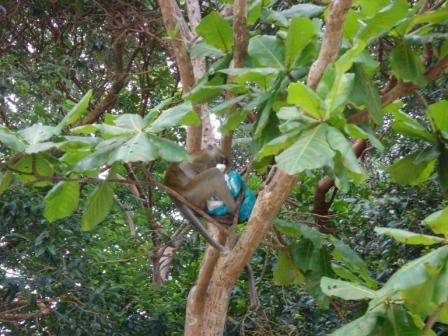
As I was enjoying the cool water, I saw that a monkey was calmly going through the contents of my knapsack! As I rushed back to the rock where I had left it, my simian friend decided that he needed my bag of toiletries, and took off up a nearby tree with it!

If you happen to see a well groomed monkey with a dazzling smile in Tanjung Tuan, you'll know which one it is!

What's a little toothpaste, soap and a toothbrush between distant cousins, especially since Evolution Day is just around the corner? I wish that I had had something more nutritious to share.

From the beach, the Sumatran coast is visible, just 38 kilometres away.

If BENDERA had wanted to attack Peninsular Malaysia by sea, would this have been the nearest spot for them?


Ships in the distance


Beyond this headland lies the beach opposite Pulau Masjid

I really would have liked to have explored more, especially the beach opposite Pulau Masjid, the "keramat Tanjung Tuan" and Hang Tuah's "footstep" and well, but they will have to wait for another trip because it was time to get back to the noisy world of humans. There were the final ceramahs to attend that evening! Stay tuned for more stories from Bagan Pinang,

Sincerely,
Malaysian Heart

Saturday, October 10, 2009

Who I am, and why I blog

Recently, a young Malaysian, who is researching citizen journalism and citizen blogging in Malaysia, emailed me with some questions to answer. After sending him/her my reply, I realised that what I wrote was a statement of why I blog, and of who I am as a blogger. I reproduce here his/her questions and my responses to them, as a statement of principles.

1. What prompted you to start blogging?
Social and political developments in Malaysia. March 8 2008 gave me a lot of hope that Malaysia was on the right track as far as our social and political growth was concerned. However, by end of 2008, cracks began to appear in the Pakatan Rakyat coalition, and Umno/BN began to make succesful attacks on the idea of a two party system, and on multiracial and multireligious cooperation in Malaysia. These attacks were also made through their Main Strean Media (MSM) and bloggers, often with dodgy evidence and very flimsy reasoning. I felt that I could do something to counter them, and to share with others my own opinions on how Malaysia should go forward.
Why is there a need to self-publish?
Before the advent of blogging, there were few economical avenues for ordinary citizens to get their views heard: letters to the editor in the MSM, or join (or form) an association and issue press statements (again to the MSM). At the end of the day, the MSM and their owners decide if your views are worthy of publication, and if your views are consistent with their agenda. Blogging allows me to avoid that "censorship", and to share my views quickly.
2. How would you categorize or describe your blog? (Is it a watchblog, political blog, community blog?)
I blog about the importance of human rights, freedom and justice in a democracy, and I blog about whenever these are threatened. The people and institutions whose actions I write about are politicians, government, MSM and other bloggers. So I guess that my blog is a socio-political watchblog.
3. Who/What are you sources of information?
1) What I personally observe and record at the events I attend, 2) tip-offs from friends and sources, which I verify first, 3) news from other bloggers and MSM, 4) the internet
Do you read news and blog about it afterwards?
Yes, but only if it is pertaining to what I write about: human rights, freedom and justice in a democracy
4. What do you understand about ‘citizen journalism’?
As I understand it, Citizen Journalism is ordinary citizens gathering news and presenting it along with their own views, using technology to reach a wide audience. IMHO, It's a democratisation of news (and views) gathering and dissemination.
5. Do you think you are practicing citizen journalism? Would you consider yourself a citizen journalist?
Yes, and yes
6. What do you hope to achieve through blogging? (Eg: To create awareness among the public?
1) persuade Malaysians as to the importance of human rights, freedom and justice in a democracy, and of the principles and values that underly them, 2) Create awareness about the ways in which MSM and other bloggers spin, lie and abuse logic to create inter-racial tension and fear for political purposes, 3) Motivate Malaysians to work together for a better future for our country
7. How would you define Malaysia’s current mainstream media?
Our MSM is 100% owned by either political parties or corporate interests. Therefore, the news they report reflects their owners' need for political and pro-corporate propaganda, not Malaysian's need for news and views on human rights, freedom, justice, good governance, transparency and democracy.
Do you still believe in their news reporting?
No. I always look for how they may be spinning the news in their interest. So should everyone else.
8. Bloggers are sometimes misunderstood for spreading non-objective (bias) commentaries. What is your take on that?
There is no misunderstanding there. There are bloggers who are very non-objective. Indeed, it may be questioned if true objectivity is even achievable. The key is for 1) Malaysians to be able to read everything critically, and 2) for all media (MSM and bloggers) to be transparent about what their position or slant is, and what they are advocating. I myself subscribe to the principles of Advocacy Journalism.
9. Are there topics/news that you choose not to blog about?
No. I believe that all topics that are in the citizens' interest can (and should) be written about responsibly.
Do you practice self-censorship?
If you define self censorship as "the act of censoring or classifying one's own work (blog, book(s), film(s), or other means of expression), out of fear or deference to the sensibilities of others", then my answer is no. However, I do subscribe to the Society of Professional Journalists' Code of Ethics, and take pains to "Minimize Harm - Ethical journalists treat sources, subjects and colleagues as human beings deserving of respect". I also choose to present my arguments in a way that (I believe) will be understood and accepted by my intended audience (Malaysians).
10. Some professional journalists do not approve citizen journalism because they believe that only trained journalists can write objectively and ethically. What do you think?
Looking at the way some professional journalists in Malaysia write, it's obvious that professional training is no assurance that a person will write objectively and ethically. IMHO, a citizen journalist can do just as well (if not better, because he/she has no editor to report to) as long as he/she is committed to ethical and objective writing and takes the trouble to learn and practice it.
p.s: Out of curiosity, is there a reason to remain anonymous? It would help me understand bloggers better.
I choose only to identify myself as Malaysian, because our current situation is one where people judge what one writes by one's religion, age, gender, ethnicity, socio-economic status etc. I would like my arguments to stand or fall on their own merits, not my identity. As an anonymous blogger, I feel more motivated to research and provide evidence for whatever I write, because being anonymous does not provide the automatic credibility (or incredibility) that some readers are content with.

I really hope that Malaysians will achieve a stage of maturity where they can read and evaluate arguments for what they are, and not be swayed by the name (and the religion, age, gender, ethnicity, socio-economic status) of who is saying it.
Sincerely,
Malaysian Heart
Today is World March Kuala Lumpur – Street Party!


Today, 10 October 2009, is World March Kuala Lumpur – Street Party! From The World March for Peace and Nonviolence's website (www.theworldmarch.org):
The World March for Peace and Nonviolence was launched during the Symposium of the World Center for Humanist Studies held at the Park of Study and Reflection in Punta de Vacas, Argentina, on November 15, 2008.

The World March aims to generate consciousness of the dangerous global situation in which we are living, a situation marked by the heightened probability of nuclear conflict, a renewed arms race, and the violent military occupation of foreign territories.

The World March is a proposal for an unprecedented social mobilization, advanced by the Humanist Movement through one of its organizations, World Without Wars.

Since its initial proposal things have developed very quickly. In just a few months the World March has received the endorsement of thousands of people, pacifist and nonviolence groups, a variety of institutions, and renowned figures from the worlds of science, culture, and politics, who are sensitive to the urgency of the moment. It has also inspired an enormous diversity of initiatives in more than 100 countries, becoming a rapidly growing human phenomenon.

And
The World March for Peace and Nonviolence is already inspiring various initiatives and activities, and these will multiply in the coming months. One will be the symbolic march of an international and intercultural team whose journey will pass through six continents. It will start on October 2, 2009 -- the International Day of Nonviolence -- in Wellington, New Zealand, and will culminate on January 2, 2010 at the foot of Mount Aconcagua in Punta de Vacas, Argentina. During this time, in hundreds of cities around the world, there will be marches, festivals, forums, conferences, and other events to create consciousness of the urgent need for Peace and Nonviolence. And throughout the world, the campaigns to gather endorsements for the March will multiply this signal beyond what is now imaginable.

For the first time in history an event of this magnitude is being set in motion through the initiative of the people. The true strength of the World March is born from the simple, conscious act of those who endorse this dignified cause and share it with others.

What's happening in KL? From Pahlawan Volunteers, who are organising and promoting WMKL:
OPEN TO ALL PEACE LOVING CITIZENS OF THE WORLD
Participate in The World March for Peace and Nonviolence.
Be one of the brave and help us to create a new, non-violent global consciousness.

Starting from 2nd October 2009 (the anniversary of Gandhi’s birth) in New Zealand to 2nd January 2010 in Argentina, WMKL is the Malaysian leg of the FIRST EVER World March that will travel the world asking for the end of wars, the dismantling of nuclear weapons and for an end to all forms of violence (physical, economic, racial, religious, cultural, sexual and psychological). More details at http://www.theworldmarch.org/

In Malaysia, five NGOs are joining hands to organize this fun filled event, which will include a Lantern Walk themed “Reclaiming the Night” and Street Festival at Jalan Bangkung, Bukit Bandaraya and Peace Dance at Leonardo’s Wine Loft on 10th October 2009, from 6pm-10pm...

* WAO http://www.wao.org.my/ ,
* NUR SALAM http://www.facebook.com/group.php?gid=38427820909 ,
* VOICE OF THE CHILDREN http://voc.jimdo.com/ ,
* SPCA http://www.spca.org.my/ and
* WORLD WITHOUT WARS http://www.theworldmarch.org/index.php?secc=MSG

Event details as follows:
DATE: SATURDAY, 10TH OCTOBER 2009
VENUE: Jalan Bangkung, Bukit Bandaraya

6:00PM–10:00PM: Street Festival at Jalan Bangkung with performances by Malaysian artists, exhibitions by NGOs, stalls selling food, ethnic items etc.

8:30PM-9:00PM: “Reclaiming the Night” Lantern Walk starting from Jalan Bangkung.
(Bring along your Tanglung and join us for this historic walk for peace and non violence.)

9:00PM-12:00AM: Peace Dance at Leonardo’s Wine Loft.
(Retro dance party. Come dressed in the 60s and 70s style.)
--------------------------------------------------------------

Join us to spread this message of Peace and NonViolence.

1. Spread the word – send out this invitation to all your contacts via email, share on your Facebook, Twitter etc.

2. Come for the event on 10th October – Bring your family and friends and join the Lantern Walk (bring your own lantern) to “Reclaim the Night” and celebrate the world march for peace and non violence. Enjoy yourself at the street festival – there will be exhibitions by participating NGOs, exciting performances, food stalls etc. Then party at the Peace Dance at Leonardo’s.

3. Set up a stall or perform at the festival.
( Contact Ed Soo – h/p no.: 016 280 3321 or email: edsoo@edsoo.com.my )

4. Make a donation to the NGOs.
(There will be a donation booth set up on the day. Cheques can be made out the organizations you wish to support. All donations are tax exempted.)

YES WE CAN make a difference!
--------------------------------------------------------------

Promoted with love by Pahlawan Volunteers
"Negara Kita, Tanggungjawab Kita" - From Conviction to Action

► JOIN Pahlawan Volunteers group @ FB
http://www.facebook.com/group.php?gid=33559455073

► JOIN THE CAUSE: Saya Anak Bangsa Malaysia
To remind ourselves Who We Really Are and What We Choose To Be
http://apps.facebook.com/causes/80669?h=plvn&recruiter_id=14355129
Will you be there?

P.S. You can follow the World March's progress on their blog here.

Monday, October 5, 2009

Did Hishamuddin Hussein and Syed Hamid Albar lie about Waythamoorthy's passport?


SAD FAREWELL: A picture of Waythamoorthy and his daughter, taken after their breakfast in Singapore,
before he departed for UK yesterday (photo and caption from this Malay Mail report datelined 28/9/09)


One of the standard responses of Umno/BN to any people's power movement that they find threatening, is to to impugn the movements motives and cast aspersions on the honour and credibility of its leaders via lies and propaganda. The Hindraf phenomenon have been (and still are) treated the same: they have been called terrorists, traitors, embezzlers and so on by our government and its mouthpieces. One such smear was the attempt to paint Hindraf leader P. Waythamoorthy, who is in exile in the UK, as a dishonest man who exiled himself just to enjoy a comfortable life in London living on Hindraf's money. Part of that smear is the lie that Waythamoorthy had willingly surrendered his passport to the Malaysian High Commission in London, and lied about it having been revoked by the Malaysian authorities.

These are the news articles that reported what Syed Hamid Albar (the former home minister) and Hishamuddin Hussein (the present one), said:
These are some of the specific things they said:

Hishamuddin showing a copy of Waythamoorthy's passport to the media (photo from here).
Hishamuddin has said the following:
Reported here: "Dia sendiri yang datang serahkan dan bukan kita yang pergi rampas. Bahkan paspot itu masih lagi sah digunakan dan di dalam simpan pejabat Pesuruhjaya Tinggi kita di London," and added, "Beliau sewajarnya berhenti dari menuduh kita macam-macam...beliau boleh ke pejabat kita (Pesuruhjaya Tinggi Malaysia) untuk ambil paspot yang dipulangkan oleh beliau sendiri itu pada bila-bila masa. Mungkin beliau merasa malu sendiri" .
Reported here: “Yes, he was the one who surrendered the passport,” he [Hishamuddin] confirmed. He added that Waythamoorthy should stop claiming that the government is stopping him from getting his passport. “Why should we apologise to him? Would you? Of course, not,” he said. Hishammuddin also added that Waythamoorthy could be too ashamed to go and get his passport because he had surrendered the document himself. “Maybe he received a better offer at that moment, he felt that the grass is always greener on the other side but when he went to the other side, he felt that it was not worth it. "Maybe he was ashamed because he himself surrendered the passport. That is why he claimed that we did not allow him to have his passport,” he said.."


Syed Hamid Albar (photo from here)
Syed Hamid has said the following (reported here):
"In other words, the Malaysian government has never made any cancellation to the mentioned travel document," said Home Minister Syed Hamid Albar Syed Hamid in a statement today.
On 3 October 2009, Waytha's wife Mrs. Shanti, his brother P. Uthayakumar and lawyer N. Surendran held a press conference at Hindraf's office where they (again) presented evidence to prove that Malaysian authorities had informed the British authorities that Waythamoorthy's passport had been cancelled, and had requested them to impound and return it to the Malaysian authorities.

Here is the letter they gave reporters, which you can download in pdf format from the link below:

I reproduce here the 4 questions asked by Waytha's lawyers, and the answers received from the UK Border Agency:
1. The precise date when the British Embassy in Kuala Lumpur was notified of the cancellation?
A: The letter from the Malaysian authorities to the High Commission was dated 14 March 2008.

2. Which Malaysian authority notified the British Embassy (was it, for example, the Immigration authorities, Foreign Office or Home Ministry, or any other department)?
A: l can confirm that the Home Office does hold information that is relevant to this part of your request. However, we have decided not to communicate this information to you in accordance with the exemption under Section 27 (2) of the Freedom of Information (FOl) A[ct] 2000, which covers confidential information obtained from a State other than the United Kingdom or from an international organisation or international court. I have explained more about this exemption below.

3. Whether any particular reason was given for the said cancellation
A: The passport was cancelled as the Malaysian authorities were seeking your client’s arre[st] to face criminal charges.

4. When was the request made by the issuing authority for the return of the passport and was there any reason given for this request?
A: A request was made by the Malaysian authorities for the return of your client’s passport on 2 July 2008 no reason was given for why they wanted the passport returned to them, Malaysian passports are of the property of the issuing authority and not of the individual holder and therefore this is why we intend to return the passport to them.
Based on this and other evidence, we can draw a timeline of events surrounding the issue of Waytha's passport. I have emphasised our minister's statements in bold:
  • 25 November 2007 - Hindraf rally in KL
  • 28 November 2007 - Waythamoorthy leaves Malaysia to avoid possible detention under the Internal Security Act and to obtain international support for HINDRAF's cause. He goes to India, then to London.
  • 13 December 2007 - Uthayakumar and 4 others detained under ISA
  • 14 March 2008 - British High Commision in KL receives letter from Malaysian authorities, informing them that Waytha's passport had been cancelled because the Malaysian authorities were seeking Waytha's arrest to face criminal charges
  • 17 April 2008 - Waytha goes to Geneva to brief the United Nations High Commissioner’s office on Human Rights
  • 19 April 2008 - Waytha moorthy returned to London from Geneva, but was informed that the Malaysian government had revoked his passport, and therefore refused entry at Gatwick airport. Waytha asked the British authorities to seek a confirmation with the Malaysian government that his passport was, indeed, being revoked. Waytha spent 2 days at Gatwick.
  • 21 April 2008 - UK Border Agency British immigration confirmed that Waytha's passport was revoked by the Malaysian government, and they (UK Border Agency) impounded his passport upon the Malaysian authorities' request. It was only then that Waytha decided to seek political asylum, which was duly given by the British authorities.
  • 26 May 2008 - Malaysian Insider article: Syed Hamid: Hindraf chief's passport never revoked
  • 2 July 2008 - Malaysian authorities requested the British authorities (in writing) for the return of Waytha's passport to them.
  • 22 October 2008 - Bernama article: Hindraf Leader P. Waytha Moorthy's Passport Was Never Revoked: Syed Hamid
What are we to make of this? It seems to me that either the UK Border Agency is lying, or our ministers are. It's sad that some Malaysians have swallowed whole the disinformation and lies of Umno/BN, and parrot them in the online discussions and comments sections without question.

Sincerely,
Malaysian Heart

P.S. The only news organisations (which I could find) had reported the press conference were:
Malaysiakini: Proof of lies, claims Waytha's lawyer
Malaysian Insider: Uthayakumar claims proof Hishammuddin lied

(UPDATED) The Nut Graph had this story on 9/10/09: No pass for Waythamoorthy

What happened to the others? What's the point of paying them RM 1.50 or RM 1.20 every day if they choose not to report the news that matters?

Friday, October 2, 2009

What lessons can Malaysians learn from Mahatma Gandhi and Satyagraha?


Mohandas Karamchand Gandhi
2 October 1869 – 30 January 1948
photo from here

Today, 2 October 2009 is the 140th anniversary of the birth of Mahatma Gandhi. In India it is celebrated as Gandhi Jayanti, and internationally it is celebrated as the International Day of Non-Violence. Besides commemorating the birth of such a human being, what lessons can we learn from his life and struggle, and why would they be of use to us?

In my humble opinion, the Mahatma's greatest achievement was in leading oppressed people to freedom. This is a very difficult undertaking, requiring great courage and ability, physical, intellectual, emotional and moral. The oppressors whom he faced were very powerful and ruled with an iron fist, yet the Mahatma was able to bring about change in a peaceful and ethical way. In a world where "one man's terrorist is another man's freedom fighter", and where the ends are held to have justified the means, the Mahatma stands out as a shining example of how one man can make a difference for the better. As Albert Einstein said of him, "Generations will scarce believe that such a one as this ever in flesh and blood walked upon this earth."

What were the personal characteristics that set the Mahatma apart? I believe that he had a very strong sense of values and principles by which he lived and by which he guided the struggle. Among these principles were (adapted from Wikipedia):
  • Truth: Gandhi dedicated his life to the wider purpose of discovering truth, or Satya. Gandhi summarized his beliefs first when he said "God is Truth". He would later change this statement to "Truth is God". Thus, Satya (Truth) in Gandhi's philosophy is "God".
  • Non-violence: Although Mahatama Gandhi was not the originator of the principle of non-violence, he was the first to apply it in the political field on a huge scale. In his own words, "There are many causes that I am prepared to die for but no causes that I am prepared to kill for."
  • Simplicity: Gandhi earnestly believed that a person involved in social service should lead a simple life. His simplicity began by renouncing the western lifestyle he was leading in South Africa. He called it "reducing himself to zero," which entailed giving up unnecessary expenditure, embracing a simple lifestyle and washing his own clothes.
  • Faith: Gandhi was born a Hindu and practised Hinduism all his life, deriving most of his principles from Hinduism. As a common Hindu, he believed all religions to be equal, and rejected all efforts to convert him to a different faith. Gandhi believed that at the core of every religion was truth and love (compassion, nonviolence and the Golden Rule). He also questioned what he saw as hypocrisy, malpractices, and dogma in all religions, including his own, and he was a tireless advocate for social reform in religion. Later in his life when he was asked whether he was a Hindu, he replied: "Yes I am. I am also a Christian, a Muslim, a Buddhist and a Jew."
These principles became the core of Satyagraha, the philosophy and practice of nonviolent resistance that led to freedom. Gandhi described it as follows:

I have also called it love-force or soul-force. In the application of satyagraha, I discovered in the earliest stages that pursuit of truth did not admit of violence being inflicted on one’s opponent but that he must be weaned from error by patience and compassion. For what appears to be truth to the one may appear to be error to the other. And patience means self-suffering. So the doctrine came to mean vindication of truth, not by infliction of suffering on the opponent, but on oneself.[2]

"The Satyagrahi’s object is to convert, not to coerce, the wrong-doer." Success is defined as cooperating with the opponent to meet a just end that the opponent is unwittingly obstructing. The opponent must be converted, at least as far as to stop obstructing the just end, for this cooperation to take place.

When using satyagraha in a large-scale political struggle involving civil disobedience, Gandhi believed that the satyagrahis must undergo training to ensure discipline. He wrote that it is “only when a people have proved their active loyalty by obeying the many laws of the State that they acquire the right of Civil Disobedience.”[11]

He therefore made part of the discipline that satyagrahis:

  1. appreciate the other laws of the State and obey them voluntarily
  2. tolerate these laws, even when they are inconvenient
  3. be willing to undergo suffering, loss of property, and to endure the suffering that might be inflicted on family and friends[11]
Gandhi also proposed this series of rules for satyagrahis to follow in a resistance campaign:[8]
  1. harbour no anger
  2. suffer the anger of the opponent
  3. never retaliate to assaults or punishment; but do not submit, out of fear of punishment or assault, to an order given in anger
  4. voluntarily submit to arrest or confiscation of your own property
  5. if you are a trustee of property, defend that property (non-violently) from confiscation with your life
  6. do not curse or swear
  7. do not insult the opponent
  8. neither salute nor insult the flag of your opponent or your opponent’s leaders
  9. if anyone attempts to insult or assault your opponent, defend your opponent (non-violently) with your life
  10. as a prisoner, behave courteously and obey prison regulations (except any that are contrary to self-respect)
  11. as a prisoner, do not ask for special favourable treatment
  12. as a prisoner, do not fast in an attempt to gain conveniences whose deprivation does not involve any injury to your self-respect
  13. joyfully obey the orders of the leaders of the civil disobedience action
  14. do not pick and choose amongst the orders you obey; if you find the action as a whole improper or immoral, sever your connection with the action entirely
  15. do not make your participation conditional on your comrades taking care of your dependents while you are engaging in the campaign or are in prison; do not expect them to provide such support
  16. do not become a cause of communal quarrels
  17. do not take sides in such quarrels, but assist only that party which is demonstrably in the right; in the case of inter-religious conflict, give your life to protect (non-violently) those in danger on either side
  18. avoid occasions that may give rise to communal quarrels
  19. do not take part in processions that would wound the religious sensibilities of any community
Why are these lessons relevant to us Malaysians? Isn't our situation in Malaysia in some ways similar to that faced by Gandhi in India? We too live in a multiracial and multireligious country, we too are ruled by what is essesntially a colonial government - one where the hard work and resources of the rakyat are expropriated for the use of those in power and their cronies. We too are denied our basic human rights, and we too are kept in control by law enforcement system that serves it's political masters, not justice (ironically, the descendant of the same law enforcement that Gandhi suffered). Perhaps our most striking similarity is that we too are oppressed because we have not been able to transcend our racial and religious divisions; our oppressors have effectively divided and ruled over us because of it.

I believe that if we Malaysians want to bring much needed change to our country in a sustainable, peaceful and ethical way, we need to practice the Mahatma's principles. Where do we start? In the words of the Mahatma himself: "You must be the change you want to see in the world."


Gandhi at Dandi, South Gujarat, picking salt on the beach at the end of the Salt March, 5 April 1930. Photograph from here

Raghupati Raghava Raja Ram, the Mahatma's favourite bhajan

Mahatma Gandhi speaking: God is Life, Truth, Light, Love and The supreme Good

Sincerely,
Malaysian Heart

Murugiah's attempt to stifle legitimate political discourse (and give BN an edge in Bagan Pasir) must be opposed!

From the New Straits Times 4 days ago (bold emphasis mine):

Instant detention threat for talk on cow's head

2009/09/28

PORT DICKSON: Anyone bringing up the Shah Alam cow's head incident during the Bagan Pinang election campaign will be detained immediately and could face charges of inciting racial tensions.

The warning was made by Deputy Minister in the Prime Minister's Department Datuk T. Murugiah, who said that it applied to Barisan Nasional and the opposition.

"We will assign officers to keep tabs on all ceramah and other activities during the campaign and they will alert the police immediately if the issue is raised."

Murugiah is the deputy minister in charge of the National Unity and Integration Department.

"We want a clean and fair campaign and to ensure no racial or religious issues are raised to incite the people."

The real purpose of this threat is to protect Umno/BN from the political fallout resulting from the deep outrage Malaysians from all walks of life felt at the Umno/BN inspired cow's head incident. Futhermore, it is a pernicious attack on free speech in Malaysia and the right of Malaysians to freely discuss and exchange ideas on matters of national interest. If this threat is left unopposed, it will set a dangerous precedent for the future of political discourse in Malaysia: that the party in government can decide what we Malaysians can and cannot speak about.

To see that this threat has nothing whatsoever to do with preserving racial harmony in Malaysia, let's take a closer look at it, by examining some definitions first:
  • Incite - to stir up or provoke to action
  • Tension - a situation or condition of hostility, suspense, or uneasiness
  • Racial - Arising from or based on differences among human racial groups
Put them together in this context, and "inciting racial tensions" means stirring up or provoking hostility, suspense or uneasiness between groups of Malaysians based on their race. The result of "inciting racial tensions" is that Malaysians would feel (and perhaps behave with) hostility, enmity and agression towards other Malaysians, just because they are from a particular other race.

Next, let's look at the cow's head incident. Was it a racial (or religious) incident, or was it a political one? Is it credible that the Malay/Muslim residents of Section 23 spontaneously decided to insult their Hindu neighbours? While there had been dissatisfaction over the temple for some time, the aggressive, thuggish behaviour only began after GE-12, when Pewaris, one of Umno/BN's "astroturf" organisations, got involved. After the incident itself, Hishamuddin and Mukhriz Mahathir provided justification and sympathy for the protesters, and Perkasa, another Umno/BN proxy, took up their case as a "jihad".

No, the cow head incident was not about race or religion per se, but Umno/BN would like it to have become one. It was just one of a series of activities inspired and encouraged by Umno/BN to destabilise Pakatan Rakyat led state governments, and in the longer term to polarise Malaysians racially and by religion. Although we Malaysians have not yet reached the stage of accepting and truly cherishing our diversity, we have been living and praying side by side and in relative peace and with mutual tolerance for centuries. Whenever there has been serious inter-racial conflict (e.g. 13 May 1969), it's easy to identify the political hands behind it.

However, this time it backfired badly on the perpetrators. Malaysians of all walks of life were horrified, and in a heartwarming demonstration of good values, principles and unity, civil society groups and opinion leaders of all races and religions rose as one to condemn the antics of the cow head protesters (and their backers). Unfortunately, Malaysia had already become a laughing stock in the world media.

Umno/BN were caught on the back foot, and realising how damaging the truth would be to them, they tried to expunge the evidence by getting the MCMC to go after Malaysiakini to remove the videos of the incident itself, and Hishamuddin's support for it, with the ridiculous excuse that the video was offensive to Hindus. In reality it was the spitting and stamping on the cow's head, as well as the threats of violence that was offensive to all Malaysians. All that the videos could do was to embarass Hishamuddin, and further damage Umno/BN's credibility as a party with values and principles for all Malaysians.

Now, is it important that Malaysians know what Umno/BN has been up to? Of course it is. We have the right to know how our government and politicians try to manipulate and divide us by race and religion so that they may hang on to power uninterrupted. We voters need to know the truth about the perfidy that pervades Umno/BN, so that we can boot them out in elections.

Would telling the truth about the cow head incident be "inciting racial tensions"? Only if the facts were twisted to imply that Malays and Muslims as a group are behind it, and meant to insult Hindus, and that Hindus should feel enmity towards all Malays and Muslims in turn. Given the fact that it was Umno/BN inspired, and that many Malay and Muslim Malaysians have strongly spoken out against it, this would be factually wrong. Anyone who argued so would be in the same category as the cow head protesters, their supporters, and people like Ridhuan Tee and Awang Selamat; they would certainly be inciting racial tension (whether all these people should be charged with sedition is another matter altogether).

Would it be in PR's interest to incite racial tensions in this way? They would have to be stupid to do so. The PR candidate in Bagan Pinang is a Malay from the Muslim party PAS. How would PR best explain the incident to the voters? By exposing Umno/BN's hand in the incident, and making it clear that it was about politics, not about race. Report the truth and let the facts speak for themselves; res ipsa loquitor, and the only ones who would deserve the rakyat's enmity would be Umno/BN dalang behind the incident.

Would doing this incite racial tension? Not in the least, but it would effectively kill off support for Umno/BN amongst reasonable peace loving Malaysians, including the Indian community who form 20% of the voters in Bagan Pinang. That is what Umno/BN is afraid of, and that is why they sent Murugiah to issue the threat. The last thing they want is a "clean and fair campaign", where Umno/BN's shenanigans can be laid bare for voters to see, and they have no qualms about abusing their position in government to threaten the rakyat.

So, how should we respond to this politically inspired "order" that is masquerading as concern for racial harmony? IMHO, we have to expose it. We need to organise ourselves so that the facts about the cow head incident are as widely known to every voter in Bagan Pinang, by all means possible. We must take great pains to show why it has nothing to do with race and religion per se, and everything to do with Umno/BN using racial and religious issues for political gain; i.e. politics as usual, Umno/BN style.

One more thing we must do. We must never let the idea, that the party in government can dictate political discourse, become accepted practice here. IMHO, we must call their bluff and challenge it by peacefully disobeying such an unjust order. We need a large multiracial and multireligious group of Malaysians who are willing to speak the truth and give the voters of Bagan Pinang the facts about the cow's head incident. These people must be prepared to be detained; and there must be sufficient others ready to take their place and be arrested in turn. Let's see how many of us Najib's 1Malaysia can arrest, and if it is willing to face the acute embarassment that will result once the free newsmedia start exposing it for the two-faced scam that it is.

Sincerely ,
Malaysian Heart